



TL;DR:
The Philippines, as ASEAN’s 2026 chair, is becoming a key hub for regional trade and investment. Its strategic position, diverse culture, and upcoming trade agreements offer significant opportunities despite political and regulatory challenges. Building local relationships and staying informed of policy developments are essential for business success in the country.
The 2026 chairmanship is a timing advantage — frameworks are being drafted now, and a business that establishes its entity and compliance base early has more influence over them than one arriving after they close.
South East Asia is defined as the region of eleven countries stretching from Myanmar to the Philippines, and in 2026, the Philippines holds the ASEAN chair, making it the most strategically significant nation in the bloc for investors and entrepreneurs right now. The Philippines is an archipelago of more than 7,600 islands, home to 112.7 million people at the 2024 census, and sits at the crossroads of Pacific trade routes. For a business weighing entry into the region, the Philippines offers a rare combination: an English-speaking workforce, a fast-growing digital economy, and a government actively writing regional trade policy.
What are the key economic opportunities in South East Asia and the Philippines?
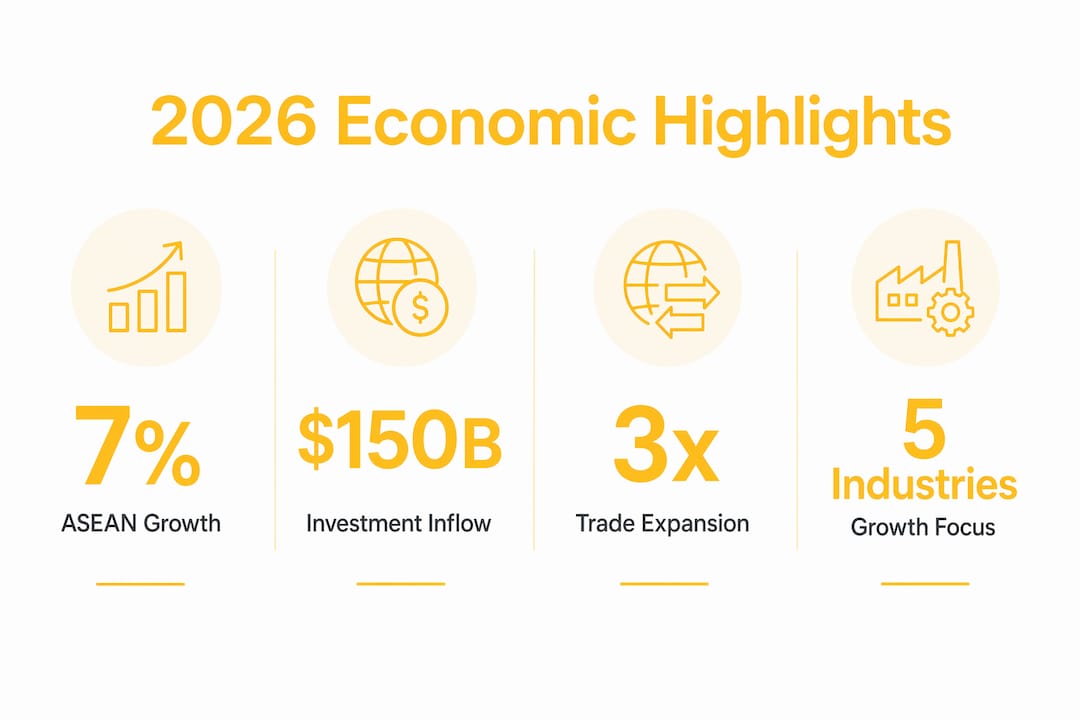
The Philippines’ ASEAN chairmanship in 2026 is not ceremonial. It is a working agenda with real consequences for investors. The chairmanship’s flagship economic project is the ASEAN Digital Economy Framework Agreement, whose negotiations concluded in Manila on 30 May 2026 with signature expected at the November summit. An ASEAN-Canada free trade agreement is also in progress — roughly 80% of chapters closed by July, conclusion targeted for November — though it sits alongside the chairmanship agenda rather than at its centre. Either deal, once signed, opens export channels and lowers barriers for foreign companies operating in the Philippines.
The sectors drawing the most attention right now include:
-
Digital economy and fintech: The Philippines is pushing for a regional digital economy framework that would standardize cross-border data flows and e-commerce rules across ASEAN.
-
Critical minerals: The country holds significant nickel and cobalt reserves, and the ASEAN critical mineral strategy positions the Philippines as a key supplier for global battery supply chains.
-
Semiconductors: The Philippines has an existing electronics export base, and regional semiconductor roadmaps are directing new investment toward assembly and testing facilities.
-
Micro and small enterprises: ASEAN’s integration agenda includes financial inclusion measures that benefit the Philippines’ large SME sector, creating downstream opportunities for B2B service providers.
The headwinds are real too. Political instability in the Philippines, Malaysia, and Thailand is constraining ASEAN’s collective action and causing governments to focus inward. Regulatory consistency is harder to predict in this environment. The March 2026 energy emergency was sharper than a headline percentage conveys. Philippine diesel sat near ₱56 per litre in January, passed ₱100 on 17 March, and reached ₱105–₱132 by month’s end. President Marcos declared a state of national energy emergency under Executive Order 110 on 24 March, and the ₱2.5 billion fuel subsidy rollout began the same day — during the crisis, not after it. Diesel was still up close to ₱40 per litre year-on-year by mid-July. That kind of volatility affects logistics costs, manufacturing margins, and consumer spending across the board.
Pro Tip: Before committing capital to the Philippines, review the 2026 regulatory trends shaping corporate compliance. Policy shifts tied to the ASEAN chairmanship agenda can affect your sector faster than you expect.
How does the culture of Southeast Asia shape business in the Philippines?
The culture of Southeast Asia is not a single thing. The region spans hundreds of ethnic groups, dozens of official languages, and three major world religions. The Philippines alone has 110 ethnolinguistic groups and around 180 living languages, with Filipino and English as the two official languages. That linguistic diversity is a practical asset for foreign businesses. Most formal negotiations, contracts, and government filings in the Philippines happen in English.
That said, cultural fluency goes beyond language. Several traits consistently shape how business gets done across the region:
-
Relationship before transaction: In the Philippines, trust is built through personal connection before business terms are discussed. Rushing to the contract stage without investing in the relationship is the fastest way to lose a deal.
-
Hierarchy and face-saving: Decisions often flow from the top down, and public disagreement or criticism of a partner’s position is avoided. Frame feedback privately and constructively.
-
Indirect communication: A “yes” in a Philippine business meeting does not always mean agreement. It often means the other party is being polite. Follow up in writing to confirm commitments.
-
Regional variation: Business culture in Metro Manila differs from Cebu, Davao, or the Visayas. What works in one region may not translate directly to another.
These norms show up in small things. Bring a modest gift to a first meeting with a local partner; dress conservatively for provincial meetings, where business attire is more formal than in Manila. Both are remembered. The main business hubs each have their own character worth understanding before you arrive: Bonifacio Global City and Makati for professional services and finance, Cebu IT Park for IT-BPM, and the Clark Freeport Zone in Pampanga for manufacturing and logistics.
What should you plan before a scouting trip?

Two things to get right before you fly. Under Executive Order 408, nationals of around 180 countries enter the Philippines visa-free for 30 days for business or tourism, and your passport must be valid for at least six months beyond your intended period of stay — not beyond your arrival date. Check your own nationality rather than assuming: Indian and Chinese passport holders currently receive 14 days, and Chinese nationals may enter only through NAIA or Mactan-Cebu. Separately, every arriving passenger must register with eTravel at etravel.gov.ph within 72 hours before arrival and present the QR code it issues. Registration is free and the government portal is the only legitimate one — airlines have denied boarding to passengers without it. Extensions are handled by the Bureau of Immigration. If you are coming to work rather than visit, the entrepreneur and investor routes — SVEG, SIRV and the 9g — are covered in our visa guide for foreign entrepreneurs.
Build the trip around two or three business districts rather than the map. Bonifacio Global City and Makati cover most professional services, banking and legal meetings; Cebu IT Park covers the IT-BPM base; Clark in Pampanga covers manufacturing and logistics. Our Metro Manila rental guide sets out district-by-district office and residential costs if the trip is likely to end in a lease, and the digital nomad visa guide covers monthly living costs for a longer stay.
Allow more time between cities than the distances suggest. Inter-island and inter-province travel is affected by ferry schedules, road conditions and weather, and a two-site day is often a three-day week. Book domestic flights well ahead during the December-to-April peak.
Carry cash outside Metro Manila. Card acceptance thins quickly beyond the major business districts, and ATMs in provincial areas can be unreliable. ₱2,000 to ₱5,000 in hand is a reasonable buffer for a day of provincial meetings.
Pro Tip: The March 2026 energy emergency pushed fuel prices up sharply and they have not fully settled. Budget generously for ground transport, and expect provincial travel to cost more than last year’s figures suggest.
How is the political and infrastructure landscape shaping the region’s future?
The Philippines’ role as ASEAN chair in 2026 gives it outsized influence over the bloc’s agenda, but that influence is not without friction. Domestic political turmoil across Southeast Asia is limiting ASEAN’s ability to deliver collective policy breakthroughs. Malaysia and Thailand are both working through electoral cycles, while the Philippines is working through a corruption and accountability crisis rather than an election — its next national vote is not until 2028. The practical effect on a business is the same either way: ministerial attention is turned inward, and multilateral commitments are harder to sustain.
Despite this, ASEAN leaders have adopted concrete contingency measures. Regional crisis plans now include coordinated fuel reserves, cross-border power grid development, and trade harmonization protocols designed to absorb external shocks like the Middle East conflict’s impact on energy markets. These are long-term projects, not quick fixes, but they signal a genuine commitment to regional resilience.
For investors and multinational businesses, the practical implications break down clearly:
-
Regulatory risk: Political transitions can delay permits, change tax incentives, or shift sector priorities. Monitor ASEAN policy announcements and Philippine budget and appointment cycles closely.
-
Infrastructure opportunity: Power grid and logistics infrastructure projects create direct procurement and partnership opportunities for construction, engineering, and energy firms.
-
Trade agreement timing: The digital economy agreement is due for signature at the November summit, with the ASEAN-Canada FTA targeted for conclusion around the same time. Businesses in relevant sectors should position themselves before both close and competition for market access intensifies.
-
Energy cost exposure: The 2026 fuel price spike is a reminder that energy costs in the Philippines are tied to global commodity markets. Manufacturing and logistics businesses need contingency pricing built into their models.
The Philippines’ ASEAN chairmanship position offers a unique window for business entry. Policy attention is high, trade frameworks are being written, and the country is actively courting foreign investment. That window will not stay open indefinitely.
Key takeaways
The Philippines’ 2026 ASEAN chairmanship makes it the single most strategically important entry point into Southeast Asia for foreign investors and businesses right now.
| Point | Details |
|---|---|
| ASEAN chair advantage | The Philippines is chairing the 2026 regional trade agenda, with the ASEAN Digital Economy Framework Agreement due for signature in November. |
| Business culture is the operating environment | Relationship-building, indirect communication and regional variation between Manila, Cebu and Davao decide deal outcomes more often than terms do. |
| Political risk is real | Domestic instability across Southeast Asia affects regulatory consistency and investment timelines. |
| Infrastructure is a long game | Regional power grids and fuel reserves are in progress but require years of multilateral coordination to deliver. |
Why a regional playbook fails in the Philippines
The most expensive assumption about Southeast Asia is that it is a single market. A strategy built for Singapore does not transfer to the Philippines, and the Philippines is not internally uniform either. Regulatory practice, labour markets and commercial norms differ between Metro Manila, Cebu and Davao.
Regional diversity is the operating environment rather than a footnote. In the Philippines the specific combination is English fluency, strong relationship norms, and a multi-agency regulatory structure. Each stage — entity choice, registration, ongoing compliance — requires local knowledge that a regional playbook does not supply.
The 2026 chairmanship is the part most often overlooked. Frameworks are being drafted now — the digital economy agreement, critical mineral arrangements, trade harmonisation protocols. A business engaging before those frameworks close has more influence over them than one arriving afterwards. Most markets are already fully regulated by the time foreign investors reach them.
Political volatility belongs in the plan as an input. The structures that hold are the ones with flexibility built in and with someone tracking regulatory developments locally. The sequence that works is to establish the legal and compliance foundation first, then scale into it.
Set up your business in the Philippines the right way
The Philippines’ position at the center of Southeast Asia’s 2026 economic agenda makes it one of the most compelling markets for foreign investment right now. Getting your business structure right from day one is what separates companies that scale from those that spend months in a correction loop.

Korp handles company registration and compliance for foreign investors and entrepreneurs entering the Philippine market. From incorporation to BIR tax registration, permits, and ongoing compliance filings, Korp integrates every step into a single guided process. If you are a foreign entrepreneur, Korp’s incorporation services for foreigners are built specifically for your situation, covering the legal structures, capital requirements, and regulatory obligations that apply to non-Filipino business owners. You can also review the foreign company registration process to understand what to expect before you start.
Get started when you are ready to register, or see solutions to compare what each stage covers.
FAQ
Is the Philippines part of Southeast Asia?
Yes. The Philippines is one of eleven countries in Southeast Asia and a founding member of ASEAN. It currently holds the ASEAN chairmanship for 2026.
What are the best places in the Philippines for business investment?
Metro Manila’s Bonifacio Global City, Cebu IT Park, and the Clark Freeport Zone in Pampanga are the top locations for foreign business investment, each offering established infrastructure and regulatory support.
What does it cost to base a business in the Philippines?
Costs vary sharply by district. Our Metro Manila rental guide covers office and residential rates across BGC, Makati, Ortigas and the Bay Area, and the digital nomad guide covers monthly living costs for longer stays. Factor in higher ground transport costs following the March 2026 energy emergency.
Do I need a visa to visit the Philippines?
Nationals of around 180 countries enter visa-free for 30 days under Executive Order 408, with a passport valid at least six months beyond the intended period of stay. Indian and Chinese passport holders currently receive 14 days. Separately, all arriving passengers must register with eTravel at etravel.gov.ph within 72 hours before arrival — it is free, and airlines have refused boarding without it. Extensions are handled by the Bureau of Immigration.
How does Philippine business culture differ from other Southeast Asian markets?
The Philippines places strong emphasis on personal relationships and indirect communication before formal agreements. English is widely used in business, which reduces language barriers but does not eliminate the need for cultural awareness in negotiations.