



TL;DR:
- Metro Manila’s office market is oversupplied overall, but prime districts like BGC and Makati have high occupancy and firm rents. Foreign entrepreneurs should focus on submarket data, relationships, and building credibility for better lease deals. Short-term lease options and virtual offices can provide flexibility during long-term market entry planning.
Setting up in Metro Manila sounds straightforward until you check the numbers. The citywide office vacancy rate sits at roughly 19% overall, which sounds like a renter’s paradise. But walk into BGC or Makati looking for a prime floor plate, and you’ll find landlords who are in no rush to negotiate. The market isn’t one thing. It’s a patchwork of micro-markets, and if you’re a foreign entrepreneur trying to secure both a business address and a place to live, knowing which patchwork square you’re stepping onto can save you serious money and months of frustration.
Table of Contents
- Metro Manila’s rental landscape: Key trends for 2026
- Comparing business districts: Office and residential options
- Securing office and residential leases: Practical steps and requirements
- Pro tips for negotiating leases and avoiding costly surprises
- The overlooked realities of Metro Manila’s rental market
- Expert support for your business launch in the Philippines
- Frequently asked questions
Key Takeaways
| Point | Details |
|---|---|
| Prime districts stay strong | Despite high vacancy overall, BGC and Makati remain highly competitive for rentals. |
| Leases require preparation | Foreigners need advance rent, deposit, passport, and proper visa to secure most rentals. |
| Costs go beyond rent | Budget for extra fees like association dues, utilities, and move-in costs. |
| Choose your district wisely | Match your business needs with district strengths for the best balance of cost and convenience. |
| Negotiation gives leverage | Understanding current market data can help you negotiate better rental terms in Metro Manila. |
Metro Manila’s rental landscape: Key trends for 2026
The headline numbers tell one story. The reality on the ground tells another. Metro Manila’s office market is technically oversupplied, but that supply is not evenly distributed. Average office rents across Metro Manila landed at around ₱987 per sqm per month in Q4 2025, but BGC commanded ₱1,331 per sqm, nearly 35% above the city average. Vacancy in BGC hovered around 9%, and Makati sat near 12%. These are not soft markets.
What’s driving this split? BPO companies, multinational corporations, and regional headquarters continue to prioritize prime addresses. They want the infrastructure, the talent pool, and the brand signal that comes with a BGC or Makati address. That demand keeps rents firm even as secondary districts pile up empty floors.
Key insight: A high citywide vacancy rate does not mean you’ll get a deal in the district you actually want. Always look at submarket data, not metro-wide averages.
Here’s what the broader picture looks like heading into 2026:
- Office supply: An estimated 583,000 sqm of new office space is expected to enter the market, which could soften rates in secondary districts
- Prime CBDs: BGC and Makati are projected to see modest rent growth of 1 to 5%, driven by continued demand from BPOs and MNCs
- Residential: Citywide residential vacancy is elevated at around 25%, but well-located condos near business hubs remain in demand
- Secondary districts: Ortigas and Quezon City offer lower office rents in the ₱650 to ₱850 per sqm range, with growing infrastructure
Understanding which office structures your business will use also affects where you should be looking. A representative office has different space requirements than a fully operational subsidiary, and that shapes your district decision before you even start calling agents.
Now that you understand the market’s complexity, let’s break down the major options available.
Comparing business districts: Office and residential options
Choosing a district isn’t just about rent. It’s about your daily life, your client perception, and your operational efficiency. As a foreign entrepreneur, you’re often solving two problems at once: where to register and run your business, and where to actually live. These don’t always point to the same answer.
Here’s a practical comparison of the major districts:
| District | Avg. office rent (₱/sqm/mo) | Residential rent (1BR, ₱/mo) | Best for | Key drawback |
|---|---|---|---|---|
| BGC | ₱1,200 to ₱1,400 | ₱35,000 to ₱80,000 | MNCs, premium clients, expat living | Highest cost in Metro Manila |
| Makati CBD | ₱1,000 to ₱1,200 | ₱30,000 to ₱70,000 | Finance, law, consulting | Traffic, older building stock |
| Ortigas | ₱650 to ₱850 | ₱18,000 to ₱40,000 | Startups, BPOs, cost-conscious firms | Less prestige, older infrastructure |
| Quezon City | ₱600 to ₱800 | ₱15,000 to ₱35,000 | Tech firms, regional HQs | Distance from southern business hubs |
| Bay Area | ₱700 to ₱950 | ₱20,000 to ₱45,000 | Leisure, gaming, POGO-adjacent | High vacancy, fewer expat amenities |
BGC and Makati are the go-to choices if your clients are international, if you need to project credibility fast, or if you want to live and work within walking distance. The premium is real, but so is the convenience. Many foreign entrepreneurs find that living in BGC and working there eliminates the commute nightmare that can consume two to three hours of your day in other parts of the metro.

Ortigas and Quezon City are worth serious consideration if you’re a startup or a small business watching your burn rate. Office rents in these districts run 30 to 40% cheaper than BGC, and the residential options are proportionally more affordable. The trade-off is that you’ll need to travel to meet clients in the prime CBDs, and the expat community is thinner.
The Bay Area has high vacancy and some genuinely attractive rates, but be careful. Amenities, transport links, and the expat support network are still developing. It can work for specific industries, but it’s not the right default choice for most foreign entrepreneurs arriving for the first time.
Pro Tip: If you’re deciding between districts, visit each one on a weekday morning and evening before signing anything. Traffic patterns in Metro Manila are not intuitive. A 4-kilometer distance can mean a 45-minute commute or a 10-minute walk, depending on the route.
For more context on structuring your entry into the market, the setup tips for foreign entrepreneurs at Korp cover the business side of district selection in detail. If you’re not ready for a full office lease, virtual office options can give you a prime business address while you figure out your long-term space needs.
Securing office and residential leases: Practical steps and requirements
Once you’ve picked your district, the paperwork begins. The process is manageable, but it has specific requirements for foreigners that you need to prepare for in advance.
For residential leases, the standard structure looks like this:
- Lease term: Most landlords require a minimum 12-month commitment
- Advance rent: One month’s rent paid upfront before move-in
- Security deposit: Two months’ rent held for the duration of the lease
- Documents required: Valid passport, valid Philippine visa (tourist, investor, or working visa), and sometimes proof of income or a bank statement
- Association dues: Paid monthly on top of rent, typically ₱2,000 to ₱8,000 depending on the building
- Move-in fees: Some buildings charge a one-time move-in fee of ₱3,000 to ₱10,000
According to residential application requirements for foreigners in Manila, shorter leases are possible but come at a premium, sometimes 10 to 20% above the standard monthly rate. If you’re still testing the market, that premium may be worth paying for the flexibility.
For office leases, the process is somewhat different:
- Lease term: Commercial leases often run 2 to 3 years, with some landlords requiring a minimum of 1 year for smaller units
- Security deposit: Typically 3 months’ rent for commercial spaces
- Documents required: SEC registration, BIR certificate of registration, and proof of business address (which creates a chicken-and-egg problem if you need the address to register)
- Fit-out period: Many landlords offer 1 to 3 months rent-free for fit-out, especially in buildings with higher vacancy
- CUSA charges: Common Use Service Area charges cover shared building maintenance and can add ₱100 to ₱200 per sqm per month on top of base rent
Watch out: The chicken-and-egg problem is real. Some registration processes ask for a business address before you’ve signed a lease, and some landlords want to see your SEC registration before they’ll sign with you. A virtual office service can break this deadlock cleanly.
Understanding your visa requirements before you start the lease process matters more than most guides admit. Your visa type affects what documents you can provide and, in some cases, what lease terms you can negotiate. Getting your company registration sorted early also gives you the documents landlords need to see. And if you’re unclear on business licensing steps, sorting those out in parallel with your lease search saves you from scrambling later.
Pro tips for negotiating leases and avoiding costly surprises
Armed with these practical tips, you can make smart, cost-effective rental decisions.
The Metro Manila rental market rewards preparation. Landlords, especially in prime districts, have seen enough unprepared foreign tenants to be cautious. Walking in with your documents ready and your market knowledge visible changes the dynamic immediately.
What’s usually negotiable:
- Fit-out periods and rent-free months (especially in buildings with 15%+ vacancy)
- Escalation rates (standard is 5 to 10% per year, but you can often push for 5%)
- Parking allocation and pricing
- Lease start dates and grace periods
- Minor fit-out contributions from the landlord
What’s rarely negotiable:
- Security deposit amounts (2 to 3 months is standard and landlords hold firm)
- Minimum lease terms in prime buildings
- Association dues (set by the building management, not the landlord)
Pro Tip: Use publicly available vacancy data as a direct negotiation tool. If a building’s floor is half-empty, say so. Landlords know their numbers, and showing that you know them too signals that you’re a serious, informed tenant, not someone to be managed.
Here’s a quick checklist of costs to clarify before you sign anything:
| Cost item | Typical range | Negotiable? |
|---|---|---|
| Monthly rent | Market rate | Yes, especially in high-vacancy buildings |
| Security deposit | 2 to 3 months | Rarely |
| Association/CUSA dues | ₱2,000 to ₱8,000/mo | No |
| Utilities (electricity, water) | Metered separately | No |
| Move-in fee | ₱3,000 to ₱10,000 | Sometimes |
| Parking | ₱3,000 to ₱8,000/mo | Yes |
| Annual escalation | 5 to 10% | Yes |
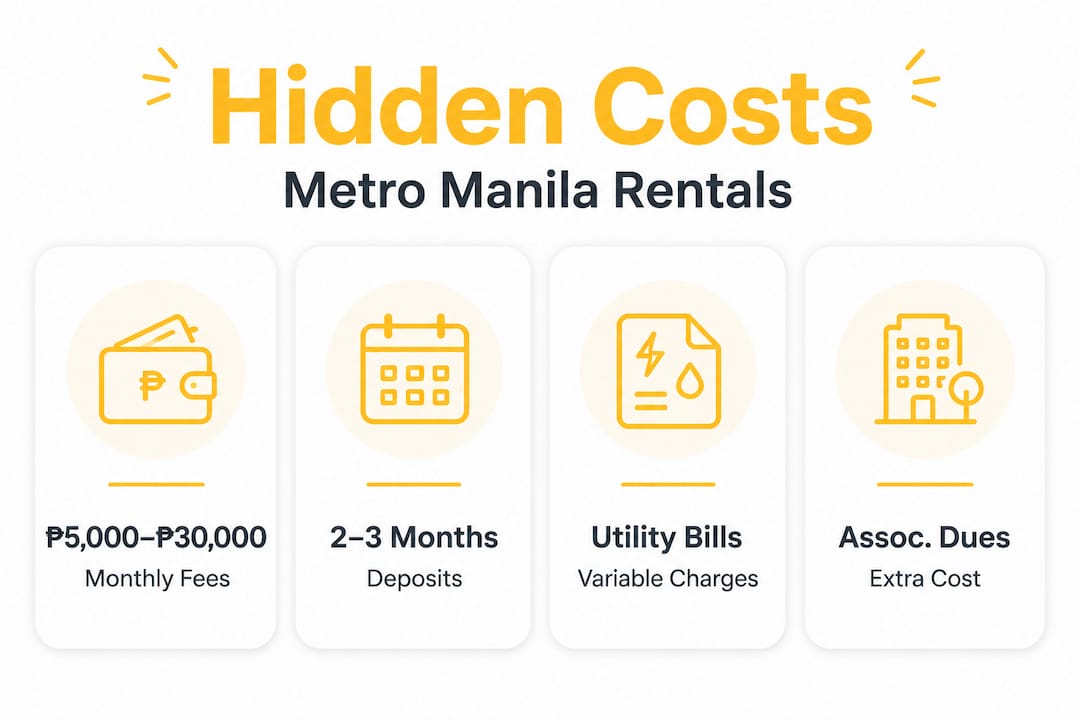
The hidden costs that catch most foreigners off guard are the association dues and utilities. In some high-end BGC buildings, electricity costs alone can run ₱15,000 to ₱30,000 per month for a standard two-bedroom unit. Always ask for the previous tenant’s utility bills if you can get them.
The overlooked realities of Metro Manila’s rental market
Here’s what most rental guides won’t tell you: the published vacancy rate for a district and your actual ability to get a good deal in that district are two completely different things. And as a foreign entrepreneur, this gap can cost you real money if you’re not careful.
I’ve seen entrepreneurs arrive in Metro Manila, read that overall vacancy is nearly 20%, and walk into a BGC building expecting to negotiate hard. They’re surprised when the leasing agent barely budges. The reason is simple. That 20% vacancy is concentrated in secondary and fringe districts. The specific buildings where foreign entrepreneurs want to be, the ones with the right address, the right management, and the right amenities, are often 85 to 90% occupied. Supply-demand logic applies at the building level, not the metro level.
The second thing most guides miss is the role of relationships and local credibility. Philippine business culture places significant weight on trust and familiarity. A local agent who knows the building manager personally can unlock lease terms that you’d never get cold-calling. This isn’t about corruption. It’s about how business gets done. Investing in a good local agent or a firm that has existing landlord relationships pays for itself quickly.
Timing matters more than most people expect, too. The best units in prime buildings get leased before they’re publicly listed. If you’re serious about a specific building, get in front of the leasing team early, even before you’re ready to sign. Express genuine interest, ask smart questions, and follow up. That relationship-building is what gets you the call when a good unit opens up.
The choice of corporation vs branch also affects your rental options in ways that aren’t obvious. A fully registered domestic corporation has more credibility with landlords than a branch office or representative office, particularly for longer commercial leases. Getting your structure right before you start your lease search is not just a legal decision. It’s a practical one.
Flexibility is underrated. The entrepreneurs who navigate Metro Manila’s rental market best are the ones who hold their district preferences loosely at first, use a virtual office to get registered, and then take the time to find the right long-term space. Rushing into a 3-year lease in the wrong building because you needed an address yesterday is a mistake that’s expensive to undo.
Expert support for your business launch in the Philippines
Securing the right space in Metro Manila is only one piece of the puzzle. Before you can sign a commercial lease, meet with clients, or open a bank account, you need a properly registered business entity. And that process has more steps than most foreign entrepreneurs expect.

Korp.ph handles the full setup process for foreign entrepreneurs, from company incorporation to BIR registration, permits, and ongoing compliance filings. Instead of chasing multiple agencies and managing a fragmented process on your own, you get a single guided workflow that keeps everything moving. Explore the full range of business registration solutions available, or visit Korp.ph to see how the platform simplifies your entire business setup from day one.
Frequently asked questions
Are there restrictions for foreigners renting property in the Philippines?
Foreigners can legally rent both residential and commercial properties in the Philippines, but must provide a valid passport, active visa, and comply with standard lease terms as outlined in typical lease requirements for foreign nationals.
What are typical residential lease terms for foreigners?
Most residential leases run 12 months with one month advance rent and two months security deposit; shorter lease terms are available but usually come with a 10 to 20% premium on the monthly rate.
Which Metro Manila districts are best for foreign entrepreneurs to rent office space?
BGC and Makati are the top choices for prestige and amenities, while Ortigas and Quezon City offer office rents 30 to 40% lower and suit cost-conscious startups well.
What hidden costs should I expect when renting in Metro Manila?
Beyond base rent, budget for association dues, utilities, and move-in fees, which can add ₱5,000 to ₱30,000 per month depending on the building and unit type.
Will 2026 see easier or tougher conditions for new rentals in Metro Manila?
Citywide conditions may soften due to new office supply entering the market, but prime areas like BGC and Makati are still projected to see modest rent growth of 1 to 5% through the year.
Recommended
- Korp.ph | Visas for foreigners in the Philippines: 2026 guide
- Korp.ph | Essential tips for foreign entrepreneurs starting a business in the Philippines
- Korp.ph | Blog & Resources
- Korp.ph | Representative Office vs Branch Office in the Philippines
- Foreigner’s Guide to Buying Property in Singapore (2025 Regulations & Taxes) | Aesthetic Havens