



This calendar covers the main annual filings a Philippine corporation owes the SEC, the BIR and its LGU: the General Information Sheet, the annual financial statements, the annual income tax return, the employer year-end forms and the business permit renewal. Monthly and quarterly tax returns run on their own cycle.
Two dates set most of the deadlines below: your fiscal year-end and the date of your annual stockholders’ meeting. Pin those down first, and file early, because a filing the SEC reverts on review counts as not filed.
TL;DR:
-
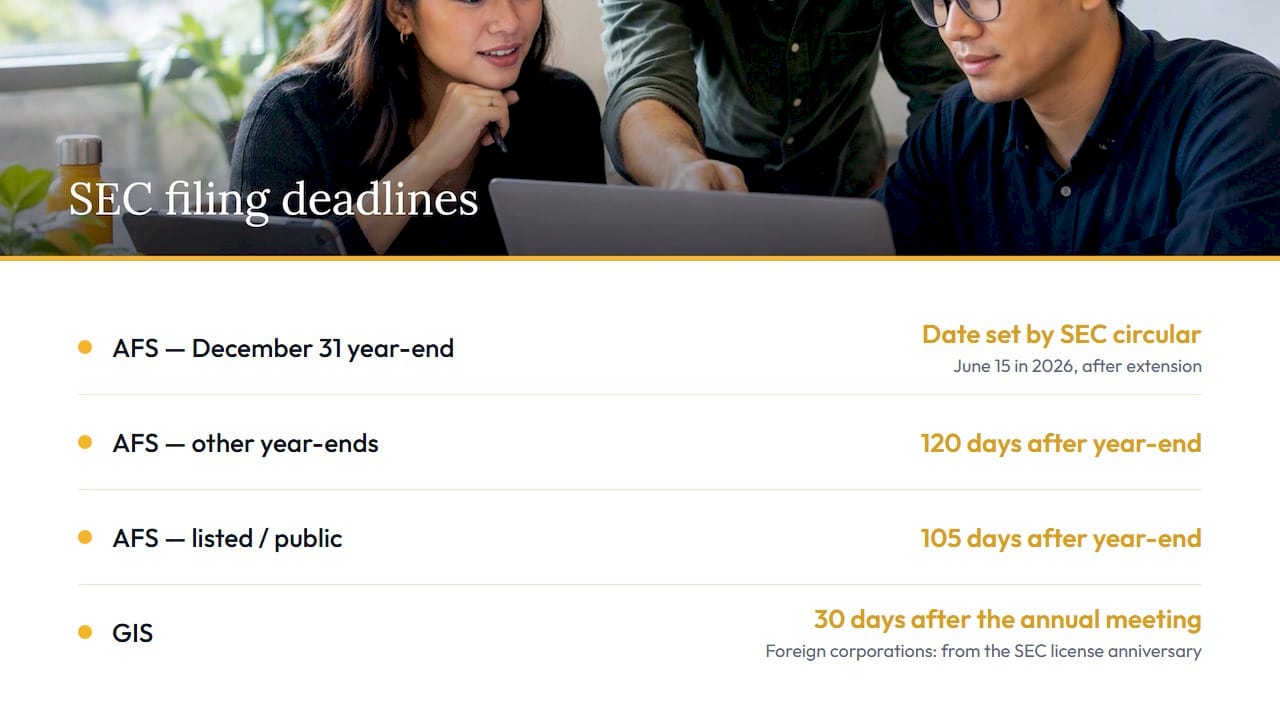
Annual financial statements: for a December 31 year-end, the SEC sets the filing date each year by circular (May 29, 2026, later extended to June 15, 2026). Other fiscal years file within 120 days of year-end.
-
General Information Sheet: within 30 calendar days of the actual annual stockholders’ meeting, or of the SEC license anniversary for a foreign corporation.
-
Annual income tax return: the 15th day of the fourth month after year-end (April 15 on a calendar year), filed even when no tax is due. In 2026 the BIR moved it to May 15.
-
January carries the DOLE 13th-month report, the business permit renewal and the employer year-end forms, all inside the same month.
-
A reverted eFAST filing counts as not filed, so file with a buffer and watch for a reversion notice.
Table of Contents
SEC annual filings: AFS, GIS, and eFAST practicalities
If your fiscal year ends on December 31, the SEC sets your annual financial statements (AFS) deadline each year by circular. For 2026, SEC Memorandum Circular No. 9, series of 2026 set May 29, and an SEC notice of April 14, 2026 moved it to June 15 after the BIR extended the income tax return deadline. If your fiscal year ends on any other date, the AFS is due within 120 calendar days of year-end. Listed and other public companies file within 105 days, attached to their SEC Form 17-A.
Before you upload, check which side of the audit threshold you fall on. A corporation with total assets or total liabilities above ₱3,000,000 files audited statements; at or below it, it may file unaudited statements with a sworn Statement of Management’s Responsibility. Corporations named in Part 1, Section 3(B) of Revised SRC Rule 68 must engage an SEC-accredited external auditor in the right category. Every AFS other than consolidated statements carries the BIR’s “received” stamp, or the confirmation receipt from the BIR’s eAFS system if you filed there. Our external audit guide covers the audit itself.
Your General Information Sheet works on a different clock entirely: it’s due within 30 calendar days of your actual annual stockholders’ meeting, or of your license anniversary if you’re a foreign corporation operating here. That date moves every year with your meeting, so it rarely lines up with the fiscal year-end that governs your AFS. Our guide to filing your GIS via eFAST walks through the submission screens step by step.
Before that GIS, declare your beneficial owners in the SEC’s HARBOR registry, which replaced beneficial-ownership reporting in the GIS from January 1, 2026; our HARBOR guide explains who counts. Where Korp is your corporate secretary, both filings are part of the subscription.
eFAST will show your filing as “submitted,” but that status isn’t final. The system runs a post-review and can revert your filing, and a reverted filing counts as not filed at all, deadline penalties included.
Before you file, confirm:
-
Your fiscal year-end, and the AFS due date that follows from it: the SEC’s date for a December 31 year-end, 120 days for any other.
-
Your actual annual meeting date, since that sets your GIS window.
-
Who signs the Statement of Management’s Responsibility, and who prepares the AFS package.
-
Whether your company needs an SEC-accredited auditor, and if it does, whether your auditor’s accreditation covers your category.
Pro Tip: Treat the eFAST QR code as provisional. The SEC issues it automatically on submission, subject to post review, and a report reverted on review counts as not filed. Watch the email address registered with the SEC for a reversion notice, and resubmit the same day.
BIR annual and year-end filings: AITR, employer returns, and filing channels
Your annual income tax return (AITR) is due on the 15th day of the fourth month after your fiscal year closes, which is April 15 on a calendar year (Section 77(B) of the Tax Code). The BIR can move it: for 2025 returns, RMC No. 30-2026 extended the deadline to May 15, 2026. The return is filed even in a year with no tax due. Companies enrolled in eFPS, whether required or by choice, file BIR Form 1702-RT through that system; every other company files through eBIRForms. Our guide to your corporation’s first annual income tax return covers year one.
Form 1702-RT applies to regular corporate taxpayers subject to the standard income tax rate, and the BIR’s own filing instructions also cover Minimum Corporate Income Tax rules for companies that owe MCIT instead of the regular rate in a given year.
January brings a separate wave of employer obligations that have nothing to do with your fiscal year-end:
-
Issue BIR Form 2316 to every employee by January 31 (RR No. 11-2013).
-
File BIR Form 1604-C along with the annual alphalist by January 31.
-
Report your 13th-month pay to DOLE through its Online Compliance Portal by January 15. The pay itself is due by December 24.
January is the single busiest compliance month of the year for most corporations: employer forms, alphalists, and 13th-month reporting all converge in the same four-week window. That overlap is exactly why founders miss one filing while scrambling to finish another.
Keep your payroll records, withholding certificates, and alphalist backups on file. Our guide on managing tax compliance covers how to set up an internal filing cadence that catches these dates before they catch you.
LGU deadlines and permit renewals you can’t ignore
The Local Government Code sets the default: renew your mayor’s permit and pay your local business tax within the first 20 days of January. Cities can extend that by ordinance, and some do: a 2026 Naga City ordinance moved its business tax deadline from January 20 to January 23. Plan on January 20 unless your city has announced an extension.
Late local business tax carries a 25% surcharge plus interest of up to 2% a month (Local Government Code, Section 168), and an unrenewed permit can halt your operations until you settle up. To stay ahead of it:
-
Calendar January 20, and move it only when your LGU announces an extension.
-
Check your city or municipal treasurer’s office for ordinance-based extensions each year.
-
Reconcile your LGU deadline against your January BIR and DOLE deadlines, which fall in the same three weeks.
Mapping your fiscal year to exact due dates
Three questions determine every date on your calendar: when does your fiscal year end, when was your last annual meeting, and which LGU governs your business address. Answer those, and the rest is arithmetic.
For a corporation closing its books on December 31, your year typically unfolds like this:
| Month | Filing | Governing deadline rule |
|---|---|---|
| January | DOLE 13th-month report, mayor’s permit and local business tax, Form 2316, Form 1604-C and alphalist | January 15 (DOLE 13th-month report); January 20 (permit and local business tax, unless extended); January 31 (Form 2316, Form 1604-C) |
| April | Annual Income Tax Return (BIR Form 1702-RT) | 15th day of the 4th month after fiscal year-end |
| Within 30 days of your meeting | General Information Sheet | 30 calendar days from annual meeting |
| May or June | Audited Financial Statements (eFAST) | Date set by SEC circular each year (June 15 in 2026, after extension); 120 days for other fiscal years |
If your fiscal year doesn’t end in December, adjust the AFS and AITR dates accordingly using the standard four-month and 120-day rules, and determine your GIS deadline based on your own meeting date rather than copying this table directly. Beyond the annual items, remember that VAT and withholding tax returns run on their own monthly or quarterly cycles year-round, so your compliance load doesn’t stop once the AFS is filed. Build in a buffer of at least a week before each regulator deadline: that cushion is what saves you if eFAST reverts a submission and you need to refile.
Running this calendar day to day: owners and pitfalls
Assign a named owner for SEC filings, BIR filings, and LGU renewals, each with an internal deadline set several days ahead of the regulator’s actual date. That gap is what gives you room to fix a rejected upload or a mismatched signature without missing the real cutoff.
Keep an audit-ready folder year-round: signed Secretary’s Certificates, auditor engagement letters, and properly formatted files ready for eFAST upload. A missed date is not the only risk: a filing that shows as submitted can still be reverted on review, and a reverted filing counts as not filed.
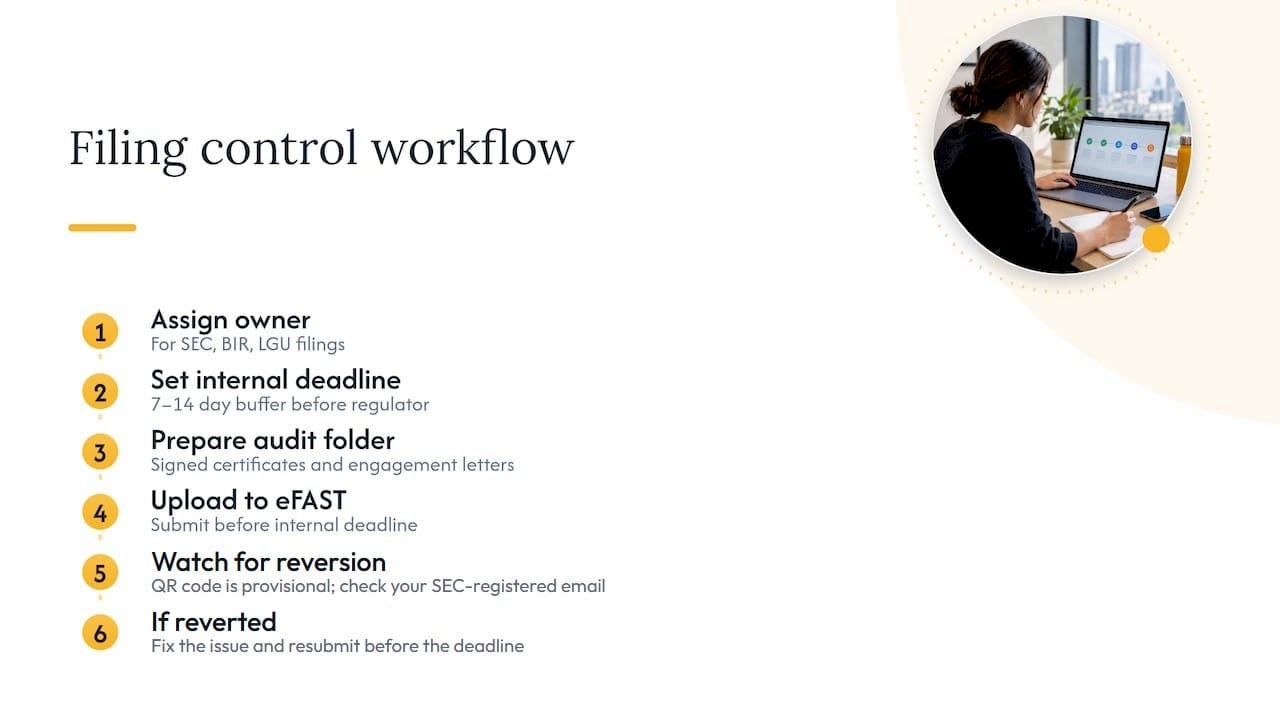
Pro Tip: Build your internal deadlines 7 to 14 days ahead of regulator dates so a reverted eFAST filing still leaves you time to resubmit.
If you want this handled for you
Where Korp is your corporate secretary, the subscription carries the SEC side of this calendar: the GIS, the HARBOR declaration, the annual meeting minutes and the AFS filing on eFAST. BIR returns are filed through our accounting partner, Proseso, a separate company. We also handle incorporation and business registration, tax registration and permits for companies setting up from scratch.

The corporate secretary subscription is ₱10,000 a month per entity and includes a compliance calendar kept for your company. If Korp did not incorporate your company, a one-time onboarding fee equal to one month applies. Visit our corporate secretary page to see what a managed compliance calendar looks like for your entity.
FAQ
What is corporate compliance in the Philippines?
Corporate compliance means meeting your recurring obligations to the SEC, BIR, and your local government unit, including the GIS, audited financial statements, annual tax returns, and permit renewals. Missing any of these can trigger penalties or, in serious cases, revoked permits that disrupt your operations.
When is the GIS due for a Philippine corporation?
Your General Information Sheet is due within 30 calendar days of your actual annual stockholders’ meeting, or of your license anniversary if you’re a foreign corporation. That date resets every year based on when your meeting actually happens, not a fixed calendar date.
When must corporations file audited financial statements?
For a December 31 year-end, on the date the SEC sets by circular each year: May 29, 2026 under SEC MC No. 9, s. 2026, extended to June 15, 2026. Other fiscal years file within 120 calendar days of year-end, and listed and public companies within 105 days.
What happens if an eFAST filing gets reverted?
A reverted eFAST submission is treated as not filed at all, even if the system initially showed it as submitted, since eFAST performs a post-review after upload. Submitting well ahead of the deadline gives you time to correct and refile before the actual cutoff passes.
Does Korp handle ongoing compliance filings?
Yes, for SEC filings. Our corporate secretary subscription, ₱10,000 a month per entity, covers the GIS, the HARBOR declaration and the AFS filing on eFAST. BIR returns are filed through our accounting partner, Proseso. We also handle incorporation and tax registration for businesses still setting up.
Sources
-
SEC notice of April 14, 2026: extension of the 2025 AFS deadline (Grant Thornton)
-
BIR RMC No. 30-2026: 2025 AITR deadline extended to May 15, 2026 (Grant Thornton)