If you are opening or running a business in the Philippines, a Fire Safety Inspection Certificate (FSIC) is the Bureau of Fire Protection’s (BFP) confirmation that your premises meet the fire code. You need it at two points: before the building can get an occupancy permit, and again when you apply for or renew your business permit. This guide explains how the FSIC and the occupancy permit (also called the Certificate of Occupancy) fit together, what to submit, what it costs, how long it takes, and what happens if you fail.
Key Takeaways
-
The FSIC comes from the BFP. The occupancy permit comes from the local Building Official. For a new building, the first is a prerequisite for the second.
-
For the occupancy stage, the BFP’s 2021 Citizen’s Charter sets a maximum of 3 working days for simple transactions and 7 for complex ones. The fee is generally 15% of LGU-charged fees, with a PHP 500 floor.
-
Buildings with wet standpipes, automatic suppression or automatic detection and alarm systems need an extra commissioning report (FSCCR).
-
A failed inspection leads to a Notice of Disapproval, or a Notice to Comply if you are already operating. It is a to-do list, not the end of the road.
-
Book your renewal inspection early: the BFP schedules an advance inspection one month before a business-permit FSIC expires.
Table of Contents
-
What an FSIC is, and how it differs from an occupancy permit
-
Our perspective: treat fire clearance as part of the launch, not a hurdle after it
What an FSIC is, and how it differs from an occupancy permit
People often use the two terms as if they were one document. They are not.
An FSIC is issued by the BFP once it determines that the required fire safety construction is in place and that fire protective or warning systems are installed according to approved plans and specifications, in compliance with RA 9514 (the Fire Code) and its implementing rules. This definition comes from the joint memorandum circular of the DILG, DPWH, DICT and DTI.
An occupancy permit is a different thing. The same circular describes it as a document issued by the Building Official certifying that a building or structure was completed and can be occupied or used according to its approved use.
The National Building Code makes the occupancy permit mandatory. Under Section 309, as reproduced by the DPWH, no building may be used or occupied, and its occupancy classification may not change, until the Building Official issues a Certificate of Occupancy. Issuance follows a final inspection and submission of the Certificate of Completion, once compliance is found.
The link between the two is stated in the BFP’s 2021 Citizen’s Charter: the occupancy-stage FSIC is a prerequisite for the Office of the Building Official’s (OBO) Certificate of Occupancy.
| FSIC | Occupancy permit | |
|---|---|---|
| Issued by | Bureau of Fire Protection | Local Building Official (OBO) |
| What it confirms | Fire safety construction and systems match approved plans and the Fire Code | The building is complete and can be used as approved |
| When you need it | At the occupancy stage, and for the business permit | Before anyone uses or occupies the building |
| Depends on | Building completion and OBO endorsement | The occupancy-stage FSIC |
Mayumi tip: Think of it as two locks on the same door. The BFP unlocks the fire safety lock, and then the Building Official can open the occupancy lock.
The two moments you will meet an FSIC
The BFP’s charter distinguishes between FSICs by purpose, and it helps to know which one you are dealing with.
1. At the occupancy stage
This applies when you build or fit out a space. The FSIC feeds into the Certificate of Occupancy. If you are a tenant moving into an existing, already-occupied building, the landlord usually holds the occupancy permit. You should still ask for a copy, because your own fit-out and operations will be inspected.
2. For the business permit
When you apply for or renew your mayor’s permit with the city or municipality, the local government asks for fire safety clearance. That is the FSIC for a business permit. It repeats on a cycle, so it is a recurring compliance item, not a one-time chore. If you are still mapping the whole permit chain, our guide to business licensing in the Philippines shows where fire clearance sits among the other approvals.
What you need to submit for the occupancy-stage FSIC
Per the BFP’s 2021 Citizen’s Charter, an FSIC needed for a Certificate of Occupancy requires:
-
The BFP application form.
-
The OBO endorsement.
-
The Certificate of Completion.
-
A certified true copy of the OBO’s occupancy-permit fee assessment.
Two additions apply in some cases:
-
An as-built plan, where the approved plans changed during construction.
-
A Fire Safety Compliance and Commissioning Report (FSCCR), where the building is required to have a wet standpipe, an automatic fire-suppression system or an automatic fire-detection and alarm system. The contractor or construction manager and the fire-safety practitioner prepare it.
The practical lesson: the paperwork is easy if the construction record is clean. Most delays come from plans that changed on site and were never documented, or from systems that were installed but never formally commissioned.
Mayumi tip: Ask your contractor for the as-built plans and commissioning documents as a condition of final payment, not as an afterthought. Chasing them after handover is slow.
Where and how to apply
Applications are filed with the BFP office that covers your city or municipality. The BFP has an online Fire Safety Inspection System (e-FSIS) for applications, payment and certificate release. Local officials have also discussed linking it with the national eLGU platform. In Pateros, DILG-NCR reported talks on integrating e-FSIS with eLGU in line with RA 11032, the law on faster government services. Availability differs by locality, so check with your local BFP office which channel it accepts before you queue.
The inspection process, step by step
Here is what to expect from application to certificate:
-
BFP review of your application and documents.
-
Payment of the applicable fire-code fee.
-
Assignment of a fire safety inspector.
-
Ocular inspection of the premises.
-
Testing of passive and active fire-protection systems.
-
Decision: the FSIC is issued, or you receive a notice listing what to fix.
Passive systems are the parts built into the structure, such as exits, fire-rated construction and signage. Active systems are the ones that operate in an emergency, such as alarms, sprinklers and extinguishers. Inspectors may check both, so walk your own space against the approved plans before the visit.
A pre-inspection walkthrough
Before the inspector arrives, check the following yourself:
-
Exits are unobstructed, and exit signs and emergency lighting match the plans.
-
Extinguishers are present, tagged and mounted where the plans say.
-
Alarm and detection systems work and have been tested.
-
Nothing in the layout has been changed since the plans were approved. If it has, make sure there is an as-built drawing.
-
Stored goods are not blocking sprinkler heads, panels or doors.
This is general good practice, not a replacement for the Fire Code. Your fire-safety practitioner or contractor can confirm the exact requirements for your occupancy type.
Fees and processing time
The BFP’s 2021 Citizen’s Charter gives the following for occupancy-stage FSIC transactions:
| Item | What the charter states |
|---|---|
| Simple transactions | Maximum of 3 working days |
| Complex transactions | Maximum of 7 working days |
| Fee | Generally 15% of LGU-charged fees, not below PHP 500 |
| Exception | A stated zero-assessment exception applies |
Those are maximums for the BFP’s part. Your overall timeline also includes getting the Certificate of Completion, the OBO endorsement and any corrections, so plan the whole chain, not only the BFP step. Fees and procedures can be updated, so confirm the current figures with your BFP office before budgeting.
What happens if you fail the inspection
A failed inspection is common, and it is recoverable. According to the BFP charter, if an occupancy-stage inspection finds non-compliance, the BFP may issue a Notice of Disapproval, or a Notice to Comply if the building is already occupied or operational, instead of issuing the FSIC.
Here is a sensible response:
-
Read the notice line by line and list each deficiency.
-
Sort items into quick fixes (signage, extinguishers, blocked exits) and work needing a contractor (alarm or sprinkler changes).
-
Fix, document with photos and receipts, and keep the as-built plan current.
-
Ask the BFP office how to request re-inspection.
The cost of ignoring it is practical as well as legal. Without the FSIC, the Certificate of Occupancy does not follow. The National Building Code, as reproduced by the DPWH, also requires the Certificate of Occupancy to be posted conspicuously on the premises, and its non-issuance, suspension and revocation fall under the code’s enforcement and appeal provisions. A business that cannot show these documents risks trouble when its mayor’s permit comes up.
Renewal and staying compliant
The FSIC for a business permit is not a set-and-forget document. The BFP’s charter schedules an advance fire safety inspection one month before the business-permit FSIC expires. It also notes a follow-up inspection three months after an FSIC for a business permit is issued.
A simple routine keeps you ahead:
-
Put the FSIC expiry and the advance inspection window in your compliance calendar.
-
Run your own check of extinguishers, alarms and exits quarterly.
-
Keep inspection reports, receipts and certificates in one shared folder.
-
Re-check the layout whenever you renovate or change how the space is used. A change in occupancy classification needs the Building Official’s sign-off.
Our annual compliance calendar for Philippine corporations is a handy way to see where fire clearance sits next to SEC, BIR and local filings. For the wider picture of what is changing for businesses, see our piece on regulatory trends in the Philippines.
Where the FSIC sits in your company setup
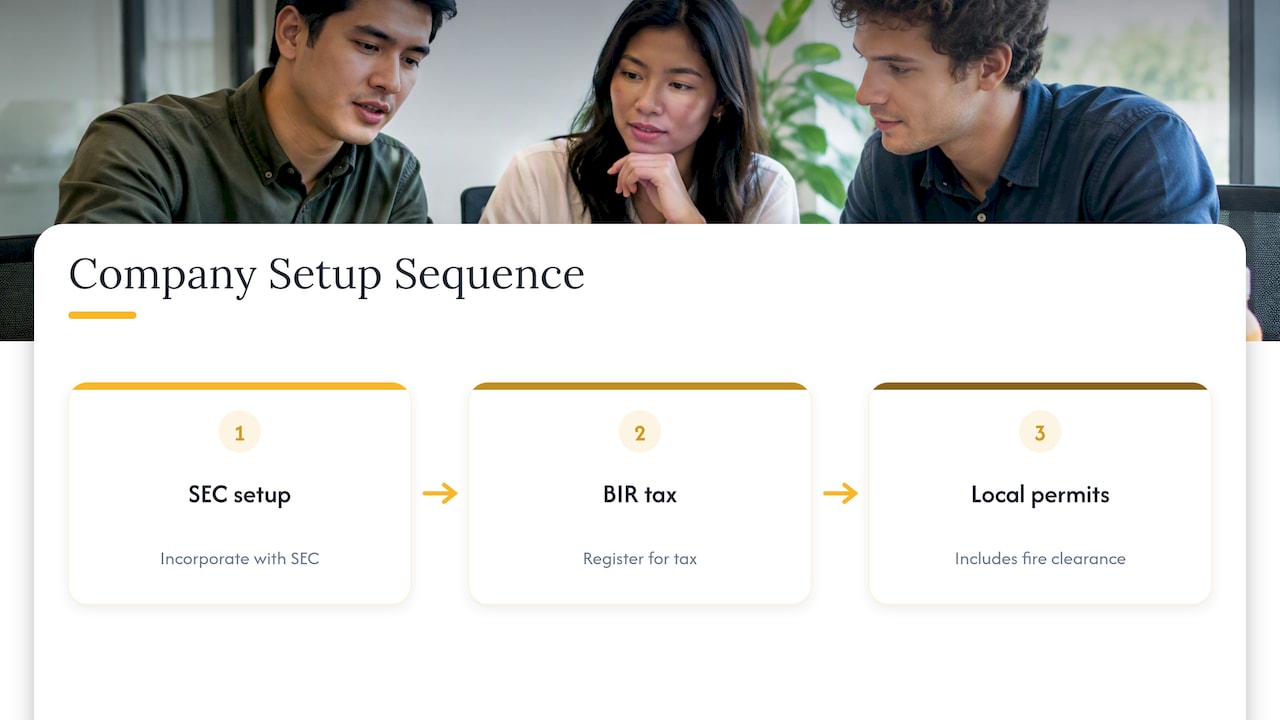
For a new company, the order matters. Incorporation with the SEC and tax registration with the BIR come first. Then you secure local permits, and fire clearance is one of the items that the local permit process leans on. If you are setting up as a foreign-owned business, our walk-through of the foreign company registration process covers the permits stage in context, and the step on tax registration follows right after.
A frequent mistake is signing a lease before checking the occupancy status of the space. If the building has no Certificate of Occupancy for your intended use, your permit timeline can stall through no fault of your own. Ask the landlord for the occupancy permit and any recent fire safety documents before you commit.
Our perspective: treat fire clearance as part of the launch, not a hurdle after it
We see the same pattern with new businesses. The company is incorporated and the tax registration is done, and then the team discovers that the permit stage depends on a building paper trail nobody has been tracking. The delay is rarely the BFP itself. It is the missing as-built plan, the unsigned commissioning report, or the landlord who cannot produce an occupancy permit.
That is why we build Korp around one guided workflow instead of a string of separate agencies. When incorporation, BIR registration, and permits and licenses sit in one place, with a dedicated expert team and minimal hand-offs, you can see what comes next and what each step depends on. You can do it all online, from anywhere, with no office visits for the registration steps we handle.
Our advice is simple. Decide on your premises early, ask for the building documents before you sign, and schedule fire clearance alongside your other permits. Momentum matters when you are launching, and a clear sequence protects it.
Getting help with permits and ongoing compliance
If you would rather not coordinate this yourself, our LGU business permit service runs the whole permit for you, from PHP 20,000 (one-off). We coordinate the fire safety, sanitary and building inspections your city requires, and you provide the building’s occupancy permit, usually from your landlord. If you don’t have premises yet, a Korp virtual office in Makati or Daet gives your company a registered address from PHP 7,500 a quarter, and we handle the business permit for companies registered there.

Once you are up and running, our Corporate Secretary plan (PHP 10,000 per month per entity) helps you keep filings and deadlines in order. Ready to start? Get started with Korp.
FAQ
Is an FSIC the same as a certificate of occupancy?
No. The BFP issues the FSIC, and the local Building Official issues the Certificate of Occupancy. At the occupancy stage, the FSIC is a prerequisite for the Certificate of Occupancy, according to the BFP’s 2021 Citizen’s Charter.
How much does an FSIC cost?
For occupancy-stage transactions, the BFP charter gives the fee as generally 15% of LGU-charged fees, but not below PHP 500, subject to a zero-assessment exception. Confirm the current amount with your local BFP office, since your LGU fees drive the calculation.
How long does it take to get one?
The BFP charter sets a maximum of 3 working days for simple occupancy-stage transactions and 7 working days for complex ones. Your total time also depends on how fast you assemble the Certificate of Completion, OBO endorsement and any required reports.
What if I fail the fire inspection?
The BFP may issue a Notice of Disapproval, or a Notice to Comply if the building is already occupied or operating, instead of the FSIC. Fix the listed items, document the work and ask the BFP office how to arrange a re-inspection.
When should I renew a business-permit FSIC?
Start early. The BFP schedules an advance fire safety inspection one month before the FSIC expires, so add that window to your compliance calendar instead of waiting for the expiry date itself.