To register a trademark in the Philippines, you search the Intellectual Property Office of the Philippines (IPOPHL) database, file an application online through eTMfile, pay the fee per class of goods or services, and then go through examination, publication and possible opposition. If the mark clears, protection lasts ten years and can be renewed. Foreign applicants without a business presence in the country must file through a Philippine resident representative.
This guide walks you through each step, what the official fees look like, and the post-registration filings that many owners miss.
Key takeaways
-
The Philippines follows a first-to-file rule, so the first party to file generally gets the right to the mark. Waiting is the expensive option.
-
Applications are filed online through IPOPHL’s eTMfile system. Official fees start at ₱1,200 per class for small entities.
-
Foreign applicants with no domicile or real commercial establishment in the Philippines need a resident representative or agent.
-
Registration lasts ten years, but you must file Declarations of Actual Use (DAUs) on schedule or the mark is removed from the register.
-
Search first. A conflicting earlier mark is the most common reason a filing fee gets wasted.
Table of Contents
Do you need to register to use the TM symbol?
No law stops you from putting “TM” next to your brand name. The symbol tells the public you claim the mark, and it may deter would-be infringers. The ® symbol is different: it signals a registered mark, so use it only once you hold a registration.
The symbol is not protection, though. The Philippines follows a first-to-file rule, which means the party that files first is granted the right to the trademark. If a competitor files your brand name before you do, your “TM” will not help you much.
What registration gives you is concrete. A Philippine registration gives the owner exclusive rights to prevent others from using or exploiting the mark. IPOPHL also notes that a registered mark can become a source of revenue through licensing or franchising agreements.
One limit to keep in mind: rights from a Philippine registration are normally limited to the Philippines, unless the mark is well-known. If you sell abroad, you need to plan registrations in those markets separately.
Mayumi tip: Register the mark before you spend money on signage, packaging and ads. Rebranding after a rejection or a dispute costs far more than the filing fee.
Who can apply, and what you need
Any person, whether an individual or a legal entity, can apply. You do not need to be a Filipino citizen or a registered Philippine company. There is one condition for foreign owners: applicants not domiciled in the Philippines, and without a real and effective commercial establishment there, must use a resident representative or agent.
Have this ready before you start:
-
Applicant details: full legal name, address and nationality or place of incorporation.
-
The mark itself: the word mark or a clear image of the logo.
-
Goods or services: a list of what the mark will cover, which determines the classes you pay for.
-
A working email address: the applicant’s or representative’s email is the primary contact for official notices, so use one that someone checks daily.
-
Representative details, if you are a foreign applicant.
If you already run a Philippine company, make sure the applicant name on the filing matches who will actually own and use the brand. Owning the mark personally while the company uses it creates licensing questions later. Our guide to establishing a business in the Philippines covers how to structure that owner in the first place.
Step 1: Search before you file
Before applying, search IPOPHL’s searchable database of trademark information. Check three things:
-
Identical names in your class and in closely related classes.
-
Similar-sounding or similar-looking names. Examiners compare the overall impression, not only exact matches.
-
Logos that resemble yours, if you are filing a design.
A clean search does not guarantee approval, but a search that shows a close match is a strong warning. If you find one, change the mark before you file rather than after you have paid.
Step 2: File through eTMfile
IPOPHL accepts trademark applications online through eTMfile. The system lets you file new applications and pay the corresponding fees online.
Payment can be made through IPOPHL’s e-payment channels, which include Maya and credit or debit cards.
The steps inside the system are straightforward: create an account, fill in the applicant and mark details, select your classes and goods or services, upload the mark, and pay. Mistakes in the goods and services description are the usual cause of correction requests later, so write them carefully.

Step 3: Examination, publication and opposition
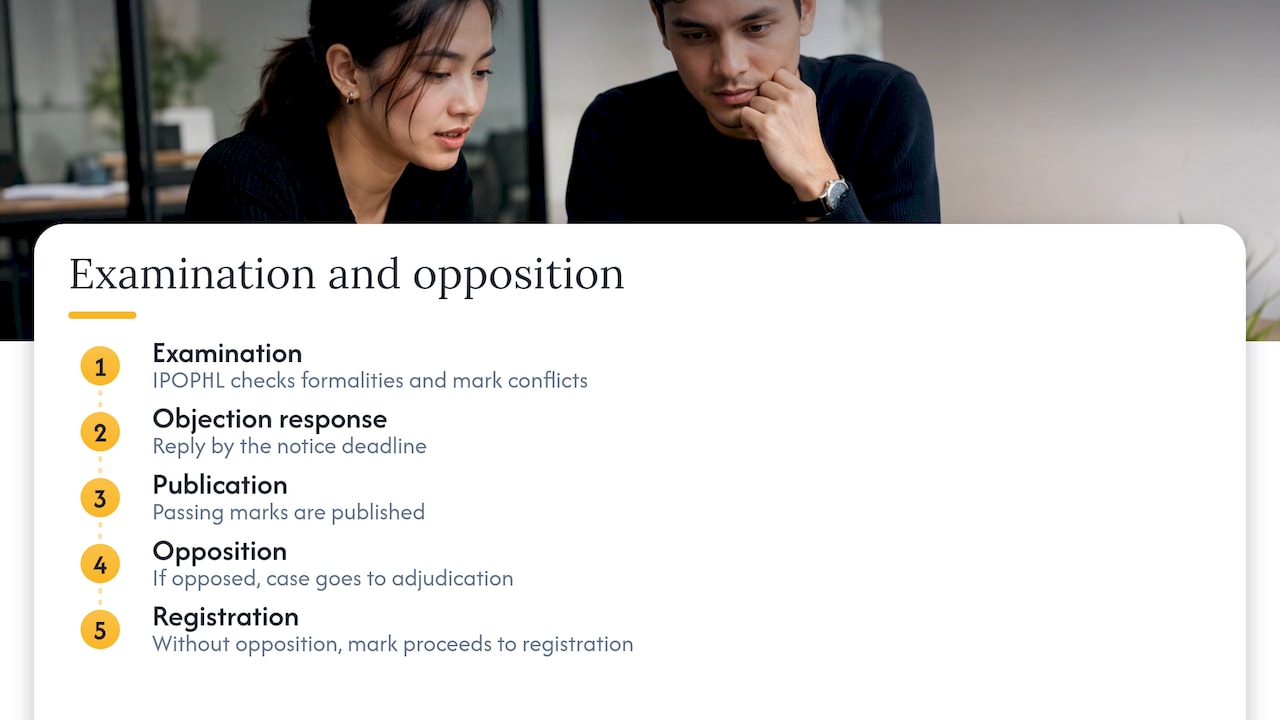
After filing, IPOPHL examines the application for formalities and for conflicts with existing marks. If the examiner raises objections, you get a chance to respond. A well-prepared response, with arguments on why your mark is distinguishable, is often the difference between approval and abandonment. Watch the reply deadlines in the notice itself, because missing one can end the application.
A mark that passes examination is published so that third parties can oppose it. If someone does, the case moves to IPOPHL’s adjudication office and your timeline stretches. If nobody does, the mark proceeds to registration.
IPOPHL says its trademark and patent bureaus have begun exploring AI tools for examination. Treat this as a direction, not a change to the process you file under today.
Timelines vary with the examiner’s workload, objections and oppositions, so rely on the status tracker in your IPOPHL account rather than a promised number of weeks. Be wary of any provider that guarantees a registration date, since the decision belongs to IPOPHL.
What does it cost?
Official fees depend on the size of the applicant. According to IPOPHL’s schedule, small entities (assets up to ₱100 million) pay ₱1,200 per class, and big entities pay ₱2,592 per class. Extra fees apply for specific actions, such as color claims or priority examination requests.
| Item | Small entity | Big entity |
|---|---|---|
| Application filing fee, per class | ₱1,200 | ₱2,592 |
| Third-year DAU, per class | ₱900 | ₱1,920 |
| Opposition or petition for cancellation | ₱10,000 | ₱14,600 |
The DAU figures come from the same fee schedule. The opposition and cancellation fees come from IPOPHL’s adjudication page. Fees can be revised, so confirm the current schedule before you pay.
Two budgeting notes:
-
Classes multiply the cost. A brand that covers clothing and a café needs at least two classes, so two filing fees.
-
Women-led MSMEs may qualify for relief. IPOPHL’s Juana Make a Mark (JMAM) program waives certain filing and publication fees for qualified applicants. Check the program’s current terms on the IPOPHL site.
Official fees are only part of the budget. If you use a representative to prepare the filing, handle objections or act as your local agent, you also pay their professional fee.
Protection lasts ten years, if you keep filing
A Philippine trademark registration is valid for ten years and renewable for successive ten-year periods. That is the easy part. The part owners forget is proof of use.
Owners must file DAUs with proof of use at set points. Under IPOPHL’s rules, these are:
-
Within three years of the filing date.
-
Within one year of the fifth registration anniversary.
-
Within one year of the fifth anniversary of each renewal.
Failure to file removes the mark from the register. So the real cost of a trademark is a ten-year calendar, not a one-time filing.
Mayumi tip: Put the three-year DAU date in your calendar the day you file, not the day you register. It counts from the filing date.
Perspective: why we treat the trademark as part of the company setup
Most founders we meet think about the trademark last: after the company is incorporated, the BIR is done, the permits are in and the logo is already on the shop front. That order works, but it carries a risk. Under first-to-file, the name you just paid to register as a company is not automatically yours as a brand.
SEC incorporation checks name availability against company names. It does not clear your brand against the trademark register. Those are two different lists kept by two different agencies. A company name can be approved while a brand conflict is sitting in IPOPHL’s database.
So our advice is simple. Search the trademark database while you are still choosing your company name. File the trademark early, ideally in the same window as incorporation. Then make sure the entity that owns the mark is the one that will actually trade under it. For foreign founders especially, a Philippine entity with a local address also solves the resident-representative question.
We built Korp around the idea that these steps should sit in one workflow and not in four separate chases. Trademark registration is part of that, handled alongside incorporation, tax registration and permits.
Where Korp fits in
If you are setting up a Philippine business, the trademark is one more item on a list that includes SEC incorporation, BIR registration and local permits. We handle these online, with no office visits, so you can start from anywhere. Our trademark registration service covers the clearance search and the application, at ₱35,000 per class, VAT inclusive. Declarations of Actual Use and responses to IPOPHL office actions are billed separately.
For the rest of the setup, the published starting prices are:
-
SEC Incorporation Only: from ₱45,000, one-off.
-
Full Business Registration: from ₱142,500, one-off.
-
Tax Registration: from ₱30,000, one-off.
-
Business Permits & Licenses: from ₱20,000, one-off.

Ready to protect your brand while you build the company behind it? Get started with Korp and tell us what you are launching.
Common mistakes to avoid
-
Filing in the wrong class. If your goods or services fall outside the class you filed, the registration may not cover what you actually sell.
-
Skipping the search. The filing fee is paid whether or not the mark is approved.
-
Using an inbox nobody reads. Official notices go to the contact email, and missed deadlines can end an application.
-
Forgetting the DAU. Registration without proof of use at the right times means losing the mark.
-
Assuming Philippine rights cover other countries. They normally stop at the border, except for well-known marks.
FAQ
How much does it cost to file a trademark in the Philippines?
The official filing fee is ₱1,200 per class for small entities and ₱2,592 per class for big entities, according to IPOPHL’s schedule. Extra fees apply for things like color claims and priority examination. If you use a representative, add their professional fee.
Can a foreigner register a trademark in the Philippines?
Yes. Any person or legal entity can apply. If you are not domiciled in the Philippines and have no real and effective commercial establishment there, you must file through a resident representative or agent.
How do I search whether a trademark name is already taken?
Use the searchable trademark database on IPOPHL’s online services portal. Search your exact name, similar spellings and sounds, and your logo, in your class and related ones. A clear result is encouraging but does not guarantee approval.
How long does a Philippine trademark last?
A registration lasts ten years and can be renewed for further ten-year periods. To keep it, you must file Declarations of Actual Use with proof of use on schedule, or the mark is removed from the register.