In the Philippines, the invoice is now the document that proves a sale. The official receipt (OR) is a supplementary document that only shows payment was collected. Since the Ease of Paying Taxes (EOPT) Act and the BIR’s Revenue Regulations No. 7-2024, a business that issues only an OR for a sale has not issued the document the law asks for. This guide explains the difference, what a valid invoice must contain, what happened to old OR booklets, and which companies must switch to electronic invoices from 31 December 2026. If you are setting up a company here, getting this right from day one saves you a frustrating correction loop later.
Key Takeaways
-
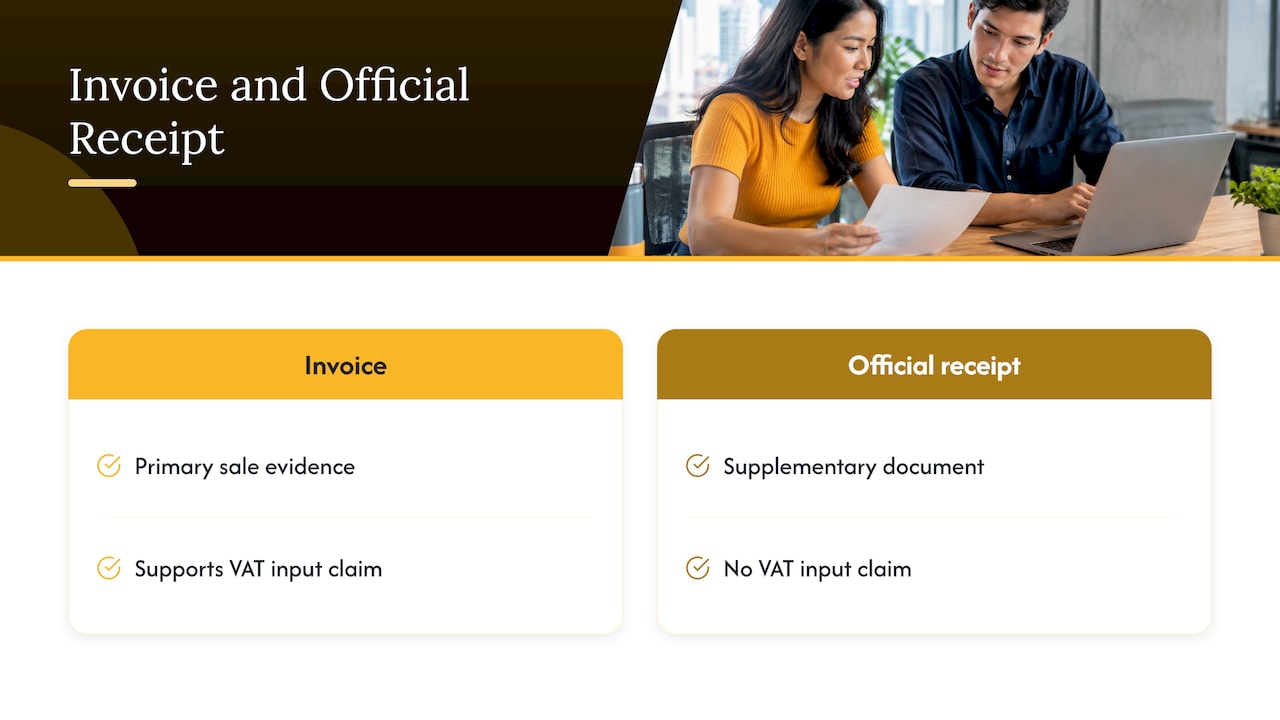
The invoice proves the sale. It is the primary evidence of a sale of goods or services under RR 7-2024 and the BIR’s RMC No. 77-2024.
-
The official receipt proves payment only. It is a supplementary document and does not support a buyer’s input VAT claim.
-
Issuing only an OR can be penalized. Failure to issue the required invoice carries a fine and possible imprisonment under Section 264(a) of the Tax Code.
-
Old OR booklets had two paths. They could be used up as proof of payment with a warning stamp, or converted into invoices. An unconverted OR issued for a sale counts as no invoice at all.
-
Your invoice needs specific details, including your BIR-registered name, TIN, serial number and the word “Invoice.” Some companies must issue electronic invoices from 31 December 2026.
The short answer: what each document proves
Think of it as two different questions a document answers.
-
An invoice answers: what was sold, to whom, and for how much? It records the transaction. It is what you use to report your output tax, and what your VAT-registered customer uses to claim input tax.
-
An official receipt answers: was the money received? It confirms that cash was collected. Under RR 11-2024, an OR by itself is proof of payment, not proof of sale.
Before the EOPT reforms, Philippine businesses lived by a different rule: the invoice was the document for goods, and the official receipt was the principal document for services. Many founders still remember it that way, and many templates and accounting tools still reflect it. That is why this question keeps coming up.
Sales invoice vs official receipt at a glance
| Invoice | Official receipt | |
|---|---|---|
| Status today | Primary evidence of a sale of goods and services | Supplementary document |
| Proves | The sale (and payment, when marked paid) | That payment was collected |
| Valid for the buyer’s input VAT claim | Yes, when it meets the requirements | No |
| Typical timing | At the point of sale or when services are rendered | Upon collection of payment |
| Required for every sale | Yes | No |
The timing point explains why people mix them up. The BIR’s RMC No. 77-2024 digest says a seller cannot issue an invoice upon receipt of payment, but may issue an official receipt, payment receipt or acknowledgement receipt when it later collects. So the OR still has a job. It just no longer does the invoice’s job.
What changed: the EOPT Act and RR 7-2024
Republic Act 11976, the EOPT Act, simplified several tax rules. Its invoicing change was implemented through RR 7-2024. According to the BIR’s RMC No. 77-2024, the invoice became the principal document evidencing the sale of goods and services, and the official receipt was reclassified as a supplementary document.
RR 7-2024 defines a supplementary document as any written document other than a sales or commercial invoice that serves as a source of accounting entries. The regulation’s list includes official receipts, delivery receipts, order slips, debit and credit memos, purchase orders, collection receipts, billing statements and statements of account. For VAT purposes, none of these supports a buyer’s input tax claim.
That last point is the practical heart of it. If your customer is VAT-registered and you hand them only an OR, they cannot claim the VAT they paid you. Expect them to ask for a proper invoice, and expect your own suppliers to be held to the same standard when you claim your input tax.
Is the official receipt still valid?
Yes, but only in a supporting role, and only in certain forms. RMC No. 77-2024 says ORs may still be issued upon collection of payment, but not as the primary evidence of a sale.
The transition rules are in RR 11-2024, dated 27 May 2024, which rewrote the transitory provisions in Section 8 of RR 7-2024. They count from 27 April 2024, the day RR 7-2024’s invoicing rules took effect, and they treat the two kinds of OR differently:
-
Manual or loose-leaf ORs: from 27 April 2024, an OR issued for a sale without first being converted into an invoice is not evidence of the sale. It counts as a failure to issue an invoice under Section 6(A) of RR 7-2024, and it cannot support the buyer’s input tax claim. Unconverted ORs may still be used up as proof of payment, stamped as described below.
-
Machine-generated ORs (from cash registers, POS machines, e-receipting software and computerized accounting systems): documents still printing “Official Receipt” were accepted for input tax only until 31 December 2024 or until the system was reconfigured, whichever came first. After that, issuing one for a sale, with or without the words struck through, counts as a failure to issue an invoice.
The second rule matters most if you use accounting software or a computerized system. A system still printing “Official Receipt” as your sales document today is a compliance problem, not a cosmetic one.
The warning stamp
An OR used as a supplementary document must carry the phrase “THIS DOCUMENT IS NOT VALID FOR CLAIM OF INPUT TAX.” RR 7-2024 requires it in bold letters, printed conspicuously on the face of every supplementary document, from official and collection receipts to delivery receipts and purchase orders. For old OR booklets still in use, the BIR’s RMC No. 77-2024 digest asks that each page be stamped. It warns that an unstamped OR is not a valid replacement for an invoice, so the seller may be treated as not having issued one.
Can a receipt be used as an invoice?
Only if it is converted into one. RR 11-2024 allowed taxpayers to convert remaining unused ORs into valid invoices by striking through “Official Receipt,” stamping an invoice name on the document, and making sure it carries all the information required by Section 6(B) of RR 7-2024. A converted OR then serves as proof of both the sale and the payment, and is valid for input tax claims until the booklet is fully consumed.
A few details about conversion, all from RR 11-2024:
-
No approval is needed. Stamping ORs as invoices does not require approval from the Revenue District Office (RDO).
-
An inventory was required. Unused manual and loose-leaf ORs to be converted had to be reported to the RDO, with the number of booklets and their serial numbers, by 31 July 2024.
-
New invoices come next. You should obtain newly printed invoices with a new Authority to Print (ATP, the BIR’s permission for a printer to produce your invoices) before the converted ORs run out.
-
Computerized users had a different path. Cash register, POS and e-receipting users could rename “Official Receipt” to an invoice name without reaccreditation, then notify the RDO of the new starting serial number. Users of a computerized accounting system (CAS) or computerized books of accounts (CBA) had to update their system registration. Adjustments were due by 31 December 2024, with any extension capped at six months. Serial numbers of renamed invoices continue from the last approved OR series.
Every one of these deadlines has passed, extensions included. A new company has no old booklets to convert. It starts with invoices printed under its own ATP, or issued from a registered system.
What a valid Philippine invoice must contain
RR 7-2024 sets out the contents in Section 6(B). In plain terms, a valid invoice shows:
-
Your BIR-registered name, your VAT or Non-VAT status, your TIN with branch code, and your registered business address
-
The word “Invoice” printed prominently
-
The date of the transaction and a serial number
-
Space for the buyer’s registered name, address and TIN
-
Quantity, unit cost and a description of the goods or the nature of the service
-
The total amount of the sale, with VAT shown separately for VAT-registered sellers
-
For mixed sales, a breakdown of VATable, zero-rated and exempt amounts
-
Where the buyer withholds tax, the amount of creditable withholding tax as a separate item, added by RR 6-2026. Invoices already printed may be used up with “Less: Withholding Tax” stamped on their face.
The buyer’s address and TIN are not required for sales to end consumers (B2C), per the regulation text. The BIR’s RMC No. 77-2024 digest adds that the business style of the buyer or seller no longer has to appear, though a seller may still show its business name for branding.
Naming your invoice
You do not have to call it a “Sales Invoice.” RMC No. 77-2024, in the BIR digest, allows descriptive names such as Cash Invoice, Charge Invoice, Credit Invoice, Billing Invoice, Service Invoice, Commercial Invoice or Miscellaneous Invoice, as long as the word “Invoice” is prominently printed. Match the type to the transaction: a cash invoice for cash sales, a charge or credit invoice for sales on credit.
Registration details printed on the invoice
RR 7-2024 also sets what is printed at the bottom of the invoice. A manual invoice shows the ATP number and the date it was issued, the BIR permit number if it is loose-leaf, and the approved serial range. An invoice generated by a computerized accounting system shows the Permit to Use number or Acknowledgement Certificate Control Number, the series range and the date issued. If you bill clients, the BIR’s RMC No. 77-2024 digest says to issue a Billing Invoice on billing rather than a billing statement or statement of account.
When you must issue an invoice
The threshold depends on your registration. Per the BIR digest of RMC No. 77-2024:
-
VAT-registered sellers must issue a VAT invoice for every sale, barter, exchange or lease, regardless of amount.
-
Non-VAT sellers must issue a Non-VAT invoice for transactions of P500 or more, or for any amount if the buyer asks for one.
RR 7-2024 says the P500 threshold is adjusted every three years using the consumer price index of the Philippine Statistics Authority.
A worked example
Say a Singapore-owned consulting company registered in the Philippines bills a Makati client PHP 100,000 plus VAT for a project in March. Here is the sequence:
-
At billing: the company issues a Service Invoice showing the PHP 100,000 fee, the VAT as a separate line, its own TIN and branch code, and the client’s registered name, address and TIN. If the client withholds tax on the fee, the creditable withholding tax goes on the invoice as a separate item too. The client can claim the input VAT from this document.
-
At payment: when the client pays in April, the company may issue an acknowledgement or collection receipt for the payment received. The client files it with the invoice, as proof that the invoice was settled.
-
What goes wrong: if the company skips step 1 and sends only a collection receipt, it has issued a supplementary document in place of an invoice. The client loses its input VAT claim, and the company has not issued the required invoice.
What happens if you issue only an OR
The consequence is real. Under the BIR’s RMC No. 77-2024, failing to issue the required invoice, including issuing only an official receipt, payment receipt, collection receipt, billing statement or statement of account for a sale, is penalized under Section 264(a) of the Tax Code. The penalty is a fine of not less than P1,000 and not more than P50,000, and imprisonment of not less than two years and not more than four years.
In practice, most businesses meet this issue first in a BIR audit, where invoices and books are compared. Our guide on BIR audits in the Philippines walks through what examiners look at. The invoice is also tied to how you keep records, so it helps to know how to register your books of accounts with the BIR.
Setting up invoicing correctly from day one
For a new company, invoicing is a registration step, not an afterthought. You cannot issue valid invoices until your BIR registration is complete and your invoices are authorized. The order generally runs like this:
-
Incorporate with the SEC (or register as a branch of a foreign company).
-
Register with the BIR, get your Certificate of Registration, and settle your VAT or Non-VAT status.
-
Register your books of accounts.
-
Have invoices printed under an ATP, or register your computerized system.
-
Start issuing invoices from your first sale.
Our walkthrough of BIR registration for a new corporation covers steps two to four in detail, and Korp’s BIR Tax Registration handles them for you. If you are not sure whether you should be VAT or Non-VAT, that choice shapes what your invoice looks like, so settle it before you print anything.
Electronic invoicing from 31 December 2026
Some companies must issue electronic invoices by 31 December 2026. Under RMC No. 98-2026, which applies RR 11-2025 as amended by RR 26-2025, the mandate covers businesses selling through e-commerce that are classified as small, medium or large; taxpayers under the Large Taxpayers Service; large taxpayers under the EOPT Act; and businesses issuing invoices from a computerized accounting system or other invoicing software. Micro taxpayers are exempt, other businesses may be added later, and anyone may adopt e-invoicing voluntarily.
An electronic invoice is generated by a registered or approved system in a structured format, sent to the buyer electronically, and capable of being reported to the BIR. An invoice typed in Word, Excel, Google Docs or Google Sheets does not count. A covered company needs a Permit to Issue Electronic Invoice from its RDO before it issues any, and the rule applies to the head office and every branch. For a new company choosing between printed invoices and accounting software, this is the moment to decide: invoicing from software puts the company in the covered group.
How we can help
Korp is a fully online platform that brings incorporation, BIR registration, permits and ongoing compliance into one guided workflow, with a dedicated expert team. The name on your BIR certificate, your branch code, your VAT status and your invoice template all have to say the same thing, so we set them up together. Our BIR Tax Registration is PHP 30,000, VAT and BIR fees included, and covers your Certificate of Registration, books of accounts and invoicing authority. Full Business Registration starts at PHP 217,500 for a foreign-owned company and PHP 142,500 for a Filipino-owned one. Founders who want their corporate filings handled can add a Corporate Secretary at PHP 10,000 per month per entity.

If you want your registration and compliance set up properly before your first invoice goes out, start at Korp.ph.
FAQ
What is the difference between an invoice and an official receipt?
An invoice is the primary proof of a sale and carries the tax details a VAT-registered buyer needs to claim input tax. An official receipt is a supplementary document showing that payment was collected. Under RR 7-2024, only the invoice supports the buyer’s input tax claim.
Is the official receipt still valid in the Philippines?
It is valid only as a supplementary document, for example to acknowledge a payment received against an earlier invoice. It cannot be your primary evidence of a sale. Unused old OR booklets could be used up with a warning stamp or converted into invoices under RR 11-2024.
Can I use a receipt as an invoice?
Only if it has been converted: “Official Receipt” struck through, an invoice name stamped on it, and all Section 6(B) information present. A plain OR does not count as an invoice. Issuing only an OR for a sale can be penalized under Section 264(a) of the Tax Code.
Do I need to issue an invoice for every sale?
If you are VAT-registered, yes, regardless of amount. If you are Non-VAT, you must issue one for sales of P500 or more, or for any amount if the buyer requests it. The P500 threshold is reviewed every three years.
Can I still call my document a “Sales Invoice”?
Yes. You may also use names such as Cash Invoice, Charge Invoice, Service Invoice or Billing Invoice, provided the word “Invoice” is clearly printed on the document.
Sources
Recommended
BIR Registration Seal Badge: What It Means for Filipino Online Sellers in 2026