The BIR Certificate of Registration (COR), BIR Form 2303, is the document that proves a business is registered with the Bureau of Internal Revenue as a taxpayer. It is issued when the business registers, on Form 1901 for sole proprietors and professionals or Form 1903 for corporations and partnerships, and pays the ₱30 documentary stamp tax. It records the business’s TIN, its Revenue District Office (RDO) and every tax it must file, and it has to be in hand, with registered invoices, before the first sale. This guide covers what the certificate shows, what to check on it, where to display it and when to update it.
Key Takeaways
-
The COR (Form 2303) is your business’s proof of tax registration. It lists your TIN, registered name, address, line of business and the tax types you must file.
-
Sole proprietors and professionals register on Form 1901. Corporations and partnerships register on Form 1903, after their SEC registration. Each branch gets its own COR.
-
Business taxpayers no longer pay the old ₱500 Annual Registration Fee. The ₱30 documentary stamp tax is the registration fee that applies.
-
Register on or before you start doing business, then display the COR at your place of business and at each branch. The BIR’s online Registration Seal Badge requirement is suspended until further notice.
-
Getting the COR is the start of compliance, not the end. Filing calendars, invoicing rules and updates follow.
What the BIR Certificate of Registration actually is
Think of Form 2303 as your business’s tax ID card. It tells the BIR, your customers and your banks that you are a registered taxpayer and which taxes you are responsible for.
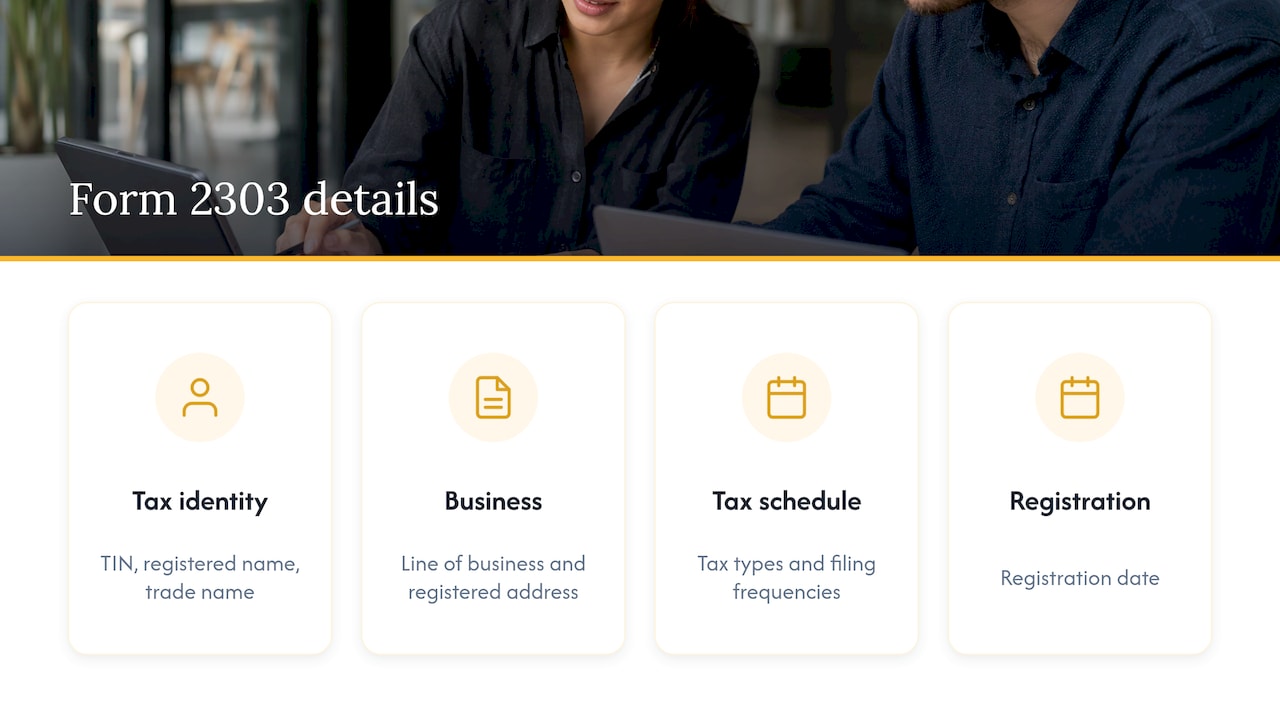
The certificate shows the business’s TIN, its registered name and every business name it trades under, its registered address and RDO, its line of business, the tax types it is registered for, and its registration date. Under Revenue Regulations No. 7-2024, each business name, including the name of an online store, has to be registered with the BIR and shown on the COR, and the business registration date is the date the certificate reflects. Certificates issued since RMC No. 38-2026 of 29 April 2026 also carry a QR code that verifies them online; an older certificate without one does not have to be replaced. The tax types printed on the certificate become your filing calendar.
Registration is also what lets a business issue invoices. Under the Ease of Paying Taxes Act, the invoice is the primary evidence of a sale, for goods and services alike, and official receipts are no longer required (RR 7-2024, Section 6). Doing business without registering is penalized under Section 258 of the Tax Code.
COR, TIN and DTI or SEC registration: how they differ
These get mixed up constantly:
-
TIN (Tax Identification Number): your taxpayer number. A business has one tied to its registration.
-
DTI or SEC registration: gives your business name or company legal existence. DTI covers sole proprietors; SEC covers corporations and partnerships.
-
BIR COR: registers that business as a taxpayer and sets out the taxes it must file.
The DTI or SEC registration comes first. For a new corporation, the TIN and the COR are issued together at BIR registration: the company applies online, pays the ₱30 documentary stamp tax, and downloads both once the RDO approves.
Who needs a COR
Anyone running a business or practicing a profession in the Philippines needs one. That includes sole proprietors, professionals, partnerships, domestic corporations and Philippine branches or representative offices of foreign companies. Self-employed individuals and freelancers who are not under an employer-employee relationship register too, usually on Form 1901, and so do online sellers, including those selling digital goods and services.
The timing rule is simple: register on or before you commence business. The BIR’s Taxpayer Guide on Business Registration reckons commencement from your first sale, or from 30 calendar days after your relevant permit or registration is issued, whichever comes first.
How the COR is issued
A corporation registers with the RDO that covers its principal office, online through the BIR’s Online Registration and Update System (ORUS), filing Form 1903 with its SEC certificate of incorporation, its articles of incorporation and a sample of its own invoice; a sole proprietor or professional files Form 1901. Once the RDO approves and the ₱30 documentary stamp tax is paid, the business downloads its COR, and the BIR’s 2026 Citizen’s Charter gives three days for a corporation registering through ORUS. Our guide to BIR registration for a new corporation covers the deadline, the documents, invoices and the first returns in full.
Extra points for foreign-owned businesses
If you are a foreign founder, the structure you choose upstream shapes the BIR paperwork. A locally incorporated company, foreign-owned or not, registers as a domestic corporation on Form 1903 with its SEC documents. A branch or representative office of an overseas company registers on the strength of its SEC license. Our guide to establishing a business in the Philippines lays out how the SEC step and the BIR step connect, and our incorporation service for foreign founders covers both.
Authority to Print and invoices
Once registered, and before its first sale, a business needs invoices the BIR recognizes: an Authority to Print its own invoices, which is free, or BIR-printed invoices, with a permit or acknowledgement certificate instead where it invoices from a computerized system (RR 7-2024, Section 5(C)). Electronic invoicing becomes mandatory on 31 December 2026 for covered taxpayers only: online sellers above micro size, large taxpayers, and businesses using a computerized accounting system or invoicing software. The RDO also issues the business a Notice to Issue Invoices.
What it costs and how long it takes
The fee picture changed, and plenty of guides online are out of date.
The Philippine Business Hub states that business taxpayers no longer pay the ₱500 Annual Registration Fee and instead pay a ₱30 Documentary Stamp Tax. In practice, that means your COR does not need an annual renewal payment. If a guide tells you to pay ₱500 every January, it predates the change.
Other charges can still apply to specific services, such as a printer’s charge for invoices or the fee of a professional who handles the filing. Korp’s BIR tax registration service is ₱30,000 one-time, BIR fees included.
Processing time has no single answer. It depends on how complete your documents are, how fast you respond if the RDO asks for something, and how busy the district office is. The BIR’s Citizen’s Charter sets the official service standards for each registration route. A clean, complete online application is the best way to keep the timeline short.

Reading your COR: what to check on day one
When the certificate arrives, read every line before you file a thing.
-
Registered name and trade name. They should match your SEC or DTI papers exactly.
-
Registered address. This decides which RDO you report to.
-
Line of business. It should reflect what you really do.
-
Tax types and filing frequencies. These become your monthly, quarterly and annual deadlines.
-
Registration date. It marks the start of your filing obligations.
A wrong tax type on a COR is easy to fix early and painful to fix after months of wrong filings. If anything is off, request an update right away.
Income tax, VAT or percentage tax
Your tax type is not a free choice. VAT registration is mandatory if your expected gross sales or receipts for the next twelve months exceed ₱3,000,000, unless you fall under an exemption. Below that, you are generally subject to percentage tax, but you may opt into VAT. A business that registers for VAT voluntarily cannot cancel it for the next three years, under Section 236(G) of the Tax Code as amended by the Ease of Paying Taxes Act. A company exporting services has to be VAT-registered to zero-rate its export sales. That makes the VAT decision worth thinking through before you submit.
After the COR: obligations that keep you compliant
The certificate is a beginning. Here is what follows.
Display it
Revenue Regulations No. 7-2024 requires the original COR to be posted where the business is conducted, “in a way that is clearly and easily visible to the public.” Each branch and facility is issued its own COR and posts it at its own location; a branch registers with the RDO where it is located, on or before it starts business. A business with no fixed place of business keeps its COR on hand and shows it when a revenue officer asks.
Selling online adds a second rule. The same regulation requires online businesses to post proof of BIR registration on their website, store page or app, and the BIR implemented it through a Registration Seal Badge, displayed in place of the COR itself (RMC No. 38-2026). On 26 October 2026, RMC No. 113-2026 suspended the mandatory display of the badge until further notice. A business that already has a badge may keep showing it, and no penalty is imposed solely for not displaying it.
E-marketplace operators are required to collect each seller’s COR as part of their seller accreditation, so expect a marketplace to ask for it before you can list.
Issue invoices
Issue an invoice from your registered series or system for every sale of ₱500 or more, and for any sale when the buyer asks; a VAT-registered business issues one for every sale, whatever the amount. Issuing an official receipt for a sale in place of an invoice counts as a failure to issue an invoice (RR 11-2024). Keep copies and record them in your books.
File on schedule
Your COR’s tax types set the calendar. Missing filings can trigger penalties even when you owe no tax, so file the return anyway. Our overview of tax and compliance in the Philippines breaks down the usual recurring items.
Update when things change
Changes such as a new address, a new line of business or a new tax type are reported to the BIR through an application for registration update, not just kept on your own records, and every tax type the business becomes liable for is registered. A move to an address under a different RDO is filed at the current RDO, and the business then secures a new COR from the new RDO. Each change shows on the certificate only once the update is approved.
Checking a TIN versus checking a COR
These are two different checks. A TIN verification confirms that a taxpayer number is valid and tied to a registered name. A COR check is different: you look at the certificate itself and confirm that its name, address, TIN and tax types match what the business tells you. A certificate with a QR code can also be verified by scanning it, and the BIR tells relying parties to confirm that the scan opens its official verification domain, verify.bir.gov.ph, before trusting the result (RMC No. 38-2026). If you are the business, make sure the copy you hand over is the current version.
If an employer, client or bank asks you for a COR, they usually want the Form 2303 document, not just your TIN.
Common mistakes that slow down a COR
-
Mismatched names. A trade name spelled differently on the SEC paper and the BIR form triggers delays.
-
Wrong tax type. Picking percentage tax when your sales point to VAT, or the reverse.
-
Incomplete attachments. Blurry scans or missing IDs lead to follow-up requests.
-
No authorization for the representative. If someone files for you, bring the Board Resolution or Secretary’s Certificate.
-
Using old fee information. Paying a ₱500 fee you no longer owe wastes time and money.
-
Registering late. The 30-day window passes fast.
Let us handle the BIR registration for you
Delays around a COR usually come from the steps beside it: a name that does not match the SEC papers, a skipped permit, a tax type picked in a hurry. Korp handles the SEC, BIR and permit steps as one project. Our BIR tax registration service is ₱30,000 one-time, BIR fees included, and our business permit service is ₱20,000 one-time, plus an estimated ₱10,000 deposit toward city hall fees, adjusted to your city’s actual assessment. If you also need the company itself, SEC incorporation of a majority foreign-owned company starts at ₱120,000, and Full Business Registration, covering SEC, BIR and permits, at ₱217,500, both one-time with SEC fees included up to ₱1 million of authorized capital, on our incorporation page for foreign founders. For a Filipino-owned company the same packages start at ₱45,000 and ₱142,500, on our incorporation page.

After registration, a Corporate Secretary is ₱10,000 per month per entity, and a virtual office address is ₱7,500 to ₱10,500 per quarter, depending on the address. Ready to move? Get started with Korp.
FAQ
What is the difference between BIR Form 2303 and the COR?
They are the same document. Form 2303 is the form number, and “Certificate of Registration” is its name. People also say “COR” or “BIR 2303” when they ask for it.
Do I need to renew my BIR COR every year?
No, not for the old annual fee. Business taxpayers are no longer required to pay the ₱500 Annual Registration Fee. You still need to update your registration when material details change and keep filing on time.
Can a foreign-owned company get a BIR COR without visiting an office?
The BIR’s ORUS portal lets registrants file online and download the certificate. A corporation will need its SEC documents first, and a branch of a foreign company needs its Philippine business license. With our service, the process is handled online from start to finish.
Which form do I use to register: 1901 or 1903?
Sole proprietors and professionals use Form 1901. Corporations and partnerships use Form 1903, supported by their SEC certificate and articles, as the BIR’s guide sets out.
Do online sellers have to show their COR?
Revenue Regulations No. 7-2024 requires online businesses to post proof of BIR registration on their website, store page or app, and RMC No. 38-2026 made the BIR Registration Seal Badge that proof, shown in place of the COR. RMC No. 113-2026 suspended the mandatory display of the badge on 26 October 2026, until further notice, and no penalty is imposed solely for not displaying it. The COR itself must still be posted at the place of business.
Sources
-
Revenue Memorandum Circular No. 38-2026, Bureau of Internal Revenue
-
Revenue Memorandum Circular No. 113-2026, Bureau of Internal Revenue