



TL;DR:
- Stock corporations issue shares and can pay dividends; non-stock corporations do neither. Both file a GIS and annual financial statements with the SEC, but audit is now required only above ₱3 million in assets or liabilities — a threshold raised from ₱600,000 in 2026. The decision is effectively permanent: a non-stock corporation cannot convert to stock by amendment, only by dissolving and starting again. Choose on purpose and funding model, not on which sounds more official.
A stock corporation has capital divided into shares and can distribute dividends to its stockholders. A non-stock corporation has no shares and distributes no profits to its members. Which one you register shapes how you raise money, who governs the company, what you file with the Securities and Exchange Commission (SEC), and how the Bureau of Internal Revenue (BIR) taxes you.
It also matters more than most founders expect, because the decision effectively runs one way. A non-stock corporation cannot be converted into a stock corporation by amending its articles — reversing the choice means dissolving and starting again. This guide covers the differences that drive the decision, the compliance each structure carries, and the three misconceptions that most often send founders down the wrong path.
Stock vs non-stock corporation in the Philippines: core differences
The Revised Corporation Code settles it in Section 3: corporations “may be stock or nonstock corporations.” Stock corporations serve profit-generating businesses; non-stock corporations serve charitable, educational, religious, or social purposes. That single distinction is the most important thing to internalize before filing anything with the SEC.
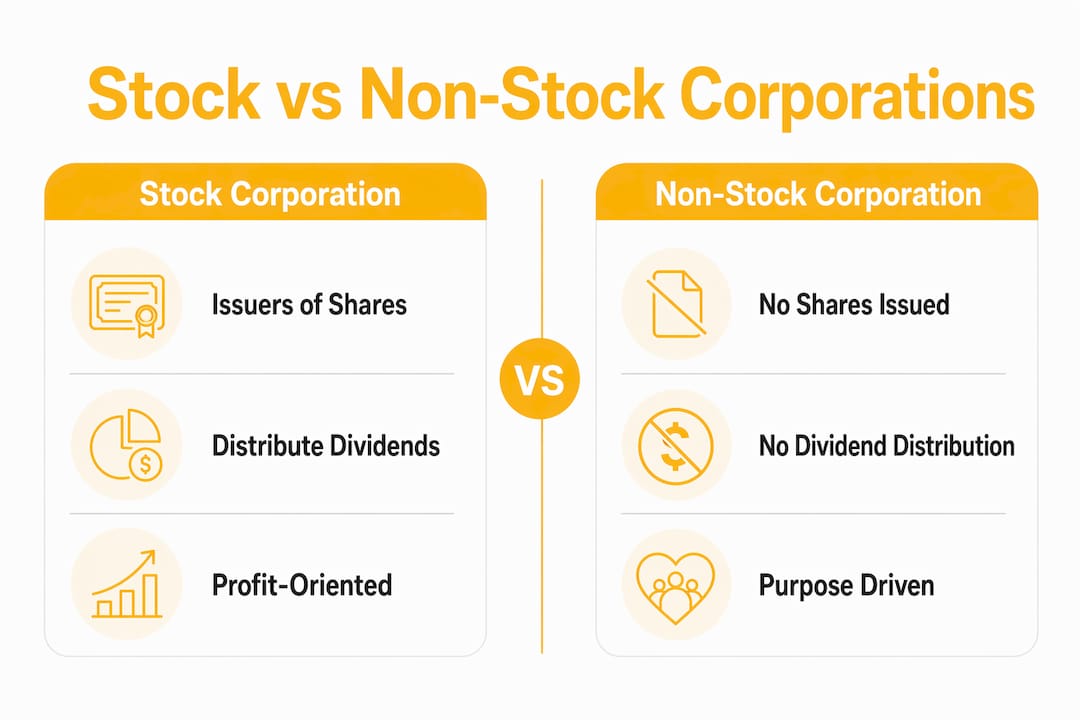
A stock corporation issues shares to its owners, called stockholders. Those stockholders hold an ownership stake proportional to their shares, and the company can legally pay them dividends from profits. Examples include trading companies, consulting firms, and business process outsourcing (BPO) operations.
A non-stock corporation does not issue shares. Its members join based on criteria set in the bylaws, not by purchasing equity. Foundations, associations, and civic clubs are the most common examples. Profits, if any, stay within the organization and fund its stated purpose.

The practical implication is direct: if you plan to raise capital from investors, issue equity, or distribute profits, you need a stock corporation. If your mission is community-driven or non-profit in nature, a non-stock structure fits better.
How do governance structures differ between the two types?
Governance is where the two structures diverge most visibly in day-to-day operations. Under Sections 22 and 23 of the Revised Corporation Code, stock corporations are managed by a Board of Directors elected by shareholders at an Annual Stockholders’ Meeting (ASM). Non-stock corporations are managed by a Board of Trustees elected by members at an Annual Members’ Meeting.
The distinction matters beyond terminology. Directors in a stock corporation answer to shareholders who have financial skin in the game. Trustees in a non-stock corporation answer to members whose stake is mission-based, not monetary. This changes how decisions get made, how disputes arise, and how leadership accountability works.
Here is a quick breakdown of the governance bodies for each type:
Stock Corporation
-
Stockholders elect the Board of Directors
-
Directors appoint corporate officers (President, Treasurer, Corporate Secretary)
-
Annual Stockholders’ Meeting is required by law
-
Two to fifteen incorporators at formation, unless structured as a One Person Corporation (OPC)
Non-Stock Corporation
-
Members elect the Board of Trustees
-
Trustees appoint officers per the bylaws
-
Annual Members’ Meeting is required by law
-
Membership criteria defined by the bylaws, not share ownership
-
No more than 15 incorporators at formation, though membership can grow without limit afterwards
For a deeper look at how to structure your board correctly, Korp has a practical guide on board roles and qualifications under Philippine law.
Pro Tip: Write your bylaws carefully. The bylaws define membership rights, voting procedures, and officer roles. Vague bylaws create governance disputes that are expensive and slow to resolve.
What are the key differences in reporting and compliance?
Both corporation types must meet SEC reportorial requirements. The overlap is significant, but the differences matter for your administrative workload.
Here are the four core compliance obligations shared by both types:
-
General Information Sheet (GIS): Filed annually with the SEC, this discloses directors or trustees, officers, and principal address.
-
Audited Financial Statements (AFS): Both types file annual financial statements with the SEC, but not all of them need an audit. An independent audit is required where total assets or total liabilities exceed ₱3,000,000. Below that, you may file unaudited statements accompanied by a sworn Statement of Management’s Responsibility signed by your authorized officers.
This threshold changed recently. SEC Memorandum Circular No. 4, series of 2026 raised it from ₱600,000, and it applies to financial statements for fiscal years ending on or after 31 December 2025 — so a small corporation that was audited last year may not need to be this year. Corporations classified in Groups A, B or C, and those with public-interest status, are audited regardless of size.
-
Beneficial Ownership Disclosure: The SEC requires disclosure of beneficial ownership information for both stock and non-stock corporations to promote transparency and prevent misuse of corporate entities.
-
Other SEC filings: Changes in officers, amendments to articles of incorporation, and other material events require timely disclosure.
Pro Tip: The SEC and the BIR use different audit triggers. The SEC looks at total assets or liabilities above ₱3 million. The BIR requires audited financial statements with your annual income tax return when gross annual sales or receipts exceed ₱3 million (NIRC §232). Same number, different basis — a low-asset company with high turnover can be exempt from one and caught by the other.
The key difference is that only stock corporations must report share capital information, including authorized capital stock, subscribed capital, and paid-up capital. Non-stock corporations skip this entirely because no shares exist.
| Compliance Requirement | Stock Corporation | Non-Stock Corporation |
|---|---|---|
| General Information Sheet (GIS) | Required | Required |
| Annual Financial Statements | Required | Required |
| Share Capital Reporting | Required | Not required |
| Beneficial Ownership Disclosure | Required | Required |
| Dividend Declaration Reporting | Required | Not applicable |
| Independent audit of FS | Required above ₱3M in assets or liabilities | Required above ₱3M in assets or liabilities |
Stock corporations face more complex compliance due to investor relationships and share transactions. That added layer of reporting is a real operational cost. Budget time and professional fees accordingly.
What legal nuances and misconceptions should entrepreneurs know?
Several widespread misconceptions about Philippine corporation types lead entrepreneurs into compliance traps. Getting these wrong costs time, money, and sometimes your registration.
Misconception 1: Non-stock corporations are automatically tax-exempt.
This is the most common and damaging error. Non-stock corporations are not tax-exempt by default. Tax exemption requires a separate application and approval from the Bureau of Internal Revenue (BIR). Non-stock status describes ownership and profit distribution structure, not tax treatment. A foundation that skips BIR registration assuming it is exempt will face back taxes, penalties, and interest.
Misconception 2: A One Person Corporation is a non-stock structure.
Under Section 116 of the Revised Corporation Code, the One Person Corporation is strictly a stock corporation with a single stockholder. It must comply with stock corporation capital structures and reporting obligations. Solo founders sometimes assume that because they are the only member, the OPC resembles a non-stock setup. It does not. OPCs are unsuitable for non-profit or charitable missions.
Two OPC rules catch solo founders out. First, an OPC must designate a nominee and an alternate nominee in its articles of incorporation — named, with residence address, contact details, and the extent and limits of their authority — and both must consent in writing before you file. They take the single stockholder’s place as director on death or incapacity, and the SEC will not register an OPC without them.
Second, the OPC form is closed to certain businesses altogether: banks and quasi-banks, preneed, trust and insurance companies, public and publicly-listed companies, and non-chartered government-owned corporations. A licensed professional also cannot use an OPC to practice their profession unless a special law allows it — an architect can own an OPC that sells something else, but not one that practices architecture.
Misconception 3: Perpetual existence is automatic.
Perpetual existence is the default corporate term under the Revised Corporation Code — you no longer need to renew it, and it is not something annual filings earn you. What filings protect is the registration itself. Missed GIS or AFS submissions expose a corporation to administrative sanctions and, ultimately, revocation.
Staying current with 2026 regulatory requirements is not optional for either structure.
Pro Tip: Apply for BIR tax exemption at the same time you register your non-stock corporation with the SEC. Starting both processes together cuts months off your timeline.
How do you choose between a stock and non-stock corporation?
The right choice depends on your business purpose, funding strategy, and long-term governance appetite. Use this framework to decide.
Match your purpose to the structure
If your primary goal is generating profit and distributing returns to owners or investors, a stock corporation is the correct choice. If your goal is advancing a cause, providing community services, or operating a membership-based organization without profit distribution, a non-stock corporation fits.
Consider your funding and investor strategy
Stock corporations can issue shares to raise capital. This makes them the right vehicle for startups seeking venture funding, businesses with multiple investors, or any company planning to scale through equity financing. Non-stock corporations cannot offer equity to funders. They rely on donations, grants, membership fees, and program revenues.
Evaluate governance complexity
Stock corporations carry more governance and reporting obligations because shareholders have financial rights that the law protects. If you want a leaner administrative structure and your mission does not require equity, a non-stock setup reduces that burden.
Here is a practical comparison to guide your decision:
| Factor | Stock Corporation | Non-Stock Corporation |
|---|---|---|
| Primary purpose | Profit generation | Non-profit or social mission |
| Ownership structure | Shares held by stockholders | Membership defined by bylaws |
| Profit distribution | Dividends allowed | No profit distribution to members |
| Capital raising | Can issue shares | Relies on donations or grants |
| Compliance complexity | Higher (share capital reporting) | Lower (no share capital filing) |
| Tax exemption | Not applicable | Must apply separately with BIR |
| Best for | Trading, consulting, BPO, startups | Foundations, associations, clubs |
Checklist before you decide:
-
Do you plan to distribute profits to owners? Choose stock.
-
Do you need to issue equity to investors? Choose stock.
-
Is your mission charitable, educational, or civic? Choose non-stock.
-
Do you want a single-owner structure? Use an OPC (stock corporation).
-
Are you applying for BIR tax exemption? Plan for non-stock, then file separately with BIR.
For a full breakdown of all corporate structure options in the Philippines, including foreign entity setups and partnerships, Korp has a comprehensive guide worth reading before you file.
Can you change your mind later?
In one direction only — and that is the strongest reason to get this right before you file.
A non-stock corporation cannot become a stock corporation by amending its articles of incorporation. The SEC’s Office of the General Counsel addressed this directly in Opinion No. 22-14: conversion by amendment would amount to distributing the corporation’s assets to its members, and would defraud donors who gave to a non-profit.
The only available route is to dissolve the non-stock corporation, liquidate its assets under the statutory distribution rules — which generally means they pass to another organization with a similar purpose rather than to your members — and then incorporate a new stock corporation from scratch. New registration, new TIN, new permits, new bank accounts, and assets that may not follow you.
So if there is any realistic prospect that your organization will one day want investors, equity or profit distribution, the non-stock route is not a reversible experiment. Choose it because the mission fits, not because it looks simpler at registration.
Key takeaways
Choosing the right corporation type in the Philippines requires matching your ownership model, profit goals, and compliance capacity to either a stock or non-stock structure from day one.
| Point | Details |
|---|---|
| Core distinction | Stock corporations issue shares and pay dividends; non-stock corporations do neither. |
| Governance bodies | Stock corporations use a Board of Directors; non-stock corporations use a Board of Trustees. |
| Shared compliance | Both must file a GIS and annual financial statements with the SEC. Audit is required only above ₱3 million in assets or liabilities. |
| Tax exemption myth | Non-stock corporations must apply separately to the BIR for tax-exempt status. |
| OPC classification | A One Person Corporation is always a stock corporation, regardless of single ownership. |
| The choice is one-way | A non-stock corporation cannot convert to stock by amendment. Reversing it means dissolution and re-incorporation. |
Why most entrepreneurs get this decision backwards
A consistent pattern shows up among founders setting up in the Philippines: most start with the structure they have heard of, not the one that fits their actual business. They register a stock corporation because it sounds more “official,” even when they are running a membership association or a foundation. Or they assume non-stock means simpler and cheaper, without realizing the BIR exemption process adds its own timeline and paperwork.
The real mistake is treating the stock versus non-stock comparison as a formality. It is not. Your corporate structure determines how you raise money, how you pay your team, how you report to the SEC, and how the BIR taxes you. Getting it wrong means restructuring later, which is expensive and disruptive.
The practical test: write down your five-year plan before picking a structure. If that plan includes investors, equity splits or profit sharing, you need a stock corporation. If it includes grant funding, donor relationships or a community mission, go non-stock and budget for the BIR exemption application from day one.
The governance burden is the part most articles skip. A stock corporation with multiple shareholders requires proper ASM documentation, share transfer records and capital reporting. That is real administrative work. If you are not ready for it, either appoint a corporate secretary or use a platform that handles it. Governance gaps are a leading cause of Philippine corporations losing good standing with the SEC.
Ready to register your corporation in the Philippines?
Picking the right structure is step one. Getting it properly registered with the SEC and the BIR is where most entrepreneurs lose momentum. Korp handles both, whether you are setting up a stock corporation for a profit-driven venture or a non-stock entity for a foundation or association.

Korp’s incorporation services cover the full registration process, from SEC filing to BIR tax registration, permits, and ongoing compliance support. The platform guides you through every step in a single workflow, so you are not chasing multiple agencies or piecing together requirements on your own. If you are a foreign entrepreneur, Korp also offers incorporation support for foreigners with guidance specific to Philippine foreign equity rules. Visit Korp’s solutions page to see the full range of registration and compliance services available.
FAQ
What is the main difference between a stock and non-stock corporation?
A stock corporation issues shares and can distribute dividends to stockholders, while a non-stock corporation has no shares and cannot distribute profits to its members. The distinction determines ownership structure, governance, and how the entity raises capital.
Are non-stock corporations tax-exempt in the Philippines?
Non-stock corporations are not automatically tax-exempt. Tax exemption requires a separate application and approval from the Bureau of Internal Revenue (BIR), independent of SEC registration.
Can a One Person Corporation be a non-stock corporation?
No. A One Person Corporation is strictly classified as a stock corporation under Philippine law and must comply with all stock corporation capital and reporting requirements.
Can a non-stock corporation be converted into a stock corporation?
Not by amending the articles of incorporation. SEC OGC Opinion No. 22-14 confirms that a non-stock corporation cannot convert directly, because it would improperly distribute assets to members. The alternative is to dissolve the non-stock corporation, liquidate its assets under the statutory rules, and incorporate a new stock corporation — effectively starting over.
What annual filings do both corporation types share?
Both stock and non-stock corporations must file a General Information Sheet (GIS) and annual financial statements with the SEC each year to maintain legal standing. The statements must be independently audited only where total assets or total liabilities exceed ₱3 million. Below that, unaudited statements with a sworn Statement of Management’s Responsibility are accepted.
Which corporation type is better for a startup seeking investors?
A stock corporation is the correct choice for startups seeking investors because it can issue shares to raise capital and distribute dividends. Non-stock corporations cannot offer equity to funders.