



Yes, a foreigner can own 100% of a Philippine corporation, provided two conditions hold. The business activity must not appear on the negative list in the Philippines, formally the Foreign Investment Negative List, and the company must either export at least 60% of its output or have enough paid-in capital: US$200,000 for most domestic market enterprises, or US$100,000 under three specific routes. This guide explains how to read the list, which activities it restricts, and how to work out where your company stands before you incorporate.
Key Takeaways
- The current list is the 13th Regular Foreign Investment Negative List, issued under Executive Order No. 113 in April 2026.
- An activity not on the list is open to up to 100% foreign ownership, subject to capital rules and other laws.
- Below US$200,000 in paid-in capital, a domestic market enterprise is capped at 40% foreign ownership. The threshold drops to US$100,000 on three routes, and an export enterprise has none.
- Software and IT services, business process outsourcing and consulting for private clients are not on the list.
- Where a cap applies, Philippine nationals must hold the rest of the capital, and control must follow ownership.
What the Foreign Investment Negative List Is
The Foreign Investment Negative List (FINL) is the government's list of business activities in which foreign ownership is limited or barred. The President issues it under Section 8 of the Foreign Investments Act (RA No. 7042), as amended by RA Nos. 8179 and 11647, on the recommendation of the Department of Economy, Planning, and Development (DEPDev). An activity that is not on the list is open to foreign investment, subject to the capital rules below and to any other law that governs it.
The current version is the 13th Regular Foreign Investment Negative List, promulgated by Executive Order No. 113 on 13 April 2026 and published on 17 April 2026. It took effect fifteen days after publication and replaced the 12th list, issued under Executive Order No. 175 in 2022.
The list has two parts:
- List A covers activities where the Constitution or a specific law limits foreign ownership. It can be amended at any time to reflect a change in the law.
- List B covers activities restricted for reasons of security, defense, risk to health and morals, and the protection of small and medium-scale enterprises. It may not be amended more often than once every two years.
The 13th Negative List at a Glance
The table groups the main entries by the maximum foreign equity allowed. The full list in the annex to EO No. 113 gives the legal basis for each entry, and its footnotes carry exceptions that matter.
If Your Activity Is Not on the List
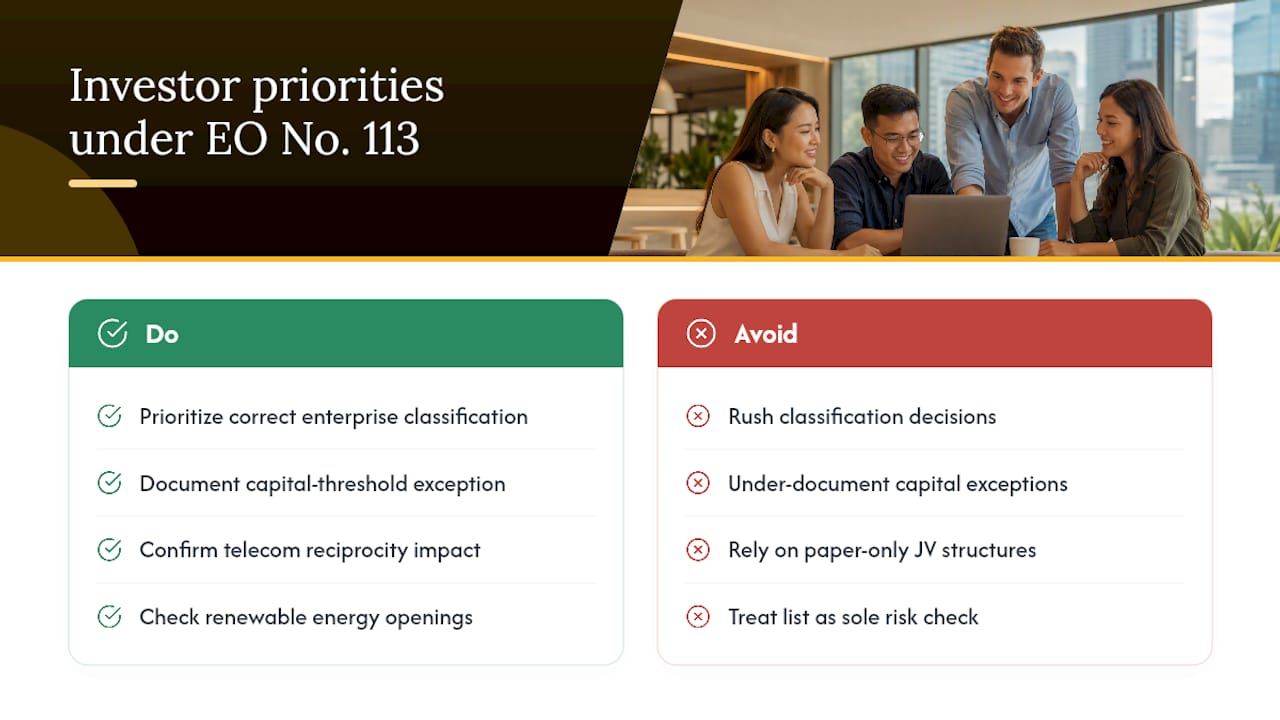
Software and IT services, business process outsourcing and consulting for private clients do not appear on the 13th list. For activities like these, the deciding factor is capital, not the list.
List B caps a micro or small domestic market enterprise with paid-in capital below US$200,000 at 40% foreign ownership. A company that wants more than 40% foreign ownership has three routes:
- Paid-in capital of at least US$200,000. Paid-in means capital actually paid into the company, not authorized capital stock.
- Paid-in capital of at least US$100,000, if the enterprise involves advanced technology as determined by the Department of Science and Technology (DOST), is endorsed as a startup or startup enabler under the Innovative Startup Act (RA No. 11337), or has at least 15 direct employees, a majority of them Filipino. These routes are set by RA No. 11647.
- Export status. An export enterprise, one that exports at least 60% of its output, may be up to 100% foreign-owned with no minimum paid-in capital, provided its activity is not on List A or List B. Export status is a continuing obligation: the company registers with the Board of Investments and reports on its export ratio, and one that falls short can be ordered to reduce its domestic sales to 40% of total production.
Each route has its own documentation. Our guide to the US$200,000 minimum capital requirement covers what each one takes.
If Your Activity Is on the List
A cap on the list applies whatever the company's capital or export ratio. Three points follow from it.
- Philippine nationals must hold the rest. In a 40% activity, at least 60% of the capital must be owned by Philippine nationals.
- Control follows ownership. In a partly nationalized activity, the Anti-Dummy Law (Commonwealth Act No. 108) limits foreign board seats to the allowable foreign equity and prohibits arrangements that give foreigners control beyond it. In a public utility, all executive and managing officers must also be Filipino citizens.
- Some entries carry their own conditions. A foreign retailer needs paid-up capital of at least ₱25 million under RA No. 11595, at least ₱10 million invested per store if it operates more than one, and a country of origin that does not bar Filipino retailers. Renewable energy, including solar, wind, hydro, and ocean or tidal energy, is carved out of the natural resources cap and allows full foreign participation.
Public Utility or Public Service?
The 40% cap on public utilities covers a defined set of activities. RA No. 11659, which amended the Public Service Act in 2022, limits "public utility" to six activities: distribution of electricity, transmission of electricity, petroleum and petroleum products pipeline transmission, water and wastewater pipeline systems, seaports, and public utility vehicles.
Other public services fall outside the constitutional cap. One limit remains: under Section 25 of RA No. 11659, foreign nationals may not own more than 50% of an entity operating critical infrastructure unless their country grants reciprocity to Philippine nationals. The telecommunications entry on the 13th list applies that rule.
How to Check Your Activity in Four Steps
- Describe the activity precisely. The list reads activities, not industries. Consulting for private clients is open; government procurement of consulting services is capped at 40%.
- Read List A and List B, including the footnotes. Exceptions such as recording under mass media, or renewable energy under natural resources, sit in the entry text and its notes.
- If the activity is not listed, settle the capital route. Decide whether the company is a domestic market enterprise or an export enterprise, then confirm which paid-in capital threshold applies.
- Check the other laws the activity touches. The list sets ownership limits. Sector regulators can still impose licensing conditions of their own before the company operates.
Which Korp Package Fits Your Ownership
Korp's incorporation for foreign founders follows the same line the Negative List draws:
- Mixed Ownership (40% foreign or less) for activities capped at 40% or lower that still allow foreign equity, and for domestic market companies below the US$200,000 capital threshold.
- Majority Foreign (more than 40%) for activities off the list, where the company meets a capital route or qualifies as an export enterprise.
Companies owned entirely by Filipinos incorporate through Korp's standard incorporation. Each package comes as a Starter, covering SEC incorporation only, or a Full Setup, covering full business registration.
Get started with your company's details, and settle the ownership structure before anything is filed with the SEC.
Frequently Asked Questions
Can a foreigner own 100% of a company in the Philippines?
Yes, if the company's activity is not on the Foreign Investment Negative List and the company either has paid-in capital of at least US$200,000, qualifies for the US$100,000 threshold, or exports at least 60% of its output.
What is the minimum capital for a foreign-owned company in the Philippines?
A domestic market enterprise more than 40% foreign-owned needs paid-in capital of at least US$200,000. The threshold drops to US$100,000 for enterprises involving advanced technology as determined by the DOST, endorsed startups and startup enablers, and enterprises with at least 15 direct employees, a majority of them Filipino. An export enterprise whose activity is not on List A or List B has no minimum.
What is the current Foreign Investment Negative List?
The 13th Regular Foreign Investment Negative List, promulgated by Executive Order No. 113 on 13 April 2026. It took effect fifteen days after its publication on 17 April 2026 and replaced the 12th list issued under Executive Order No. 175 in 2022.
What is the difference between List A and List B?
List A covers activities where the Constitution or a specific law limits foreign ownership, and it can be amended at any time to reflect a change in the law. List B covers activities restricted for security, defense, health and morals, or the protection of small and medium-scale enterprises, and it may not be amended more often than once every two years.
Can a foreign-owned company provide consulting services in the Philippines?
Consulting for private clients is not on the Negative List, so it is open to foreign ownership subject to the capital rules. Government procurement of consulting services is capped at 40% foreign equity.
Can foreigners own land in the Philippines?
Ownership of private land is capped at 40% foreign equity, so a corporation that owns land must be at least 60% owned by Philippine nationals. The list makes an exception for a natural-born Filipino who has lost Philippine citizenship.
Sources
- Executive Order No. 113, s. 2026, with the 13th Regular Foreign Investment Negative List (Official Gazette)
- RA No. 7042, Foreign Investments Act of 1991 (Lawphil)
- RA No. 11647, amending the Foreign Investments Act (Lawphil)
- RA No. 11659, amending the Public Service Act (Lawphil)
- RA No. 11595, amending the Retail Trade Liberalization Act (Lawphil)
Recommended
- Korp.ph | Incorporation in the Philippines for Foreign Companies: How to Avoid the USD 200,000 Minimum Capital Requirement
- Korp.ph | Anti-Dummy Law guide for startups in the Philippines
- Korp.ph | What Is the Cost to Set Up a Foreign-Owned Corporation in the Philippines
- Korp.ph | Foreign-Owned Domestic Corporation vs Branch Office in the Philippines