



TL;DR:
- Singapore and the Philippines are usually presented as an either/or. Both allow up to 100% foreign ownership in most sectors, so the real differences are capital, tax and speed. Singapore: flat 17% tax, S$1 minimum capital, days to incorporate, deep investor access. The Philippines: far lower operating costs, 25% tax (20% for small domestic corporations, as low as 5% for registered export projects), and a US$200,000 capital requirement waived entirely for exporters. The strongest structures use Singapore for the cap table and the Philippines for operations — planned early, not retrofitted.
The Philippines versus Singapore for SMEs is usually framed as a choice between two countries. For most founders it is not. Singapore offers regulatory predictability, a flat 17% corporate tax rate and one of Asia’s deepest capital markets. The Philippines offers substantially lower operating costs, a large and fast-growing domestic market, and incentives that can reduce tax to 5% or nothing for registered export projects. Both permit up to 100% foreign ownership in most sectors — the differences that matter are capital requirements, speed to trade, and what you are actually trying to fund. This guide covers both, and the hybrid structure that uses each for what it does best.
How do costs and operational expenses compare for SMEs in the Philippines and Singapore?
The Philippines is approximately 62% cheaper than Singapore in overall cost of living as of Q2 2026, with rent running 73% lower. That gap is not just a lifestyle statistic. For an SME, it translates directly into how long your runway lasts and how quickly you can hire.

Labor costs tell an even sharper story. Philippine agencies deliver high-volume creative production at one-third to one-fifth of comparable Singaporean labor costs for services like content creation, customer support, and digital marketing. A dedicated mid-sized Manila team costs roughly the same as hiring one senior consultant in Singapore. For SMEs in early growth stages, that difference can fund an entire department.
Rent compounds the advantage further. Office space in Metro Manila or Cebu runs a fraction of what you would pay in Singapore’s central business district. A serviced office in Makati that costs PHP 25,000 per month would be the equivalent of a hot-desk membership in Raffles Place. The savings free up capital for product development, marketing, and hiring.
That said, lower sticker prices do not mean lower total cost. Singapore’s compliance infrastructure is more predictable, which reduces the risk of unexpected fines or regulatory delays. You need to factor in nominee director fees, Corporate Service Provider (CSP) retainers, and annual filing costs when calculating Singapore’s true operating expense.
The Philippines has a number of its own that comparisons routinely leave out, and it is the largest one a foreign founder faces. A foreign-owned company serving the Philippine domestic market must put in US$200,000 of paid-in capital. Singapore’s minimum is S$1.
That gap closes for export-oriented businesses. A company exporting at least 60% of its output is exempt entirely and can be 100% foreign-owned with no minimum capital. If you are building a service business selling to clients abroad — which describes most BPO, creative and software operations — the US$200,000 does not apply to you. If you are selling into the Philippine market, it does, and it changes the arithmetic considerably. We break the full figure down in our guide to the cost of setting up a foreign-owned corporation in the Philippines.
Pro Tip: Calculate your total cost of ownership across both markets before committing. Include nominee director fees, CSP retainers, BIR compliance costs, and local permit renewals. The cheapest incorporation fee rarely reflects the actual annual cost of staying compliant.
What are the regulatory differences SMEs face in the Philippines and Singapore?
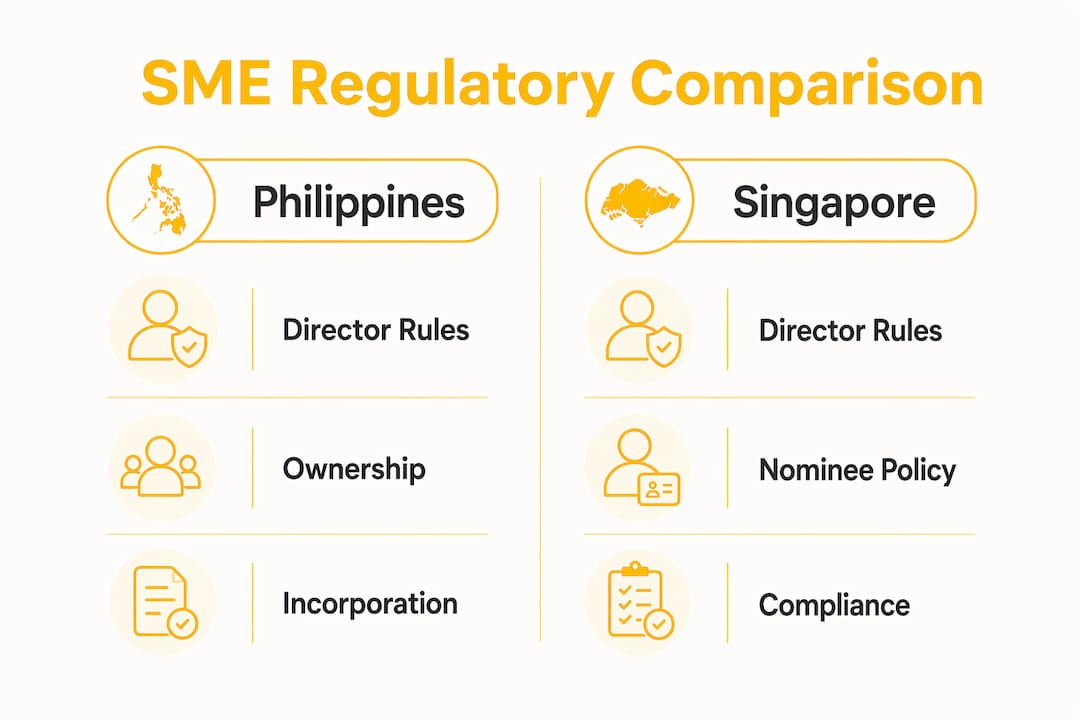
| Factor | Philippines | Singapore |
|---|---|---|
| Director requirements | Filipino or foreign directors allowed; foreign equity caps apply in certain sectors | At least one director ordinarily resident in Singapore (Companies Act 1967); resident company secretary within six months; local registered office |
| Incorporation timeline | SEC incorporation alone: typically 7 to 10 days. Complete registration — SEC, BIR tax registration, LGU business permits and government contribution registrations — typically 6 weeks or more | ACRA incorporation alone: often 1 to 3 business days online. Full operating readiness — resident company secretary, GST registration where applicable, CPF for employees — takes longer |
| Foreign ownership | Up to 100% permitted by default. Restricted only where the Constitution, the Foreign Investment Negative List (13th list, EO 113 s. 2026) or a specific law says otherwise — land and public utilities are reserved to entities at least 60% Filipino-owned, and mass media is closed. Retail is open, subject to capital thresholds | 100% foreign ownership permitted in most sectors |
| Minimum paid-in capital | US$200,000 for a foreign-owned domestic market enterprise; US$100,000 with advanced-tech certification, endorsed startup status, or ≥15 Filipino employees. Export enterprises selling ≥60% abroad are exempt — 100% foreign, no minimum | S$1 |
| Tax incentives | CREATE MORE (RA 12066): Income Tax Holiday, then 5% Special CIT or Enhanced Deductions, plus VAT zero-rating — for projects registered with an Investment Promotion Agency such as BOI or PEZA | Startup SG Tech grants up to S$500,000 for qualifying tech companies |
| Ongoing compliance | BIR filings, SEC annual reports, local government permits | Annual return filing, GST registration if applicable, ACRA compliance |
| Corporate income tax | 25% standard; 20% for domestic corporations with net taxable income ≤₱5M and total assets ≤₱100M excluding land | Flat 17%, with Start-Up Tax Exemption on the first S$200,000 of chargeable income for the first three years |
| Consumption tax | 12% VAT; registration mandatory above ₱3M annual sales or receipts | 9% GST; registration mandatory above S$1M annual taxable turnover |
Singapore has required every company to have at least one director ordinarily resident in Singapore since the Companies Act 1967, alongside a resident company secretary appointed within six months and a local registered office. The Corporate Service Providers Act 2024 did not create that requirement. It regulates the providers who supply nominee directors and registered addresses, tightening the due diligence they must perform.
For a foreign founder with no resident director of their own, engaging a licensed CSP is the practical route to satisfying the Companies Act — and it is a recurring cost that founders routinely underestimate when comparing incorporation quotes.
The Philippines operates under a different logic. Incorporation is more complex procedurally, involving the Securities and Exchange Commission (SEC), the Bureau of Internal Revenue (BIR), and local government units. This is also where most timeline comparisons mislead. Getting a company incorporated with the SEC takes roughly 7 to 10 days. Getting it registered and able to trade — BIR, business permits, government contributions — takes six weeks or more. Singapore’s headline “incorporate in a day” figure covers only the equivalent of the first step. Compare like with like, or the gap looks far wider than it is. Korp prices the two separately for exactly that reason — SEC incorporation on its own, or the full registration through to trading.
The trade-off is what that complexity buys. The CREATE MORE tax incentive framework rewards companies that invest in local production, employment, and export capability. If your SME qualifies, the tax savings can be substantial. Foreign entrepreneurs should review the foreign company registration process carefully before assuming Philippine incorporation is simply slower or harder than Singapore.
Pro Tip: Get local professional guidance before you incorporate in either country. In Singapore, the CSP you choose shapes your compliance experience. In the Philippines, early BIR registration errors create a frustrating correction loop that costs time and money to fix.
How accessible is financing for SMEs in the Philippines versus Singapore?
Financing access is where the two markets diverge most sharply, and it matters more than most founders expect.
-
Singapore’s VC ecosystem includes over 1,000 active VC and PE firms with no nationality restrictions for investors, making it one of the most accessible capital markets in Asia for foreign-founded SMEs.
-
Startup SG Tech provides government grants of up to S$500,000 for qualifying technology companies, reducing the pressure to dilute equity in early rounds.
-
Philippine SME growth is strong on paper. 79% of Philippine SMEs reported growth in 2025, and 89% expect growth in 2026. CPA Australia’s Asia-Pacific Small Business Survey, covering 4,166 businesses across 11 markets, also found that 64% required external funding, and the Philippines ranks among the lowest in the region for ease of SME finance access.
-
Philippine financing options typically require significant local collateral, relationships with government-backed programs like the Small Business Corporation (SB Corp), or access to Development Bank of the Philippines (DBP) credit lines. These programs exist but involve more friction than Singapore’s private capital markets.
-
Foreign ownership is not the differentiator here. Both countries permit up to 100% foreign equity in most sectors. What differs is capital — S$1 in Singapore against US$200,000 for a foreign-owned company serving the Philippine domestic market, waived for exporters.
The practical implication is clear. If you need institutional capital in the next 12 to 24 months, Singapore gives you a shorter path to it. If you are bootstrapping or relying on revenue-based growth, the Philippines’ cost structure makes that strategy more viable for longer.
What sectors offer the best growth opportunities for SMEs in each country?
The sector fit between the two markets is distinct, and choosing the wrong market for your industry is a costly mistake.
-
Professional services and financial technology thrive in Singapore, where the Monetary Authority of Singapore (MAS) provides a well-defined licensing framework and international clients expect Singapore-registered counterparts.
-
Information and communications technology benefits from Singapore’s infrastructure, talent pipeline from the National University of Singapore (NUS) and Nanyang Technological University (NTU), and proximity to regional enterprise clients.
-
Wholesale trade and logistics favor Singapore’s port infrastructure and free trade agreements, which cover over 25 countries and blocs including the United States, the European Union, and ASEAN.
-
Creative production, content, and digital services are natural fits for the Philippines, where English proficiency, cultural adaptability, and lower labor costs make high-volume output economically viable.
-
Manufacturing and export-ready production in the Philippines benefits directly from the CREATE MORE framework, which the Department of Trade and Industry (DTI) actively promotes to Singapore SMEs looking for a cost-efficient production base.
-
Customer experience and business process outsourcing remain a Philippine strength, with Metro Manila, Cebu, and Davao all offering established talent pools and infrastructure.
-
E-commerce and digital retail work in both markets but with different dynamics. Singapore provides access to higher-spending consumers and regional logistics hubs. The Philippines offers a rapidly growing domestic market of over 115 million people with accelerating mobile commerce adoption.
The SMEs Go Digital program in Singapore and the CREATE MORE framework in the Philippines both signal government intent to accelerate SME digitization. Founders who align their sector with these policy priorities gain access to grants, tax relief, and preferential procurement opportunities.
How can SMEs build a hybrid strategy using both the Philippines and Singapore?
The most sophisticated founders do not choose between the two markets. They use both, and the structure matters.
-
Singapore as your HQ gives you a high-integrity legal address for investor relations, contract signing, and regional market access. Singapore’s tax treaties, transparent governance, and internationally recognized legal system make it the preferred holding company location for ASEAN-focused businesses.
-
The Philippines as your operational hub handles creative production, customer support, content delivery, and back-office functions at a fraction of Singapore’s cost. The DTI actively encourages this model, positioning the Philippines as a production base for Singapore-headquartered SMEs.
-
Hybrid structures avoid the single-market trap. Operating solely in Singapore burns cash fast. Operating solely in the Philippines limits your investor credibility and capital access. The hybrid model captures the strengths of both without the worst trade-offs of either.
-
Common pitfalls include CSP modular traps. Some founders sign up for a Singapore CSP package that bundles nominee director services, registered address, and compliance filings at a low monthly rate, only to discover that scaling the structure requires expensive add-ons. Read the contract before you sign.
-
The Anti-Dummy Law limits nominee arrangements. If your Philippine entity operates in a partly nationalised activity, Commonwealth Act 108 caps foreign participation in management and the board to your allowable equity share, and prohibits using Filipino nominees to hold shares on a foreigner’s behalf. A hybrid structure that leans on nominee shareholdings is the one version of this model that creates genuine legal exposure. What the Anti-Dummy Law actually prohibits is worth reading before you design the structure, not after.
-
Transfer pricing and intercompany agreements between your Singapore HQ and Philippine subsidiary require proper documentation. Tax authorities in both countries scrutinize related-party transactions, and getting this wrong creates liability on both ends.
Singapore-based founders planning a Philippine expansion should review how to structure their Philippine operations before incorporating, since the entity type you choose affects your tax exposure, foreign equity limits, and compliance obligations for years.
Pro Tip: Before setting up a hybrid structure, get a tax opinion covering both jurisdictions. The savings from lower Philippine operating costs can be partially offset by transfer pricing adjustments or withholding taxes if the intercompany arrangement is not properly documented from day one.
Key takeaways
The most effective SME market strategy in Southeast Asia combines Singapore’s investor credibility with the Philippines’ cost-efficient operational capacity, structured through a deliberate hybrid corporate model.
| Point | Details |
|---|---|
| Cost advantage is decisive on operations | Operating costs run far lower in the Philippines, with labour a fraction of Singapore rates — but foreign-owned domestic market companies face a US$200,000 capital requirement that Singapore does not impose. |
| Singapore wins on capital access | Over 1,000 active VC and PE firms and government grants like Startup SG Tech make Singapore the superior fundraising base. |
| Regulatory complexity differs | Singapore requires a resident director under the Companies Act; the Philippines requires US$200,000 paid-in capital for foreign-owned domestic market companies, waived for exporters. |
| Sector fit drives the decision | Singapore leads in fintech, professional services, and ICT; the Philippines excels in creative production, BPO, and digital services. |
| Hybrid structures outperform single-market plays | Using Singapore as HQ and the Philippines as an operational hub avoids high burn rates and limited investor access simultaneously. |
Why the “either/or” framing on this decision costs founders money
Most articles frame the Philippines versus Singapore choice as binary. In practice, the businesses that scale well across Southeast Asia rarely treat it that way. They use Singapore for the cap table and the Philippines for the cost structure, and they build the legal bridge between the two early rather than retrofitting it under pressure.
The most common expensive mistake is incorporating in Singapore because it sounds credible, then spending down the runway on Singapore salaries for work that could be done in Manila at a fraction of the cost. By the time the problem is obvious, the company is too cash-constrained to set up a Philippine subsidiary properly. The hybrid model only works when it is planned before it is needed.
The second is underestimating Philippine regulatory complexity. The Philippines is not difficult because it is poorly designed. It is complex because registration runs through several agencies, each with its own sequence and timelines. Treating it as a single checkbox is what produces compliance gaps that take months to unwind. Reviewing practical guidance for foreign founders before starting saves both time and money.
A reasonable rule of thumb: if institutional capital is the goal within the next 18 months, start with Singapore. If the business runs on talent and volume, start with the Philippines and add Singapore when the investor conversation becomes real. Either way, the structure is cheaper to design early than to correct later.
How Korp can help you set up your SME in the Philippines
If the Philippines is part of your market entry plan, whether as your primary base or as the operational arm of a hybrid structure, getting the incorporation and compliance right from day one is non-negotiable.

Korp specializes in company registration and compliance for both local and foreign entrepreneurs in the Philippines. From SEC incorporation and BIR tax registration to ongoing compliance filings and virtual office support, Korp handles the full setup in a single guided workflow. You do not chase agencies or piece together advice from multiple providers. Foreign founders can also explore incorporation services for foreigners to understand exactly what is required before committing. If you are ready to move, Korp is built to get you there without the paperwork headaches.
FAQ
Is the Philippines or Singapore cheaper for SME operations?
Operating costs are substantially lower in the Philippines — cost-of-living comparisons put the gap at roughly 62%, with rent around 73% lower and labour a fraction of Singapore rates. The exception is capital: a foreign-owned company serving the Philippine domestic market must put in US$200,000 of paid-in capital, against S$1 in Singapore. Exporters selling at least 60% abroad are exempt.
Can a foreigner own 100% of a company in the Philippines?
Yes, in most cases. The Foreign Investments Act allows up to 100% foreign equity by default. Restrictions apply only where the Constitution, the Foreign Investment Negative List or a specific law limits them — land and public utilities are reserved to entities at least 60% Filipino-owned, and mass media is closed to foreign equity. Retail is open, subject to capital thresholds. The practical constraint for most founders is not ownership but capital: a foreign-owned domestic market enterprise needs US$200,000 in paid-in capital, while an export enterprise selling at least 60% abroad is exempt entirely.
What is the CREATE MORE framework in the Philippines?
CREATE MORE (RA 12066) expanded the Philippines’ fiscal incentives regime. Qualifying projects registered with an Investment Promotion Agency — BOI, PEZA and others, under Fiscal Incentives Review Board oversight — can access an Income Tax Holiday, followed by either a 5% Special Corporate Income Tax or an Enhanced Deductions Regime, plus VAT zero-rating on eligible purchases. Registration with an IPA is the gate: investing in local production does not by itself qualify a company.
How does Singapore’s Startup SG Tech grant work for SMEs?
Startup SG Tech provides government grants of up to S$500,000 for qualifying technology companies in Singapore, reducing early-stage equity dilution and supporting rapid scaling within Singapore’s startup ecosystem.
What is a hybrid SME strategy combining the Philippines and Singapore?
A hybrid strategy uses Singapore as the holding company and HQ for investor relations and market credibility, while the Philippines serves as the operational hub for cost-efficient production, creative services, and customer support.