



TL;DR:
The Philippines ranks first in the 2026 Ataraxis Global Outsourcing Talent Index, ahead of Malaysia and India, scoring 90 on English proficiency against India’s 60.
A hybrid model combining India’s technical expertise with the Philippines’ communication strengths offers a competitive advantage.
The Philippines ranks first in the 2026 Ataraxis Global Outsourcing Talent Index, published by the offshore staffing firm Ataraxis Management, outranking India on both English proficiency and digital infrastructure. For Indian outsourcing executives, this creates a direct opportunity: expand your outsourcing business from India to the Philippines and capture the communication and cultural strengths that your Indian operations cannot fully replicate. The winning model is not replacement. It is a hybrid approach that pairs India’s engineering depth with the Philippines’ customer-facing excellence, giving your firm a competitive edge across both technical and communication-heavy service lines.
What unique advantages does the Philippines offer for specific outsourcing roles?
The Philippines ranked No.1 globally in the Ataraxis Global Outsourcing Talent Index 2026, scoring 90 on English proficiency versus India’s 60. That gap is not a minor statistical difference. It translates directly into measurable performance on voice support, client communication, and customer-facing roles where accent neutrality and cultural fluency matter to Western clients.

The role differentiation between the two countries is clear. Philippines outsourcing strengths center on customer support, back-office administration, marketing operations, and any function requiring sustained written or verbal communication. India’s strengths remain in software development, IT infrastructure, and technical engineering. Trying to force one country to do the other’s best work is the most common and costly mistake Indian executives make.
Pro Tip: When evaluating which roles to move to the Philippines, map your current client complaints first. If the issues cluster around communication quality or responsiveness, those are your Philippine candidates.
| Function | Best location | Primary reason |
|---|---|---|
| Voice customer support | Philippines | English proficiency, cultural alignment |
| Software development | India | Deeper technical talent pool |
| Back-office administration | Philippines | Large IT-BPM talent pool, cost efficiency |
| IT infrastructure management | India | Mature technical ecosystem |
| Marketing and content operations | Philippines | Western cultural familiarity |
What legal and operational steps must Indian companies address first?
Setting up operations in the Philippines requires deliberate legal and compliance groundwork. Two corporate structures are available to an Indian firm: a domestic corporation registered with the SEC, or a branch office of the Indian parent. Each carries different capital requirements, tax obligations and timelines. A third route often presented alongside them — an Employer of Record — is not a corporate structure at all, and it is worth being precise about why.
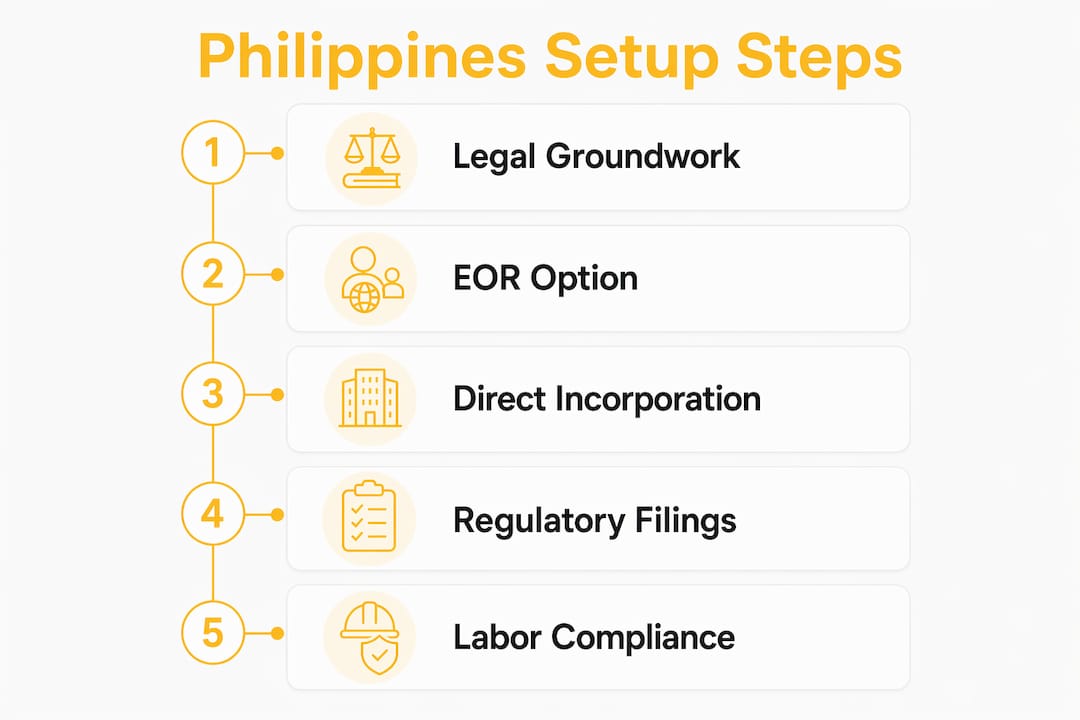
An Employer of Record is not a corporate structure — it is a contract with a third party who becomes the legal employer of your Filipino staff. It can work as a bridge for a small team on a defined runway, and it carries a real constraint worth knowing before you sign. DOLE Department Order No. 174-17 absolutely prohibits labor-only contracting, which is what an arrangement becomes when the provider does not genuinely exercise the right of control over the work, or lacks substantial capital while supplying staff who perform your core business. A legitimate contractor must hold at least PHP 5,000,000 in paid-up capital and be registered with DOLE; failure to register raises a legal presumption that the arrangement is labor-only contracting. If it is recharacterized, your Indian parent is treated as the direct employer of Philippine staff, with no local entity through which to manage that exposure. For an outsourcing firm whose Filipino team will do the core client work, the entity route is the one that holds. We have written a fuller comparison in EOR vs own entity in the Philippines.
For firms ready to incorporate directly, the key regulatory bodies are the Securities and Exchange Commission (SEC) for company registration, the Bureau of Internal Revenue (BIR) for tax registration, and the local government unit (LGU) for business permits. You can read a detailed breakdown of the BPO incorporation process to understand each step before committing resources.
| Setup option | Time to launch | Best for |
|---|---|---|
| Employer of Record (EOR) | 1–4 weeks to first hire | A short, defined bridge only — see the constraints above |
| Domestic corporation (export enterprise) | 1 day–3 weeks for SEC; 2–4 months for full operational readiness | Any BPO billing ≥60% offshore — 100% foreign ownership, no USD 200,000 minimum |
| Domestic corporation (domestic market) | 1 day–3 weeks for SEC; 2–4 months for full operational readiness | Serving Philippine clients; USD 200,000 paid-in capital applies above 40% foreign ownership |
| Branch office | 2–12 weeks for SEC; 3–6 months for full operational readiness | An Indian parent that needs the Philippine operation to remain part of the same legal entity |
The SEC’s own OneSEC service targets one-day approval, and eSPARC regular processing advises status within seven working days. RA 11032 caps every agency at three, seven or twenty working days by complexity, so where a launch slips it is almost always incomplete documents or the LGU inspection sequence rather than agency turnaround.
The Philippine Labor Code governs employment contracts, mandatory benefits, and termination procedures. Filipino employees are entitled to Social Security System (SSS) contributions, PhilHealth coverage, and Pag-IBIG Fund contributions from day one. Payroll compliance is non-negotiable and must be built into your operational budget before you hire your first employee.
How do you build a Philippine outsourcing office step by step?
A structured expansion process prevents the most expensive mistakes. The steps below reflect what actually works for Indian firms entering the Philippine market, not a generic checklist.
-
Conduct role-specific market research. Identify which of your current service lines depend most on communication quality, client interaction, or back-office volume. These are your Philippine candidates. Early role-specific decisions yield better talent outcomes than generic country-level choices.
-
Choose your entry structure. For most Indian outsourcing firms this is a domestic corporation registered as an export enterprise — the fastest route that actually creates a Philippine entity, and at 60% or more offshore billing it carries no minimum paid-in capital. A branch office keeps the operation inside the Indian parent but adds a PHP 500,000 securities deposit under Section 143 of the Revised Corporation Code and a lower audit threshold. The branch office setup guide covers the SEC filing requirements and capital thresholds in detail.
-
Register your legal entity. File with the SEC, register with the BIR, and secure your LGU business permit. Each agency has its own timeline and document requirements. Missing one step creates a correction loop that delays your entire launch.
-
Set up your registered address. Section 13 of the Revised Corporation Code requires your articles of incorporation to state a principal office located in the Philippines, and SEC Memorandum Circular No. 16, s. 2014 requires it to be specific down to the street and barangay — a city name alone is no longer accepted. A virtual office address meets this. The LGU stage is different: a business permit requires a Fire Safety Inspection Certificate under Section 7 of the Fire Code (RA 9514), and depending on the LGU and your declared line of business, a sanitary permit, zoning clearance or ocular inspection as well. Whether a virtual-office agreement is accepted there in place of a conventional lease varies by city, so confirm it with the LGU before you file.
-
Recruit and onboard your Philippine team. Use local job platforms and recruitment agencies familiar with the IT-BPM sector. Filipino professionals in the outsourcing industry expect structured onboarding, clear KPIs, and regular feedback cycles.
-
Integrate with your Indian operations. Establish shared communication tools, overlapping working hours, and escalation protocols between your Indian and Philippine teams. The hybrid outsourcing model works best when both teams operate as one coordinated unit, not two separate silos.
Pro Tip: Schedule a weekly cross-country sync between your Indian and Philippine team leads for the first six months. Most coordination failures in new offshore offices are not strategic — they are unshared context, and a standing meeting is the cheapest fix available.
Budget before you commit to a structure. Build your model on wages plus statutory costs, not on headline savings percentages. The Philippine Statistics Authority’s 2024 Occupational Wages Survey puts the average monthly wage for general office clerks at PHP 19,721, and the Information and Communications sector — the highest-paying industry surveyed — at PHP 43,676. On top of base pay, budget for SSS, PhilHealth and Pag-IBIG employer shares, 13th-month pay, and statutory leave. Provider rate cards quoting USD per hour bundle salary, overhead and margin together, so they are not comparable to a wage figure and should not be used as one.
What mistakes do Indian companies make when expanding to the Philippines?
The most damaging mistake is treating the Philippines as a direct copy of your Indian operations. The management styles, communication norms, and workplace expectations differ in ways that are not obvious from the outside.
-
Role mismatch: Assigning software development or complex IT architecture work to Philippine teams without deliberate screening and training leads to productivity loss. Building specialist software teams in the Philippines requires more investment than in India because the technical ecosystem is less mature.
-
Choosing on cost alone: The Philippines offers real cost savings, but selecting providers or staff purely on price produces the same quality problems you were trying to escape. Evaluate communication skills, industry experience, and cultural fit alongside rates.
-
Ignoring retention strategy: Filipino outsourcing professionals respond strongly to career development programs, clear promotion paths, and recognition. Attrition runs high across every offshore delivery market, so treat retention as something you build rather than something the location supplies.
-
Underestimating compliance complexity: Philippine regulatory requirements are specific and enforced. Missing BIR deadlines or failing to register mandatory employee benefits creates fines and reputational risk.
“In Deloitte’s survey, 67% of organizations reported adopting outcome-based outsourcing models that prioritize measurable results and innovation.” — Deloitte, The power of a multidimensional workforce, April 2026
That shift matters for Indian firms. Your Philippine office should be built around talent outcomes, not just headcount arbitrage. The firms winning in 2026 are the ones treating their Philippine teams as a strategic capability, not a cost line.
Key takeaways
Expanding from India to the Philippines works best when you match roles to each country’s strengths and treat the two operations as one integrated unit.
| Point | Details |
|---|---|
| Philippines leads in communication roles | English proficiency score of 90 versus India’s 60 makes the Philippines the clear choice for customer-facing work. |
| Hybrid model is the standard | Pair India’s engineering depth with the Philippines’ communication strengths for full operational coverage. |
| The entity route is the one that holds | An EOR can bridge a short, defined period, but DOLE Department Order No. 174-17’s prohibition on labor-only contracting makes it unsuitable where Filipino staff perform your core client work. |
| Export enterprises can be 100% foreign-owned | A BPO billing at least 60% offshore is an export enterprise, exempt from the USD 200,000 minimum paid-in capital that applies to domestic-market foreign ownership. |
| Compliance comes first | Hiring through your own entity means SEC, BIR and LGU registration all precede your first hire — as do SSS, PhilHealth and Pag-IBIG employer registrations. |
What separates the firms that make this work
Two patterns are visible in how Indian outsourcing firms approach the Philippines. One treats it as a lower-cost version of an existing Bangalore or Hyderabad operation. The other treats it as a distinct capability that completes an existing service offering. The second performs better, and the reasons are structural rather than cultural.
Cultural alignment with Western clients is the factor most often underestimated at the planning stage. Where it registers is account performance: client satisfaction scores, contract renewals, and the time a new account takes to reach full productivity.
The Philippine IT-BPM sector is mature, which means a new office is not starting from scratch. There is an established talent pipeline, industry training infrastructure, and a workforce that already understands outsourcing norms.
The firms that succeed apply the same rigor to the Philippine office that they applied to their Indian operations: correct legal setup, structured onboarding, and deliberate role design. The firms that cut corners on compliance or skip the integration work spend their first year correcting it.
The India-Philippines hybrid is an operating structure rather than a trend. It delivers 24-hour coverage, role-optimized talent allocation, and consistent client experience across both technical and communication-heavy service lines.
How Korp can help you set up in the Philippines
Setting up a compliant Philippine entity is the step that most Indian outsourcing executives underestimate. The paperwork is specific, the agencies are multiple, and a single missed filing can delay your entire launch by months.

Korp handles company registration, BIR tax enrollment, LGU permits, and ongoing compliance filings through a single guided workflow. For Indian firms expanding offshore, Korp’s company registration solutions cover everything from initial SEC incorporation to corporate secretary support and virtual office services. You can also explore incorporation services for foreign companies if you are setting up a subsidiary or branch. Korp’s team knows the Philippine regulatory environment and moves fast so you can focus on building your team, not chasing agencies.
FAQ
What is the best corporate structure for Indian firms entering the Philippines?
A domestic corporation is the route that fits an outsourcing firm. A BPO billing at least 60% offshore qualifies as an export enterprise, which can be 100% foreign-owned with no minimum paid-in capital. A branch office keeps the Philippine operation inside the Indian parent entity but costs more in capital terms. An Employer of Record creates no entity at all and carries the labor-only contracting constraints described above.
Which outsourcing roles are best suited for the Philippines?
Customer support, back-office administration, marketing operations, and any communication-heavy function perform best in the Philippines. Software development and IT infrastructure roles remain stronger in India.
How should Indian firms model Philippine labor costs?
Build the comparison on wages plus statutory costs rather than headline percentages. The Philippine Statistics Authority’s 2024 Occupational Wages Survey puts general office clerks at PHP 19,721 per month and the Information and Communications sector at PHP 43,676. Provider rate cards quoted in USD per hour bundle salary, overhead and margin together, so they are not comparable to a wage figure.
What Philippine government agencies must Indian companies register with?
Companies must register with the Securities and Exchange Commission (SEC), the Bureau of Internal Revenue (BIR), and the relevant local government unit (LGU) for business permits.
Can an Indian outsourcing firm own 100% of its Philippine company?
Yes, if it qualifies as an export enterprise — exporting at least 60% of its output or revenue. Under the Foreign Investments Act as amended by RA 11647, an export enterprise can be up to 100% foreign-owned with no minimum paid-in capital. A company serving mainly Philippine clients is a domestic market enterprise, and above 40% foreign ownership the USD 200,000 minimum applies.