
Many foreign entrepreneurs mistakenly believe that retiree visas automatically authorize them to work and operate businesses in the Philippines. This misconception leads to compliance violations, visa cancellations, and disrupted operations. Choosing the right visa aligned with your employment and investment intentions is essential for legal business activity and long-term residency in the Philippines.
Table of Contents
- Introduction To Philippine Visas For Foreign Entrepreneurs
- Overview Of Visa Types Relevant For Foreign Entrepreneurs
- Work Authorization And Business Compliance Under Different Visas
- Comparative Analysis: Which Visa Fits Your Entrepreneurial Needs?
- Practical Steps To Secure Your Visa While Setting Up Business
- Common Misconceptions And Legal Pitfalls To Avoid
- Summary And Next Steps For Foreign Entrepreneurs
- How Korp.ph Supports Your Philippine Business Journey
Key takeaways
| Point | Details |
|---|---|
| Different visas grant distinct work and residency rights | The 9(g) employment visa allows legal work, while the Special Investor’s Resident Visa (SIRV) offers indefinite stay without employment rights. |
| Investment thresholds vary significantly by visa type | SIRV requires USD 75,000 minimum investment, whereas the 9(g) visa requires company sponsorship with no capital requirement. |
| Compliance and timely renewals prevent legal issues | Maintaining accurate documentation and renewing visas before expiry avoids penalties, cancellations, or deportation. |
| Coordinating visa applications with business registration streamlines setup | Simultaneous processing reduces delays and ensures legal operation from day one. |
Introduction to Philippine visas for foreign entrepreneurs
The Philippine visa system presents unique challenges for foreign entrepreneurs seeking to establish and operate businesses. Selecting the appropriate visa category is not merely administrative but directly impacts your ability to legally work, manage operations, and maintain residency status. 25% of visa applications face delays or denials due to incomplete compliance, underscoring the importance of informed preparation.
Foreign entrepreneurs typically encounter several obstacles when navigating Philippine immigration. Documentation requirements are extensive and vary by visa type. Processing timelines can extend from weeks to months depending on government workload and application completeness. Many entrepreneurs also operate under misconceptions about visa privileges, particularly regarding work authorization under investment or retiree visas.
Operating a business on tourist visas or mismatched visa categories carries serious risks. Immigration authorities actively monitor foreign nationals engaging in unauthorized employment or business activities. Violations result in fines, visa revocations, deportation, and potential bans on future entry. Understanding which visa categories align with your entrepreneurial goals protects both your legal status and business continuity.
Key challenges include:
- Legal compliance with employment and immigration regulations
- Delays caused by incomplete or inaccurate documentation
- Misunderstanding visa privileges and work authorization limits
- Coordinating visa timelines with business registration milestones
- Managing renewal requirements to avoid lapses in legal status
Pro Tip: Begin your visa research and document preparation at least six months before your planned move to the Philippines. Early preparation allows time to address unexpected requirements or delays without jeopardizing your business launch timeline.
Overview of visa types relevant for foreign entrepreneurs
Foreign entrepreneurs in the Philippines have three primary visa options depending on their work intentions and investment capacity. Each visa type serves distinct purposes and carries specific eligibility criteria, benefits, and limitations.
9(g) Pre-arranged Employment Visa
The 9(g) visa is designed for foreign nationals employed by Philippine companies. This visa requires sponsorship from a registered Philippine employer and grants legal work authorization. Validity periods range from one to two years, with renewals processed through the Bureau of Immigration. The 9(g) visa suits entrepreneurs actively managing operations and drawing salaries from their Philippine companies.
Key features:
- Requires employment contract and sponsorship from Philippine company
- Grants legal work authorization tied to sponsoring employer
- Renewable every one to two years depending on contract terms
- No minimum investment requirement but company must meet capitalization rules
- Allows multiple entries during validity period
Special Investor’s Resident Visa (SIRV)
The SIRV targets foreign investors making substantial capital commitments to Philippine businesses. This visa requires a minimum USD 75,000 investment in a government-approved enterprise and offers indefinite residency. However, SIRV holders do not receive automatic work authorization and must apply for separate employment permits if they wish to actively manage operations.
Key features:
- Minimum USD 75,000 investment in qualified Philippine enterprise
- Indefinite residency with no need for periodic renewals
- Multiple entry privileges for visa holder and immediate family
- No default work authorization requires separate permits for employment
- Investment must be maintained throughout residency period
Special Resident Retiree’s Visa (SRRV)
The SRRV caters to retirees but attracts some entrepreneurs due to its long-term residency benefits. Eligibility and deposit requirements vary by age, nationality, and program track. While the SRRV offers extended stay privileges, it does not grant work authorization without additional permits, making it less suitable for entrepreneurs intending active business involvement.
| Visa Type | Investment Requirement | Work Authorization | Residency Duration | Renewal |
|---|---|---|---|---|
| 9(g) Employment | None (company sponsorship) | Yes, tied to employer | 1-2 years | Required |
| SIRV | USD 75,000 minimum | No (separate permit needed) | Indefinite | Not required |
| SRRV | Variable by age/track | No (separate permit needed) | Long-term, multi-entry | Periodic compliance |
Work authorization and business compliance under different visas
Understanding work rights and compliance obligations under each visa type prevents legal violations and operational disruptions. Work authorization is not universal across visa categories, and entrepreneurs must align their visa choice with intended business activities.
9(g) Visa Work Rights
The 9(g) visa explicitly grants work authorization, but only for the sponsoring employer named in the visa application. Holders cannot legally work for other companies or engage in separate business ventures without obtaining additional permits. Employment terms, job titles, and salaries listed in visa applications must match actual practice. Immigration authorities conduct audits and non-compliance results in visa cancellations.
SIRV and SRRV Work Limitations
SIRV holders reside in the Philippines based on investment, not employment. They may own businesses and receive dividends but cannot actively work without applying for Alien Employment Permits (AEP) through the Department of Labor and Employment. Similarly, SRRV holders are classified as retirees. Engaging in employment activities requires separate work permits and compliance with labor regulations. Many entrepreneurs mistakenly assume investment or retiree visas permit business management, leading to immigration violations.

Ongoing Compliance Obligations
All visa holders must maintain compliance with Philippine immigration and tax laws. This includes:
- Timely visa renewals and payment of associated fees
- Accurate employment records and contract documentation
- Tax filings and compliance with Bureau of Internal Revenue requirements
- Reporting address changes and employment status updates
- Maintaining minimum investment thresholds for SIRV holders
Pro Tip: Maintain a dedicated compliance calendar tracking visa renewal dates, tax filing deadlines, and permit expirations. Missing deadlines triggers penalties and complicates future applications, potentially disrupting your business operations.
Comparative analysis: which visa fits your entrepreneurial needs?
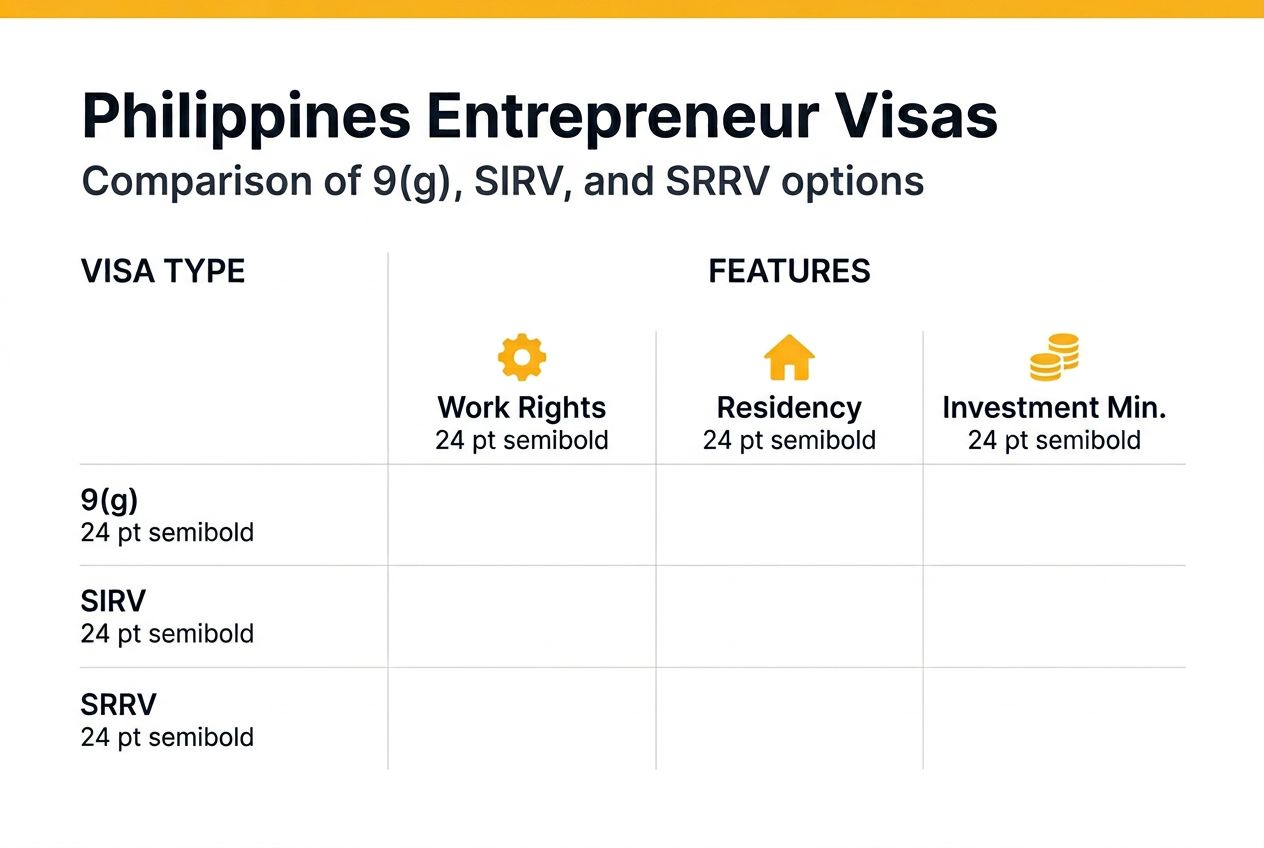
Choosing between the 9(g), SIRV, and SRRV depends on your specific business model, investment capacity, and work involvement. A structured comparison clarifies which visa aligns with your entrepreneurial circumstances.
| Feature | 9(g) Employment Visa | SIRV | SRRV |
|---|---|---|---|
| Investment Minimum | None (sponsorship required) | USD 75,000 | Variable (age/program dependent) |
| Work Authorization | Yes, for sponsoring employer | No (requires separate AEP) | No (requires separate permit) |
| Residency Duration | 1-2 years (renewable) | Indefinite | Long-term, multi-entry |
| Renewal Complexity | Moderate (annual or biennial) | None | Periodic compliance checks |
| Family Inclusion | Dependent visas available | Spouse and dependents included | Spouse and dependents included |
| Best For | Active entrepreneurs managing operations | Passive investors seeking residency | Retirees or those prioritizing stay over work |
Decision Framework
If you plan to actively manage daily operations, hire employees, and draw a salary, the 9(g) employment visa is your optimal choice. It provides clear work authorization and aligns with hands-on entrepreneurship. The renewal process is straightforward for compliant employers, and many foreign entrepreneurs successfully operate under 9(g) status for years.
If you have substantial capital and prefer passive investment with indefinite residency, the SIRV offers stability without renewal hassles. However, you must commit to the USD 75,000 investment threshold and recognize that active management requires additional permits. This visa suits investors who own businesses but delegate operations to local managers.
The SRRV is rarely ideal for active entrepreneurs due to work authorization limitations. It benefits those prioritizing long-term residency for retirement planning or those with minimal business involvement.
Pro Tip: Consult with an immigration lawyer or business services provider before committing to a visa type. Your choice impacts not only legal status but also tax obligations, business structure requirements, and operational flexibility for years to come.
Practical steps to secure your visa while setting up business
Coordinating visa applications with business registration ensures efficient, compliant establishment. Follow these steps to streamline the process and avoid delays.
-
Define your business and employment intentions. Determine whether you will actively manage operations (requiring work authorization) or invest passively. This decision guides visa selection and business structure.
-
Assess investment capacity for SIRV eligibility. If you have USD 75,000 or more available and prefer indefinite residency, explore SIRV options. Verify investment qualifies under government criteria and prepare capital transfer documentation.
-
Prepare comprehensive documentation for both visa and business registration. Required documents typically include passport copies, birth certificates, police clearances, business plans, financial statements, and employment contracts. Gather these simultaneously to avoid sequential delays.
-
Apply for your chosen visa with proper sponsorship or investment proofs. For 9(g) visas, your Philippine company must be registered and capable of issuing employment contracts before visa application. For SIRV, investment must be deposited and verified by appropriate government agencies.
-
Align visa issuance timing with business registration milestones. Coordinate with your company registration service provider to ensure your business is legally operational when your visa is approved. This alignment allows immediate lawful business activity upon arrival or status change.
-
Register your company and obtain necessary permits. Foreign company registration in the Philippines involves multiple agencies including the Securities and Exchange Commission and Bureau of Internal Revenue. Business licensing requirements vary by industry and location, so research your specific obligations early.
-
Maintain detailed records and compliance calendars. From day one, track visa validity dates, permit expirations, tax filing deadlines, and renewal requirements. Proactive management prevents lapses that trigger penalties or operational disruptions.
Common misconceptions and legal pitfalls to avoid
Many foreign entrepreneurs operate under false assumptions about Philippine visa privileges, leading to compliance violations and legal consequences. Clearing up these misconceptions protects your business and residency status.
SRRV Does Not Grant Automatic Work Authorization
The most prevalent misconception is that retiree visas permit business activities. SRRV holders may own businesses but cannot legally work without separate Alien Employment Permits. Immigration authorities enforce this distinction, and violations result in visa cancellations and potential deportation.
Tourist Visas Are Not Business Visas
Some entrepreneurs enter the Philippines on tourist visas intending to operate businesses while arranging proper documentation. This approach is illegal. Tourist visas explicitly prohibit employment and business activities. Immigration audits target foreign nationals working on tourist status, and penalties include fines, blacklisting, and deportation.
Timely Renewals and Document Accuracy Are Non-Negotiable
25% of visa applications face delays or denials due to incomplete compliance. Missing renewal deadlines or submitting inaccurate information triggers lengthy correction processes. In serious cases, authorities cancel visas entirely, forcing entrepreneurs to leave the country and reapply from abroad.
Consequences of non-compliance include:
- Visa cancellations requiring departure and reapplication
- Fines and penalties for unauthorized employment
- Deportation and bans on future entry
- Disruption of business operations and contractual obligations
- Legal liability for employing unauthorized foreign nationals
“Proper visa selection and compliance are the foundation of sustainable business operations in the Philippines. Entrepreneurs who prioritize legal status from day one avoid costly disruptions and build businesses with confidence.”
To avoid pitfalls, consult official sources and experienced professionals. The Korp.ph blog offers resources on business registration, compliance, and operational best practices. Understanding why the Philippines attracts foreign businesses helps contextualize visa strategies within broader market opportunities.
Summary and next steps for foreign entrepreneurs
Navigating Philippine visas requires matching visa types to your specific work intentions and investment capacity. The 9(g) employment visa suits active entrepreneurs managing daily operations. The SIRV benefits passive investors with substantial capital seeking indefinite residency. The SRRV serves retirees or those prioritizing long-term stay over work authorization.
Key actions for successful visa acquisition and business establishment:
- Choose your visa based on whether you need work authorization or prefer investment-based residency
- Prioritize legal compliance from day one, including timely renewals and accurate documentation
- Coordinate visa applications with business registration to launch operations without delays
- Seek professional guidance from immigration lawyers or business services providers for complex cases
- Maintain detailed compliance calendars tracking all deadlines and requirements
Starting your Philippine business journey with the right visa foundation ensures legal operation, protects your residency status, and positions your venture for long-term success.
How Korp.ph supports your Philippine business journey
Establishing legal residency while launching your Philippine business involves coordinating multiple government agencies and complex requirements. Korp.ph specializes in company registration and compliance solutions that simplify this process for foreign entrepreneurs. Our team coordinates visa applications with business setup, ensuring your company is legally registered and operational when your visa is approved.

We handle company incorporation for foreign entrepreneurs, tax registration, permit acquisition, and ongoing compliance filings through a single integrated platform. This eliminates the fragmentation and delays common when working with multiple service providers. Our expertise in Philippines business registration and compliance helps you navigate immigration requirements alongside corporate obligations, reducing complexity and accelerating your market entry. Many foreign entrepreneurs trust Korp.ph to manage the technical details while they focus on building their businesses.
FAQ
What is the difference between the 9(g) visa and the Special Investor’s Resident Visa?
The 9(g) is an employment visa that grants work authorization for a specific sponsoring employer, renewable every one to two years. The SIRV is an investment visa requiring USD 75,000 minimum capital commitment, offering indefinite residency without automatic work rights.
Can I work under the Special Resident Retiree’s Visa?
The SRRV does not automatically authorize employment or active business management. If you wish to work, you must apply for separate Alien Employment Permits through the Department of Labor and Employment while maintaining your retiree visa status.
How can I renew my visa without disrupting my business operations?
Begin renewal applications at least two months before your visa expires. Maintain complete compliance documentation including tax records, employment contracts, and business permits. Engaging immigration professionals or comprehensive services ensures timely processing and prevents operational disruptions.
Is it possible to change from an SRRV to a 9(g) employment visa?
Changing visa types is possible but requires meeting eligibility criteria for your target visa category. For the 9(g) visa, you need a sponsoring Philippine employer and employment contract. The process involves submitting a new application rather than converting your existing visa status.