

TL;DR:
UnionBank offers a fully digital account opening tailored for Philippine SMEs and firms.
Two main account types suit different business sizes and cash flow needs, from startups to scaling companies.
Proper preparation of documents and compliance are vital for quick approval and smooth onboarding.
Opening a corporate bank account in the Philippines has a reputation for being slow, paper-heavy, and branch-dependent. That reputation is outdated. UnionBank has built a digital-first banking path that lets SMEs and entrepreneurs set up a corporate account seamlessly. This guide covers everything you need: which account type fits your business stage, what documents to prepare, how the online application works, what it costs, and how UnionBank stacks up against alternatives. If you want to move fast and stay compliant, you’re in the right place.
Table of Contents
-
Types of UnionBank corporate accounts: Which fits your business?
-
Document requirements and compliance: What you need to prepare
-
Step-by-step process: How to open your UnionBank corporate account online
-
Our take: What most business owners get wrong about corporate banking in the Philippines
Key Takeaways
| Point | Details |
|---|---|
| Online setup advantage | UnionBank lets Philippine entrepreneurs open a corporate account entirely online. |
| Right account for your needs | Choose between Biz Starter or BizCheck based on your business stage and transaction volume. |
| Compliance is crucial | Ensuring all documents are prepared and verified speeds up your approval process. |
| Competitive local features | UnionBank excels for SMEs versus other traditional banks in the Philippines. |
Why choose UnionBank for your corporate account?
Not all Philippine banks treat business owners the same way. Most still require in-person visits, stacks of notarized documents, and a waiting game that can stretch for weeks. UnionBank made a deliberate shift away from that model, and it shows.
UnionBank was the first Philippine bank to enable branchless business account opening, making it a genuine game-changer for entrepreneurs who value time. Its UB Negosyante platform handles MSME and small business accounts entirely online, while The Portal serves larger corporations with more complex treasury needs. You apply, upload documents, and get access, all through your device.
The bank’s credibility is backed by results, not just marketing. UnionBank has been recognized as Best Bank for SMEs and Best Mobile Banking Tech, two awards that reflect real service performance. When you’re choosing where to park your company’s funds and run daily transactions, that kind of track record matters.
Here’s what makes UnionBank stand out for Philippine entrepreneurs:
-
Digital setup: Apply online via UB Negosyante (MSMEs) or The Portal (corporations), no branch visit needed
-
Fast onboarding: Initial access granted quickly; full access follows after document review
-
Award-winning app: Recognized for mobile banking technology and SME support
-
Local expertise: Built specifically for the Philippine business environment, including BIR-linked features
-
PDIC coverage: All accounts are insured up to PHP 500,000 by the Philippine Deposit Insurance Corporation
“UnionBank’s digital-first approach is not just a feature. It’s a signal that the bank understands how modern entrepreneurs actually work.”
If you’re in the process of deciding whether to open a corporate bank account in the Philippines, UnionBank should be near the top of your shortlist, especially if speed and compliance are priorities.
Types of UnionBank corporate accounts: Which fits your business?
With UnionBank’s credentials established, let’s compare their actual corporate banking products and who each is best for.
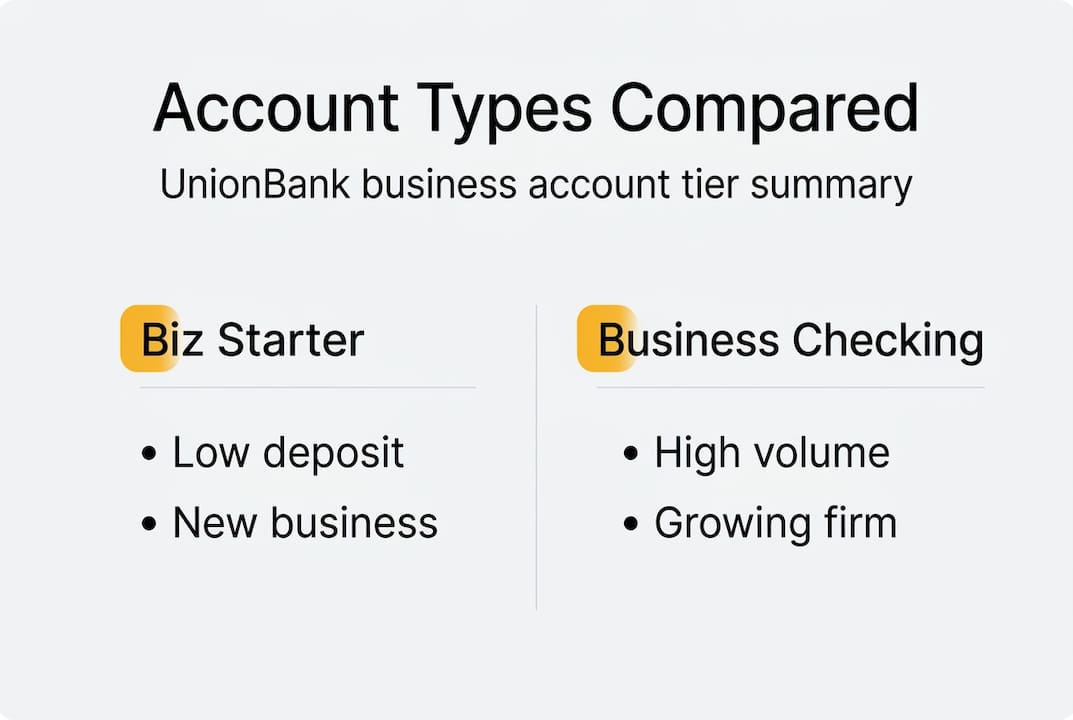
UnionBank offers two primary account tiers for businesses, and the right choice depends on your transaction volume, growth stage, and how much capital you’re working with. Picking the wrong tier means either over-committing capital or missing out on features you actually need.
The two main account types are Biz Starter and Business Checking/Check, each designed for a different business stage. Larger corporations with more sophisticated banking needs can also use The Portal platform, which supports advanced digital treasury management.
| Feature | Biz Starter | Business Checking |
|---|---|---|
| Opening deposit | PHP 5,000 | PHP 100,000 |
| Average daily balance (ADB) | PHP 5,000 | PHP 100,000 |
| Fall-below fee | PHP 1,000 | Varies |
| Best for | Startups, MSMEs | Scaling businesses |
| Check issuance | No | Yes |
| PDIC insurance | Up to PHP 500,000 | Up to PHP 500,000 |
Biz Starter is where most new entrepreneurs should begin. The low entry point makes it accessible, and the digital features are more than sufficient for early-stage operations. Once your business scales and you need check-writing capability or higher transaction thresholds, Business Checking becomes the logical upgrade.

The Portal is a separate layer entirely. It’s designed for corporations that need multi-user access, approval workflows, and real-time treasury visibility. Think of it as enterprise-level banking built into an app.
Pro Tip: Before choosing your account type, estimate your average monthly balance over the next six months. If you can reliably maintain PHP 5,000, Biz Starter is a cost-effective start. If your cash flow is more variable, build in a buffer to avoid fall-below fees.
Make sure your business is properly registered before applying. If you haven’t finalized your structure yet, reviewing company incorporation services can help you sort that out first.
Document requirements and compliance: What you need to prepare
Choosing the right account type is step one. Gathering the right documents is essential to move ahead smoothly, and this is where most applications stall.
Document requirements vary depending on your legal structure. Sole proprietors submit DTI registration; partnerships and corporations need SEC documents. Getting this wrong means delays, not rejections, but delays still cost you time.
Here’s a breakdown by business type:
Sole proprietorship:
-
DTI Certificate of Registration
-
Valid government-issued IDs of the owner
-
Mayor’s permit or business permit (if available)
Partnership or corporation:
-
SEC Certificate of Registration
-
Articles of Incorporation or Articles of Partnership
-
Notarized General Information Sheet (GIS)
-
Board Resolution authorizing account opening
-
Valid IDs of all authorized signatories
-
Mayor’s or business permit (recommended)
-
Company logo (optional but speeds processing)
All applicants go through KYC (Know Your Customer) and AML (Anti-Money Laundering) digital verification. This applies to all beneficial owners and signatories. Having clean, consistent information across all documents reduces back-and-forth significantly.
Pro Tip: Scan all documents at 300 DPI and save as PDF before starting your application. Blurry uploads are one of the top reasons for resubmission requests, which adds unnecessary days to the process.
This is especially relevant if you’re opening a branch office or expanding an existing structure, since branch setups require their own set of SEC and head office documents.
For entrepreneurs completing Philippines company incorporation, timing matters. Apply for the bank account after your SEC registration is finalized, not before. And make sure your corporate documents reflect current corporate governance essentials to satisfy UnionBank’s internal review. Staying aligned with banking compliance practices from day one will save you from resubmission loops later.
Step-by-step process: How to open your UnionBank corporate account online
Once you’ve assembled your documents, here’s how to get your UnionBank corporate account up and running entirely online.
The process is more straightforward than most people expect. No appointment. No branch. Just a clean digital workflow with clear checkpoints.
-
Prepare your complete document set. Gather all required documents based on your business structure. Ensure IDs are valid and not expired.
-
Register on UB Negosyante or The Portal. Go to the appropriate platform. MSMEs use UB Negosyante. Corporations with advanced needs use The Portal.
-
Fill in your business profile. Enter company details, business type, industry, and contact information accurately. Inconsistencies trigger manual review.
-
Upload all required documents. Submit high-quality scans. Include optional documents like permits and logos to strengthen your application.
-
Register authorized signatories and beneficial owners. Complete the digital KYC/AML process for each person. All signatories must verify their identity.
-
Make your initial deposit. Fund the account to meet the minimum opening deposit: PHP 5,000 for Biz Starter or PHP 100,000 for Business Checking.
-
Get immediate limited access. After submission, you’ll receive limited access to your account almost right away. Full access follows after UnionBank’s operations team completes their review.
| Stage | What happens | Timeframe |
|---|---|---|
| Submission | Documents uploaded, deposit made | Day 1 |
| Initial access | Limited account functions available | Within hours |
| Ops review | UnionBank verifies all documents | 2 to 5 business days |
| Full access | All features unlocked | After review completion |
To speed things up, double-check that all names, addresses, and registration numbers match exactly across every document. A single inconsistency, like a slightly different business address, can trigger a manual review flag.
For a deeper walkthrough on what to expect, the detailed account opening guide covers additional scenarios. You should also stay current on 2026 regulatory trends that may affect compliance requirements during your application.
Fees, digital banking, and comparison with alternatives
After opening your account, it’s crucial to know the ongoing costs, features, and when a global banking alternative might make more sense.
UnionBank keeps its fee structure relatively transparent for local transactions. Here’s what you should know:
-
Fall-below fee: PHP 1,000 for Biz Starter if your balance drops below the ADB for two consecutive months
-
PESONet transfers: Free for digital transfers within the Philippines
-
SWIFT wire transfers: USD 20 or more per outgoing international transfer
-
Debit card annual fee: No annual fee for Biz Starter’s digital debit card
-
Online banking access: Free with all business accounts
-
Bill payment: Available digitally at no added cost
The digital features are genuinely useful for day-to-day operations. You can pay suppliers, settle government contributions, and monitor balances all from the UnionBank app. For a local-first business, this covers most needs well.
Where things get less favorable is international banking. If you’re sending or receiving payments across borders regularly, UnionBank’s SWIFT fees add up quickly. For those situations, fintech alternatives like Wise offer multi-currency accounts with lower cross-border fees and better exchange rates.
“UnionBank is the right tool for Philippine-based operations. If your business is scaling globally, layer in a fintech solution for international transactions rather than expecting one bank to do everything.”
For a closer look at the structural decisions that affect banking choices, especially if you’re weighing a foreign corporation comparison, understanding how your entity type affects banking access is worth the read. You can also find a detailed Wise review for side-by-side cost comparisons.
Our take: What most business owners get wrong about corporate banking in the Philippines
Let’s step back and share some lessons learned from helping hundreds of Philippine businesses get their banking in order.
The biggest mistake isn’t choosing the wrong bank. It’s applying before the paperwork is truly ready. Most delays in UnionBank’s account opening process trace back not to the bank’s systems, but to incomplete KYC and AML submissions. A missing board resolution or an expired ID on a signatory can stall the entire process by days.
Digital-first banking like UnionBank’s genuinely reduces friction, but it only speeds things up when your compliance documents are already solid. The platform can’t compensate for gaps in your corporate records.
Our honest take: Biz Starter fits the majority of local startups and early-stage MSMEs just fine. You don’t need Business Checking on day one. But once you’re processing larger volumes, hiring staff, or engaging international clients, review your banking setup proactively. That’s also when corporate secretary services become valuable for keeping your corporate records audit-ready.
Winning at corporate banking in the Philippines means pairing local compliance discipline with smart digital efficiency. One without the other will slow you down.
Streamline registration and compliance with expert support
Setting up a UnionBank corporate account is genuinely more accessible than most entrepreneurs expect, but it works best when your business registration and compliance documents are clean and complete from the start.

At Korp.ph, we help entrepreneurs navigate company registration, SEC and BIR compliance, and corporate documentation so your banking application has no weak points. Whether you’re just starting out or expanding, our team knows exactly what UnionBank and other Philippine banks need to see. Explore our company registration solutions or get specialized support through incorporation for foreigners. Work with business compliance experts who take the guesswork out of the process, from day one through ongoing filings.
Frequently asked questions
How long does it take to open a UnionBank corporate account online?
You get limited access almost immediately after submitting your documents, with full access typically granted within a few business days once UnionBank’s operations team completes their review.
Can foreign-owned companies open a UnionBank corporate account in the Philippines?
Yes. Foreign-owned companies are eligible as long as they provide complete SEC registration documents and pass all KYC and AML verification requirements for all authorized signatories.
What is the minimum deposit for a UnionBank corporate account?
Biz Starter requires PHP 5,000 and Business Checking requires PHP 100,000 as both the minimum opening deposit and the required average daily balance.
Are there fees if my balance drops below the required minimum?
Yes. The Biz Starter fall-below fee is PHP 1,000, charged when your balance stays below the minimum average daily balance for two consecutive months.
How does UnionBank compare to other options for international transactions?
For cross-border payments, UnionBank’s SWIFT fees are relatively high at USD 20 or more per transfer, making fintech alternatives like Wise more cost-effective for businesses with frequent international payment needs.