

TL;DR:
- Running payroll in the Philippines requires registrations with multiple government agencies, accurate monthly remittances to the BIR and SSS/PhilHealth/Pag-IBIG, and audit-ready records kept for 10 years. For 2026, BIR Revenue Regulation 29-2025 has expanded several de minimis benefit ceilings — giving more room to design tax-efficient compensation. Outsourcing or compliant software helps, but legal responsibility for remittances stays with the employer.
Getting payroll in the Philippines right is not optional. It is a legal obligation that touches five government agencies, a tightly scheduled calendar of filings, and contribution rates that change regularly. Many entrepreneurs and HR professionals assume payroll is just about cutting checks on time. The reality is that a single missed filing with the Bureau of Internal Revenue (BIR) can trigger a 25% surcharge, 12% annual interest, and a compromise penalty (ranging from ₱200 to ₱50,000 depending on the amount due), and incomplete registrations expose you to labor audits before you have even hired your second employee. This guide walks you through every layer of Philippine payroll compliance in plain terms.
Table of Contents
-
Key Takeaways
-
Payroll compliance in the Philippines starts with registration
-
Payroll processing cycles, taxes, and mandatory contributions
-
Record keeping, payslips, and annual reporting
-
Choosing payroll software and outsourcing options
-
Common payroll mistakes you need to avoid
-
A practical perspective on payroll complexity in the Philippines
-
How Korp helps you get payroll-ready from day one
-
FAQ
Key Takeaways
| Point | Details |
|---|---|
| Five agencies | You must register with BIR, SSS, PhilHealth, Pag-IBIG, and DOLE. |
| Remittances have hard cutoffs | BIR withholding tax is due by the 10th of the following month; missing it triggers a 25% surcharge, 12% annual interest, and a compromise penalty. |
| Payslips are mandatory | DOLE requires payslips every pay period; electronic versions are accepted if employees have regular, secure access and contents cannot be altered after issuance. |
| Records must last 10 years | Payroll records touching withholding tax must be kept for 10 years under BIR rules: hardcopies for five, electronic copies for five more. |
| Software automates math, not liability | Payroll tools calculate correctly, but the legal responsibility for on-time remittance stays with you. |
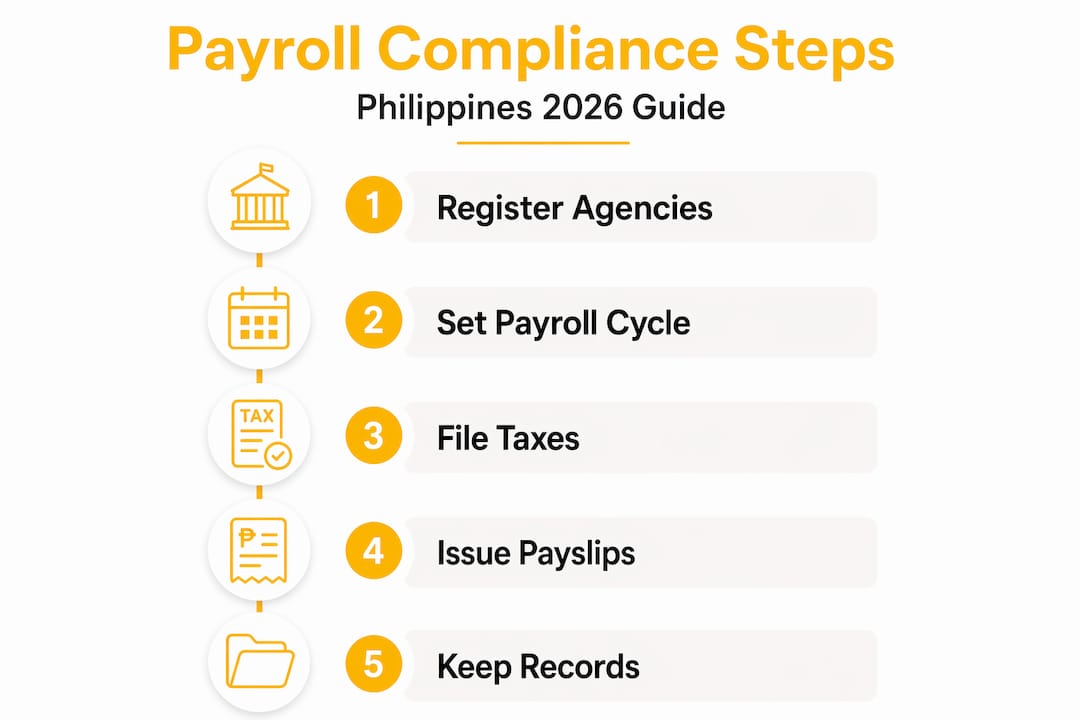
Payroll compliance in the Philippines starts with registration
You need employer accounts with five government agencies. This is not a formality. Each agency has its own registration form, its own processing timeline, and its own set of penalties for skipping the queue.
Here is the exact sequence you need to follow:
-
BIR (Bureau of Internal Revenue): File BIR Form 1901 if you are a sole proprietor or Form 1903 if you are a corporation. This gives you a Taxpayer Identification Number (TIN) and registers you as a withholding agent. You cannot legally deduct income tax from employee wages without this.
-
SSS (Social Security System): Apply for an employer ID using the SSS Employer Registration Form (SS Form R-1). Employee records go through SS Form R-1A. SSS handles retirement, disability, and death benefits for your workforce.
-
PhilHealth (Philippine Health Insurance Corporation): Submit the Employer Data Record (ER1 form) to get your PhilHealth employer number. This covers your employees’ national health insurance contributions.
-
Pag-IBIG Fund (HDMF): Complete the Employer’s Data Form (HDMF EDF-001) to register as a contributing employer. Pag-IBIG handles housing loans and provident savings for employees.
-
DOLE (Department of Labor and Employment): Under DOLE Rule 1020 of the Occupational Safety and Health Standards (OSHS), every employer must register the establishment with the DOLE Regional Office using form DOLE-BWC-IP-3 within 30 days before starting operations. The registration is free and valid for the lifetime of the establishment, but you must re-register when there is a material change (e.g., relocation, change of ownership, or change in business name). Note: The Revised IRR of RA 11058 took effect on May 16, 2025 (DOLE Department Order No. 252, s. 2025).
On timeline: sole proprietorships typically complete all registrations in two to four weeks, while corporations should expect four to eight weeks. If you are a foreign entrepreneur, budget extra time for document authentication. Korp’s step-by-step business guide covers the BIR registration process in detail for both local and foreign-owned companies.
Pro Tip: Register with all five agencies concurrently where possible. SSS, PhilHealth, and Pag-IBIG applications can often run in parallel. Waiting to finish one before starting the next adds weeks you do not have.
Payroll processing cycles, taxes, and mandatory contributions
Philippine employers most commonly run payroll on a semi-monthly cycle (every 15th and last day of the month) or a monthly cycle. Semi-monthly is standard for most office-based employees, and it aligns neatly with government remittance schedules.

Your tax withholding responsibilities work like this. Every pay period, you calculate each employee’s withholding tax based on their gross compensation and apply the applicable rate under the current TRAIN Law brackets. Brackets run from 0% (annual taxable income at or below ₱250,000) up to 35% for high earners under the TRAIN Law. BIR withholding tax remittance via BIR Form 1601-C is due by the 10th of the following month for manual and eBIRForms filers. eFPS filers follow a staggered schedule (typically the 11th to the 15th) based on industry classification. Critically, monthly 1601-C filing is mandatory even when there is no tax to remit — skipping a zero-amount filing is still a violation.
Beyond income tax, here is what you contribute to government funds each month:
-
SSS: The contribution rate is 15% of Monthly Salary Credit (MSC) — 10% employer share and 5% employee share. MSC ranges from ₱5,000 (minimum) to ₱35,000 (maximum), effective January 2025. At the maximum MSC, the employer share is ₱3,500 regular + ₱30 Employees’ Compensation (EC) = ₱3,530. For employees with MSC above ₱20,000, contributions include a Mandatory Provident Fund (MPF) component.
-
PhilHealth: The premium rate is 5% of monthly basic salary, shared equally — 2.5% employer and 2.5% employee. A salary floor of ₱10,000 and ceiling of ₱100,000 apply, so monthly premiums range from ₱500 (minimum) to ₱5,000 (maximum).
-
Pag-IBIG: The standard rate is 2% employer and 2% employee, computed on the Maximum Fund Salary (MFS) of ₱10,000 (raised from ₱5,000 effective February 2024 under HDMF Circular No. 460). The maximum mandatory contribution is therefore ₱200 each from employer and employee. Employees earning ₱1,500 or below pay only 1%, while the employer still pays 2%. Employees may contribute more voluntarily through MP2.
-
ECC (Employees’ Compensation Commission): Paid entirely by the employer. This fund covers work-related injury or illness.
A concrete example:
For an employee at MSC ₱30,000, monthly employer contributions break down as:
-
SSS: ₱2,000 (regular share, capped at MSC ₱20,000) + ₱1,000 (MPF on the portion above ₱20,000) = ₱3,000
-
EC: ₱30
-
PhilHealth: ₱750 (2.5% of ₱30,000)
-
Pag-IBIG: ₱200 (capped at MFS ₱10,000)
-
Total: ₱3,980 per month, on top of salary. As a percentage, total employer contribution obligation runs 13–14% of gross salary at lower-to-mid brackets, then tapers off as employees cross the MSC and PhilHealth ceilings.
Pro Tip: Set calendar reminders for the 10th of each month for BIR remittances and for SSS/PhilHealth/Pag-IBIG deadlines, which vary by employer ID number. Missing by even one day starts the penalty clock.
Payroll tax regulations in the Philippines change more often than most business owners expect. Keeping a compliance calendar current is not optional administration. It is risk management.
A 2026 update worth knowing: BIR RR 29-2025 expanded de minimis benefit ceilings
Effective for 2026, the BIR has raised the tax-exempt ceilings on several de minimis benefits. Notable changes include: rice subsidy (₱2,000 → ₱2,500/month), uniform & clothing allowance (₱7,000 → ₱8,000/year), actual medical assistance (₱10,000 → ₱12,000/year), laundry allowance (₱300 → ₱400/month), Christmas and major anniversary gifts (₱5,000 → ₱6,000/year), and monetized unused vacation leave for private employees (10 → 12 days/year). Properly structured, these can boost employee take-home pay without inflating taxable compensation — but they remain non-taxable only when classified correctly and supported by proper payroll records.
Record keeping, payslips, and annual reporting
Sloppy records are how audits happen. The BIR and DOLE both have the authority to request payroll documentation, and if you cannot produce it, you face penalties regardless of whether you actually paid everything correctly.
Here is what you are required to maintain and file:
| Document | Agency | Frequency | Deadline |
|---|---|---|---|
| BIR Form 1601-C | BIR | Monthly | 10th of following month |
| BIR Form 1604-C + Alphalist | BIR | Annual | January 31 |
| BIR Form 2316 (issue to employees) BIR Form 2316 (submit duly signed copies to BIR) |
BIR | Annual | January 31 February 28 |
| SSS contribution report | SSS | Monthly/Quarterly | Per employer ID schedule |
| PhilHealth contribution report | PhilHealth | Monthly | Per schedule |
| DOLE 13th Month Pay Report | DOLE | Annual | January 15 |
| DOLE Rule 1020 re-registration (form IP-3) | DOLE | Upon material change | Re-file when name, location, or ownership changes |
| DOLE Annual Establishment Report on Wages (AERW) | DOLE / NWPC | Annual | Submission window 15 May – 31 August (per annual labor advisory) |
On payslips: DOLE requires you to issue a payslip to every employee for every pay period. It must show gross pay, deductions, and net pay. Electronic payslips are accepted under longstanding DOLE practice, provided employees have regular and secure access to view them and the contents cannot be unilaterally altered after issuance. The underlying payslip obligation comes from Rule X, Section 6 of the Omnibus Rules Implementing the Labor Code.
Payroll records that form part of the books of accounts must be retained for 10 years under the National Internal Revenue Code (NIRC) and BIR Revenue Regulations No. 17-2013: physical originals for the first five years, then electronic copies (in a compliant electronic storage system) for the following five. The general DOLE labor standards retention rule is three years under Article 305 of the Labor Code, but the BIR’s 10-year rule is the practical baseline for payroll records that touch withholding tax. That means a 2026 payroll record should be accessible until 2036.
A few audit readiness practices worth building into your monthly routine:
-
Reconcile your BIR 1601-C filings against actual payroll registers each month
-
Keep a signed acknowledgment from each employee for their annual 2316 form
-
Match your SSS, PhilHealth, and Pag-IBIG payment receipts to your payroll register line by line
-
File your DOLE 13th Month Pay Report on time every January, even if amounts are straightforward
Choosing payroll software and outsourcing options
Manual payroll spreadsheets work until they do not. One formula error in a tax computation, multiplied across 30 employees, creates a compliance gap that takes months to correct. Modern payroll tools and outsourcing arrangements exist specifically to close that gap.
When selecting a payroll system for a Philippine business, these are the factors that actually matter:
-
Local regulatory compliance: The software must reflect current BIR tax tables, SSS schedules, PhilHealth rates, and Pag-IBIG rates, updated automatically when regulations change. Local payroll software tailored to Philippine law consistently outperforms generic global platforms on this dimension.
-
Government form generation: Look for tools that produce BIR Form 1601-C, 1604-C, 2316, and contribution reports ready for submission, not just calculation outputs.
-
Integration with HR systems: Payroll accuracy depends on clean data inputs. A system that connects directly to your time and attendance and employee records eliminates the manual data transfer step where most errors occur.
-
Audit trail: Every computation should be logged and traceable. If BIR asks why a specific employee’s withholding looked a certain way in March 2025, you need to be able to pull that answer in minutes.
On outsourcing: payroll compliance in the Philippines is an ongoing active process that demands regular updates as tax brackets, contribution ceilings, and labor rules shift. Many businesses at the five to twenty employee stage find outsourcing payroll processing to a local accounting or payroll firm more cost-effective than building that expertise in-house.
For companies entering the Philippine market for the first time, an Employer of Record (EOR) is worth considering. EOR services act as the registered employer on paper, handling all statutory filings and contributions while you retain day-to-day control of your team. They suit early-stage market entry well. Once your operations are established, migrating to a dedicated local payroll provider typically gives you more control and lower costs.
Pro Tip: Before committing to any payroll software or service provider, ask them specifically how they handle BIR table updates mid-year. If the answer involves a manual patch or a waiting period, that is a red flag.
Common payroll mistakes you need to avoid
Most Philippine payroll penalties are avoidable. They stem from a handful of recurring errors, not complex regulatory traps.
Watch out for these:
-
Incomplete agency registration before payroll starts. Running payroll without an employer SSS number or Pag-IBIG account is a violation, full stop.
-
Late or partial remittances. A late BIR payment triggers a 25% surcharge, 12% annual interest, and a compromise penalty. Partial payment does not reduce the penalty percentage; it just reduces the base amount it applies to.
-
Non-compliant or missing payslips. Failing to issue payslips, or issuing ones that omit required fields, opens you to DOLE inspection penalties.
-
Assuming software handles remittances automatically. Payroll software computes the correct amounts but does not initiate actual government payments. The legal responsibility for on-time remittance stays with you as the employer.
-
Ignoring DOLE Rule 1020 re-registration. Many employers file once and forget it. Rule 1020 requires you to re-register when there is a material change such as relocation, change of ownership, or change in business name.
-
Missing the annual 1604-C and alphalist deadline. January 31 is the cutoff every year, and it applies regardless of company size.
-
Missing the annual DOLE Establishment Report on Wages (AERW). Under Article 124 of the Labor Code (as amended by RA 6727), all private establishments must file an annual report on rank-and-file employees, terms of employment, and salaries through aerw.nwpc.dole.gov.ph. The 2025 AERW (covering employees as of 31 December 2025) is open for submission from 15 May to 31 August 2026 under DOLE Labor Advisory No. 08, Series of 2026. The submission window changes each year, so check DOLE’s annual advisory.
If you discover an error, do not wait for an audit to surface it. Voluntary disclosure and late filing consistently result in lower penalties than enforcement-driven discovery. Korp’s BIR audit compliance guide walks through exactly how to handle that situation.
Pro Tip: Do a payroll compliance self-audit every quarter. Pull your 1601-C filings, cross-check against payment receipts, and verify your government agency accounts are current. Thirty minutes quarterly saves days of correction later.
A practical perspective on payroll complexity in the Philippines
Across entrepreneurs and HR teams, a consistent pattern emerges: everyone understands payroll is important, but far fewer treat it with the same urgency as sales or product development until a penalty notice arrives.
The complexity is real, but it is manageable when approached as a system rather than a monthly chore. The businesses that run into trouble are rarely the ones that misunderstood the law. They are the ones that delayed registration, assumed their software was handling everything, or did not check whether their DOLE reports were current after a hiring surge.
Another common misconception is that payroll compliance is a back-office function. It is not. It directly affects employee trust, agency relationships, and a company’s ability to scale without legal entanglements. An employee who notices their SSS contributions are not being remitted correctly does not stay quiet forever — and rightfully so.
The practical takeaway: invest in the right regulatory compliance knowledge early. Whether that means a qualified payroll specialist, a local software platform, or a compliance partner, the cost is a fraction of what a single BIR audit correction cycle will demand in time and finances. Build the system once, maintain it consistently, and payroll becomes the least of your worries.
How Korp helps you get payroll-ready from day one
Getting payroll in the Philippines wrong is expensive. Getting it right from the start requires knowing exactly which agencies to register with, in what order, and how to maintain that compliance as your business grows.

Korp is built for exactly this. The platform guides entrepreneurs and HR teams through company registration, BIR tax registration, and agency setup, all in a single coordinated workflow. Rather than chasing separate agencies and managing paperwork across multiple offices, you get a dedicated expert team that handles the process end to end. Whether you are a foreign entrepreneur setting up your first Philippine company or a local business owner scaling your workforce, Korp connects the dots between incorporation, compliance filings, and ongoing regulatory support. Visit Korp.ph to see how the platform can get your business payroll-ready, correctly and without the back-and-forth.
FAQ
What agencies must employers register with for payroll in the Philippines?
Employers must register with five agencies before running payroll: BIR, SSS, PhilHealth, Pag-IBIG, and DOLE. Each requires a separate employer account and has its own registration timeline.
When is BIR withholding tax due for Philippine employers?
BIR Form 1601-C must be filed and payment remitted by the 10th of the month following the payroll period. Late filing triggers a 25% surcharge, 12% annual interest, and a compromise penalty on the amount due.
Are electronic payslips legal in the Philippines?
Yes. Under longstanding DOLE practice and Rule X, Section 6 of the Omnibus Rules Implementing the Labor Code, electronic payslips are accepted provided employees have regular and secure access each pay period and the contents cannot be altered after issuance.
How long must payroll records be kept in the Philippines?
Under the NIRC and BIR Revenue Regulations No. 17-2013, accounting records including payroll must be retained for 10 years — five years as original hardcopies, followed by five years in a compliant electronic storage system. The DOLE labor standards retention period is three years, but the BIR 10-year rule is the practical baseline.
What is the difference between an EOR and a local payroll provider in the Philippines?
An Employer of Record (EOR) acts as the legal employer of record and handles all statutory filings, making it suitable for foreign companies testing the Philippine market before committing to incorporation. A local payroll provider, by contrast, processes payroll and handles compliance filings for clients who have already incorporated and registered as the legal employer — typically a more cost-effective model once the entity is in place.