



TL;DR:
Setting up a holding company in the Philippines is accessible for both Filipino and foreign investors through streamlined SEC registration pathways.
This structure offers asset protection, centralized management, tax efficiency, and investment pooling benefits, proven by major conglomerates and smaller businesses alike.
Proper compliance and strategic planning are crucial to avoid delays and maximize the advantages of a well-structured Philippine holding company.
Setting up a holding company isn’t just for billion-peso conglomerates. Many entrepreneurs and foreign investors overlook this structure because they assume it’s too complex or reserved for corporate giants. The reality? The Philippines offers clear, modernized pathways through the Securities and Exchange Commission (SEC) for both Filipino and foreign investors to establish holding companies efficiently. Whether your goal is asset protection, centralized group management, or long-term tax efficiency, this guide walks you through ownership rules, capital requirements, registration steps, and compliance essentials so you can move forward with confidence.
Table of Contents
Key Takeaways
| Point | Details |
|---|---|
| Foreign ownership allowed | Foreigners can fully own holding companies outside restricted sectors with the right capital. |
| Capital requirements matter | Minimum paid-up capital depends on ownership structure and whether the company serves the domestic market. |
| Digital SEC registration | eSPARC streamline the process, making registration faster and easier. |
| Compliance is ongoing | Holding companies must meet annual filing and governance obligations to avoid penalties. |
| Expert guidance saves time | Professional support helps avoid costly mistakes and ensures smooth setup. |
Why choose a holding company structure in the Philippines?
A holding company is a corporation that primarily exists to own shares in other companies rather than to produce goods or services itself. Think of it as the parent sitting at the top of a corporate family tree, controlling subsidiaries and consolidating group-level decisions. That structure brings real advantages.
Key benefits of a Philippine holding company:
-
Asset protection: Liabilities in one subsidiary generally do not flow up to the parent holding company or across to other subsidiaries. This firewall protects your broader portfolio.
-
Centralized management: You govern multiple business units through one parent entity, making strategic decisions, capital allocation, and governance far more efficient.
-
Tax efficiency: Intercorporate dividends received by a domestic holding company from domestic subsidiaries are generally exempt from regular income tax under the National Internal Revenue Code, making profit repatriation within the group cleaner.
-
Investment vehicle: A holding company is an elegant structure for pooling investor capital before deploying it into operating subsidiaries.
The Philippines has proven this model works at scale. Holding conglomerates like SM Investments, Aboitiz Equity Ventures, and JG Summit have built some of Southeast Asia’s most resilient business empires through holding structures. But these giants didn’t invent a concept exclusive to them. Family businesses, SMEs, and even startup founders use holding companies to organize multiple ventures cleanly.
“The holding company model isn’t about size. It’s about structure. Even a founder with two or three operating businesses can benefit enormously from a clean, well-governed parent entity.”
The SEC has also made registration more accessible. The OneSEC platform enables one-day registration for simple 100% Filipino-owned stock corporations, removing one of the biggest historical barriers. For context on how different corporate structures compare in the Philippine context, it helps to understand your options before committing to one.
Pro Tip: Don’t confuse a holding company with an operating company. If you are also running day-to-day business operations through the same entity, you lose some of the legal insulation that makes the holding structure valuable in the first place.
Ownership and capital requirements for holding companies
This is where Filipino and foreign investors split paths. Understanding the rules upfront saves you from costly document rejections or structural redesigns later.
For Filipino investors
If your holding company will be 100% Filipino-owned, the registration process is significantly faster and simpler. You can use SEC’s digital platforms without additional foreign equity clearances. The OneSEC system is built for exactly this scenario.
For foreign investors
Foreign investors have more to navigate, but the opportunity is real. Foreign-owned holding companies not listed on the Foreign Investment Negative List (FINL) can be 100% foreign-owned. The FINL is a government-maintained list of industries where foreign equity is restricted or prohibited. If your holding company’s intended activities fall outside the FINL, you have full ownership flexibility.
One important caveat: foreign equity in subsidiaries is traced through the holding company under SEC rules. A 100% foreign-owned holding company cannot be used to circumvent ownership caps in restricted sectors. If your holding company will own a Philippine subsidiary in a partially restricted industry (a 60/40 sector), the holding company’s foreign ownership counts toward that subsidiary’s foreign equity ratio.

Capital requirements at a glance:
| Ownership structure | Minimum paid-up capital |
|---|---|
| 100% Filipino-owned | No general minimum under the Revised Corporation Code (sector-specific requirements may apply, e.g., financing, lending, insurance) |
| More than 40% foreign equity | USD 200,000 |
| Advanced tech, startup-endorsed, or 15+ Filipino employees | USD 100,000 (reduced threshold) |
The USD 200,000 minimum applies when foreign equity exceeds 40%. This is a hard threshold you need to plan for early because it affects your capitalization documents, bank certification requirements, and SEC filings.
One thing worth flagging: the export enterprise exemption from this minimum applies to manufacturers, processors, service enterprises, and traders that themselves export 60% or more of their output. A pure holding company that only owns shares in subsidiaries does not qualify, because dividends received are not “exports” under the Foreign Investments Act. Foreign-owned holding companies serving the domestic market are almost always treated as Domestic Market Enterprises and must meet the USD 200,000 (or reduced USD 100,000) capital requirement.
Additional foreign investor considerations:
-
Verify your intended holding activities against the current FINL before filing anything.
-
Understand that the FINL is updated periodically, so check the most recent version.
-
If you plan for subsidiaries to operate in restricted sectors, the holding company itself may not face restrictions even if subsidiaries do.
-
Consult on the difference between a domestic corporation and a branch office before deciding on structure.
Pro Tip: Under the FIA, an export enterprise must be a manufacturer, processor, service enterprise, or trader that itself exports 60% or more of its output. A pure holding company owning shares in operating subsidiaries does not meet this definition, since dividends received from subsidiaries are not “exports of output.” If your goal is to operate export-oriented businesses with minimal capital, the cleaner structure is to make the operating subsidiary the export enterprise (100% foreign-owned, PHP 5,000 minimum paid-up) while the holding parent meets its own USD 200,000 requirement separately, or to consider alternative structures like a regional operating headquarters depending on your activities.
For a detailed breakdown of the foreign company registration process specific to the Philippine context, reviewing the full regulatory picture before you begin is strongly recommended.
Step-by-step: Registering your holding company with the SEC
The SEC has modernized its registration system considerably. Two platforms matter most: eSPARC (Electronic Simplified Processing of Application for Registration of Company) for standard registrations and OneSEC for streamlined, faster processing of eligible domestic corporations.
Registration process overview
-
Reserve your company name. Use the SEC’s name verification tool to check availability. Your name must not conflict with existing registrations and should clearly indicate corporate status (e.g., “Holdings, Inc.” or “Ventures Corporation”). For guidance on picking a compliant name, the SEC-compliant company name rules are worth reviewing carefully.
-
Prepare your incorporation documents. Core documents include the Articles of Incorporation, By-Laws, Treasurer’s Affidavit (confirming paid-up capital), and for foreign-owned entities, a bank certificate confirming deposit of the minimum paid-up capital.
-
Submit your application digitally. Through eSPARC or OneSEC, upload your documents, pay the filing fees online, and submit. The SEC registration process is now largely digitized, reducing the need for in-person visits for most standard applications.
-
Receive your Certificate of Incorporation. Once the SEC approves your application, you receive your Certificate of Incorporation, which officially brings your holding company into legal existence.
-
Complete post-incorporation steps. These include registering with the Bureau of Internal Revenue (BIR) for your Tax Identification Number (TIN) and official receipts, obtaining local government permits (if applicable), and setting up your corporate bank account.
Traditional vs. digital registration comparison:
| Factor | Traditional route | Digital route (eSPARC/OneSEC) |
|---|---|---|
| Processing time | Several weeks | 1 to 5 business days (simple cases) |
| In-person visits required | Multiple | Minimal or none |
| Document submission | Physical copies | Digital uploads |
| Fee payment | Over-the-counter | Online payment |
| Name reservation | In-person queue | Online search and reservation |
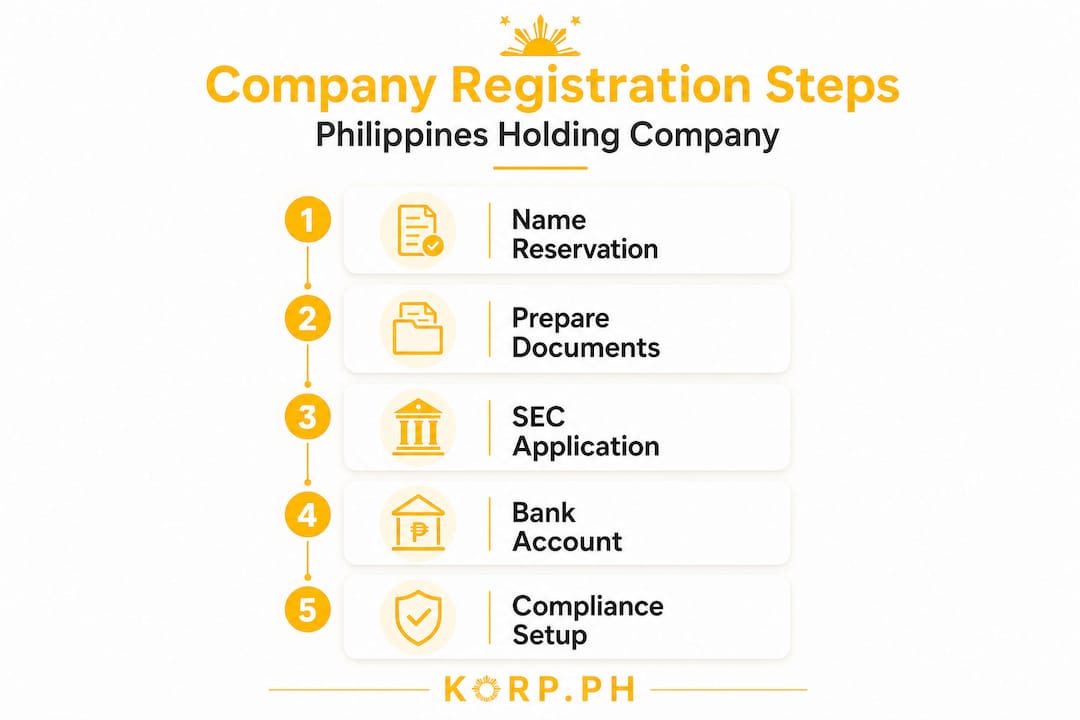
The digital route is almost always the better choice for holding companies with straightforward ownership structures. For the full online incorporation guide, a step-by-step walkthrough is available for both local and foreign applicants.
Pro Tip: Reserve your company name and prepare your capital certification documents before you start the formal application. These two items cause the most delays. If your bank takes two weeks to issue a capital certification letter, starting the reservation process while you wait means you do not lose momentum.
After incorporation, opening a corporate bank account is one of the first post-registration priorities. Banks in the Philippines have varying requirements for foreign-owned entities, so early preparation matters here too.
Key compliance requirements and pitfalls to avoid
Registration is just the beginning. Holding companies in the Philippines have ongoing obligations that, if missed, carry real penalties. The SEC and BIR both impose fines for late or incomplete filings, and repeated lapses can lead to revocation of your certificate of incorporation.
Annual SEC filings required for holding companies:
-
Audited Financial Statements (AFS): Prepared by a certified public accountant and submitted annually to the SEC. The deadline depends on your fiscal year end and SEC-assigned filing schedule.
-
General Information Sheet (GIS): Filed within 30 days of your annual stockholders’ meeting. The GIS captures current ownership structure, board composition, and officer details. Missing this deadline triggers automatic penalties.
-
Annual Report (for publicly listed entities): Not applicable to most private holding companies, but worth noting if you plan to go public later.
Corporate governance requirements:
Holding companies must maintain proper board composition, including the required number of independent directors for certain structures. For a detailed breakdown, the corporate governance essentials for Philippine corporations explains what the SEC expects at each level. Board meeting minutes, resolutions, and stock transfer records must also be properly maintained.
Common compliance pitfalls:
-
Missing the GIS filing deadline due to confusion about the annual meeting date
-
Failing to update the SEC after ownership structure changes, which is required promptly
-
Submitting AFS with qualifications or errors that trigger SEC queries
-
Not maintaining a proper corporate secretary, which is a legal requirement and a practical safeguard
“Compliance isn’t a once-a-year task. The companies that run into trouble are usually the ones that treat it that way. Build a system, not a scramble.”
Understanding board of directors requirements is especially important for holding companies, since governance missteps at the board level can jeopardize your subsidiary relationships and investor confidence.
Pro Tip: Set up a compliance calendar at the start of every fiscal year. Mark every SEC and BIR deadline, your annual stockholders’ meeting date, and any local government permit renewals. A missed deadline on paper is never worth the penalty in practice.
What most guides miss about holding companies in the Philippines
Most articles on this topic focus on the mechanics: the forms, the fees, the steps. That is useful. But there is a strategic layer that often gets skipped, and it matters especially for entrepreneurs and foreign investors who want to get this right from day one.
The first thing most founders overcomplicate is the initial setup. Many spend months in legal consultations debating governance structures before they have even confirmed their company name is available. The SEC’s digital tools have dramatically simplified the technical side. You do not need a perfectly architected corporate governance framework before you register. Get the structure right, then refine governance as your business grows.
The second blind spot is compliance systematization. New holding company owners often think compliance is about volume: the more documents they file, the safer they are. That is not how it works. Compliance is really about timing and accuracy. Filing the right document late is worse than people assume. Filing an inaccurate document on time is also a problem. The real skill is building a reminder system and working with people who track these things professionally.
The third overlooked angle is strategic board appointments. A holding company’s board can do more than fulfill legal requirements. Appointing directors with relevant industry expertise, creditor relationships, or regulatory connections can actively strengthen your subsidiaries. Many founders appoint placeholder directors just to meet the minimum requirement, missing a real strategic opportunity.
Finally, export orientation is underused as a structuring strategy, but it works at the operating subsidiary level, not the holding company level. A pure holding company that only owns shares cannot itself qualify as an export enterprise. The practical play is to structure operating subsidiaries around export-oriented activities so they can be 100% foreign-owned with minimal capital, while the holding parent is capitalized separately to meet its own requirements. This is worth a serious conversation with your legal advisor before finalizing your capitalization plan.
The gap between knowing what to do and actually executing it cleanly is where most holding company setups get delayed or derailed. Knowing how to establish a business in the Philippines in a practical, sequenced way closes that gap faster than reading regulations alone ever will.
Take the next step: Simplify your holding company setup
Establishing a holding company in the Philippines is genuinely achievable, but the details matter. From FINL checks and capital certification to SEC filings and BIR registration, each step has its own requirements, and a misstep in one area can delay your entire timeline.

Korp.ph is built to handle exactly this kind of complexity on your behalf. Whether you are a Filipino entrepreneur organizing multiple business units or a foreign investor structuring your first Philippine holding company, our registration and compliance solutions cover every stage from name reservation to annual filings. Foreign investors can explore our incorporation services for foreigners for tailored guidance on FINL compliance, capital requirements, and SEC processing. Start your Philippines business registration journey with a team that knows the system and keeps your momentum going.
Frequently asked questions
Can a foreigner fully own a holding company in the Philippines?
Yes. If the holding company’s activities are not restricted by the Foreign Investment Negative List, foreigners can hold 100% ownership, provided they meet capital and regulatory requirements.
What is the minimum capital requirement for a holding company with foreign investors?
The standard minimum is USD 200,000 paid-up capital for companies with more than 40% foreign equity selling to the domestic market. This is reduced to USD 100,000 if the enterprise involves DOST-certified advanced technology, is endorsed as a startup under the Innovative Startup Act, or has a majority of direct employees who are Filipino, in no case fewer than 15. Export enterprises (exporting at least 60% of output) are not subject to this minimum and can be 100% foreign-owned with as little as PHP 5,000 paid-up capital.
How quickly can a Philippine holding company be registered?
For simple 100% Filipino-owned corporations, the OneSEC platform can complete registration in as little as one business day. Foreign-owned companies with additional compliance steps typically take longer.
What documents are required to register a holding company?
You will need a reserved company name, Articles of Incorporation, By-Laws, a Treasurer’s Affidavit, and for foreign-owned entities, a bank certificate confirming deposit of the required minimum paid-up capital.
What annual compliance filings are necessary for holding companies?
Holding companies must submit audited financial statements and a General Information Sheet to the SEC each year, along with BIR filings covering income tax returns and other applicable tax obligations.
Recommended
-
Korp.ph | How to Set Up Your Board of Directors in the Philippines
-
Korp.ph | Foreign-Owned Domestic Corporation vs Branch Office in the Philippines
-
Korp.ph | Foreign Company Registration Process in the Philippines
-
Korp.ph | How to Choose a Company Name in the Philippines: SEC Rules, Restrictions, and Tips