



TL;DR:
- Closing a company in the Philippines involves a lengthy process requiring approvals from multiple government agencies to avoid penalties. You must complete internal steps like board approval, employee notifications, and document collection before filing with the SEC, BIR, and LGUs, with BIR clearance often being the biggest obstacle. Proper post-closure procedures include asset liquidation, record preservation, and legal compliance to prevent ongoing liabilities and penalties.
As you may expect, closing a company in the Philippines is not as simple as locking the office door and moving on. Knowing how to properly close a company in the Philippines means working through a layered process involving the Securities and Exchange Commission (SEC), the Bureau of Internal Revenue (BIR), local government units (LGUs), and the Department of Labor and Employment (DOLE). Miss a step, and you could face penalties on a business that no longer operates. This guide walks you through everything: from internal approvals and employee obligations to final asset distribution and record keeping.
Table of Contents
-
Key Takeaways
-
How to close a company in the Philippines: what to do first
-
Government filings and clearances: step by step
-
Labor and social agency compliance during shutdown
-
Post-closure obligations and final steps
-
Practical considerations when closing a company in the Philippines
-
Let Korp handle your company closure from end to end
-
FAQ
Key Takeaways
| Point | Details |
|---|---|
| Closure takes 12 to 24 months | The business dissolution process Philippines requires sustained effort across multiple agencies over more than a year. |
| Board approval is mandatory | A majority vote of stockholders is required where no creditors are affected (Sec. 134, RCC); two-thirds is required only where creditors are affected (Sec. 135, RCC). |
| BIR clearance is the bottleneck | Tax audits alone can add 6 months to 2 years to your timeline, making early BIR engagement critical. |
| Employee obligations are strict | You must notify DOLE and employees at least 30 days before closure and settle separation pay in full. |
| Records must be kept for 5 years | Under the Ease of Paying Taxes Act (RA 11976), books of accounts and accounting records must be preserved for five years from the filing deadline of the relevant return — reduced from the previous ten-year requirement. |
How to close a company in the Philippines: what to do first
Before you file a single document with any government agency, you need to get your own house in order. Rushing into external filings without completing internal steps is one of the fastest ways to create costly delays.
Here is the required sequence of internal actions:
-
Hold a board meeting and pass a resolution. The board must formally vote to dissolve the company and recommend closure to the stockholders. This resolution triggers the official process.
-
Get stockholder approval. Under the Revised Corporation Code (RA 11232), voluntary dissolution where no creditors are affected (Section 134) requires only a majority vote of the outstanding capital stock — a change from the old Corporation Code, which required two-thirds. Voluntary dissolution where creditors are affected (Section 135) still requires a two-thirds vote. You need documented minutes of the meeting, with notice given to each shareholder at least 20 days prior, and that notice published once in a newspaper of general circulation.
-
Notify employees and DOLE. Philippine labor law requires written notice to affected employees and to DOLE at least 30 days before their termination date. Do this in parallel with your board resolution, not after.
-
Settle all employee compensation. Compute and prepare separation pay for each affected employee. Under Article 298 of the Labor Code, closure not due to serious business losses requires separation pay equivalent to one (1) month pay or one-half (1/2) month pay per year of service, whichever is higher, with a fraction of at least six months counted as one whole year. Closure due to serious business losses, if properly proven and documented, does not require separation pay at all.
-
Gather financial documents. Compile audited financial statements, general information sheets, tax returns for the last three years, and all contracts. The BIR will ask for all of this during its closure audit.
Pro Tip: Time your board resolution and employee notices to happen on the same week. If you notify employees before the resolution is passed, you may create legal exposure. If you wait too long after the resolution, you lose critical filing time with government agencies.
One thing most business owners overlook at this stage: you should also conduct a full inventory of liabilities. Outstanding loans, unpaid supplier invoices, pending lawsuits, and lease obligations all need to be accounted for before you start filing. Surprises at the SEC or BIR level slow everything down.
Government filings and clearances: step by step
Once internal preparations are complete, you move into the formal business dissolution process Philippines side. This is where most of the clock runs. For most companies — particularly those with annual gross sales above PHP 3 million or gross assets above PHP 8 million — corporate dissolution takes more than 12 months from start to finish, and the BIR is almost always the reason it takes that long. Taxpayers qualifying for the RMC 47-2026 fast-track can move significantly faster on the BIR side, but the SEC dissolution timeline that follows BIR clearance still applies.
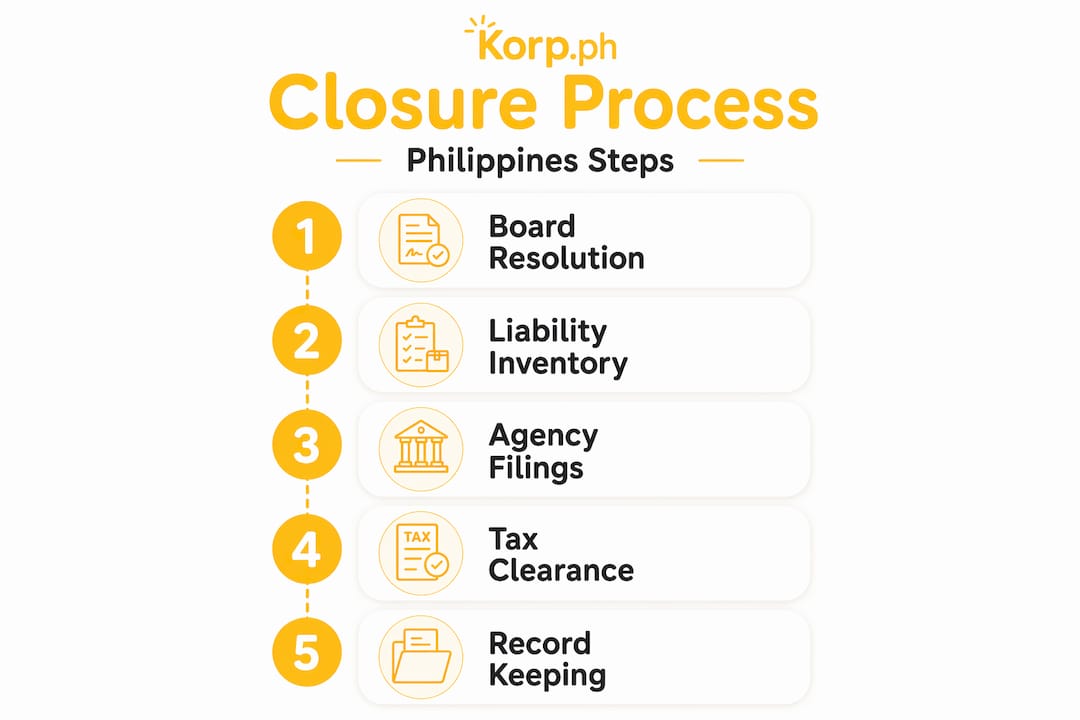
Here is a breakdown of what each agency requires:
SEC filing
-
Submit a Verified Request for Dissolution (Section 134, no creditors affected) or a Verified Petition for Dissolution (Section 135, creditors affected), following SEC Memorandum Circular No. 5, Series of 2022.
-
Attach the board resolution, stockholder approval minutes, audited financial statements, BIR tax clearance, secretary’s certificate confirming no pending intra-corporate dispute, and the publisher’s affidavit of publication.
-
Publication of the notice of stockholders’ meeting is required in both scenarios — once in a newspaper of general circulation under the RCC (reduced from three consecutive weeks under the old Corporation Code).
Note on shortening the corporate term as an alternative route: Beyond filing a verified request or petition for dissolution, Section 136 of the RCC allows voluntary dissolution by amending the Articles of Incorporation to shorten the corporate term. This route can defer the upfront BIR tax clearance requirement at the SEC level — the corporation continues to exist until the shortened term expires, with BIR clearance still required during the subsequent liquidation phase. For groups with active operations or contingent liabilities, this can provide a smoother runway.
Note on involuntary dissolution: Under Section 138 of the RCC and SEC Memorandum Circular No. 13, Series of 2019, the SEC may revoke a corporation’s registration for non-filing of the General Information Sheet (GIS) and Audited Financial Statements (AFS) for five (5) consecutive years. Treated as a deliberate strategy, this can be a legitimate SEC exit route — but only when properly sequenced. The BIR closure and tax clearance must be completed first, and all employee, LGU, SSS, PhilHealth, and Pag-IBIG obligations must be settled before allowing SEC reportorial filings to lapse. Used this way, the company effectively becomes dormant on the SEC side while no further liabilities accrue elsewhere, and the SEC eventually revokes the registration. Used incorrectly — by simply walking away from all filings — it produces the opposite result: SEC penalties for non-filing accumulate per year, BIR registration remains open with continuing tax obligations and penalties, and labor or LGU exposure remains live. This route requires a clean sequencing plan, not abandonment.
BIR tax clearance
BIR closure is historically the most complex and time-consuming part of the entire dissolution process. Recent reforms under the Ease of Paying Taxes Act (RA 11976) — and specifically RMC 47-2026 — have meaningfully changed the picture for smaller businesses. Whether your closure takes three working days or two years now depends primarily on two thresholds: gross sales and gross assets.
Regardless of size, every closing taxpayer must:
-
File BIR Form 1905 to update your registration status.
-
Submit final tax returns for all applicable tax types: income tax, VAT or percentage tax, withholding taxes, and documentary stamp tax where applicable.
-
Under RMC 47-2026, closure applications may now be filed either manually at the Revenue District Office (RDO) where the head office or branch is registered, or electronically through dedicated online portals and official email channels.
-
Once complete documentary requirements are submitted, penalties for non-filing of tax returns stop accruing, and the taxpayer’s registered form types are placed under “deregistered” status — preventing further accumulation of open tax cases during processing.
Fast-track closure for qualified micro taxpayers
Issued on May 19, 2026, RMC 47-2026 establishes an “Ease of Closing Business” framework for micro taxpayers. The fast-track applies to taxpayers whose gross sales for the immediately preceding taxable year do not exceed PHP 3 million, or whose gross assets upon retirement do not exceed PHP 8 million.
For qualified taxpayers in this bracket:
-
No mandatory audit is required, although the BIR retains discretion to audit in suspicious cases.
-
Tax clearance is issued within three (3) working days of submission of complete requirements, provided there are no open cases or outstanding liabilities.
-
For micro taxpayers with open cases, the same three-working-day clearance applies once outstanding liabilities and penalties are settled concurrently with the closure application.
Standard closure process (above the thresholds)
Taxpayers whose gross sales exceed PHP 3 million or whose gross assets exceed PHP 8 million, and any taxpayer with pending audits under a Letter of Authority, fall outside the fast-track and remain subject to the traditional closure audit process:
-
The BIR will withhold tax clearance and registration cancellation until internal auditors complete a formal review of the company’s books.
-
The closure audit typically covers the last three taxable years (the prescriptive period under NIRC Section 203), extending up to ten years in cases of fraud or non-filing under Section 222.
-
Closure audits at this level take 6 months to 2 years on average and remain the single most common cause of stalled closures.
-
Pay all deficiency taxes, surcharges, and penalties assessed during the audit before the clearance is issued.
-
Note that under the new Single-Instance Audit Framework introduced by RMO 1-2026 (effective January 2026), tax clearance requests for business closure are one of the recognized exceptions allowing a dedicated audit eLA — even where the taxpayer is otherwise subject to a consolidated annual audit.
Can a small or medium taxpayer wind down operations to qualify for the fast-track?
In principle, yes — but the assessment is based on the immediately preceding taxable year’s gross sales, not current-year activity. A company that recorded PHP 10 million in gross sales last year cannot file for fast-track closure this year simply because current activity has dropped. To qualify:
-
The most recent completed taxable year’s gross sales must not exceed PHP 3 million (or gross assets upon retirement must not exceed PHP 8 million), as documented in the submitted Audited Financial Statements.
-
The taxpayer should have no pending Letter of Authority or open audit cases.
For owners anticipating closure 12 to 24 months ahead, this can be a legitimate planning strategy — winding down operations in advance of the final taxable year so that the closure-year AFS reflects gross sales below the threshold. It is not a workaround that can be applied at the moment of filing.
LGU clearances
-
Surrender your Mayor’s Permit to the city or municipal government where your business operated.
-
Obtain a Barangay clearance confirming no outstanding obligations at the local level.
-
Settle any unpaid local business taxes before clearances are released.
| Agency | Document Required | Estimated Timeline | Typical Cost |
|---|---|---|---|
| SEC | Verified Request or Petition for Dissolution, board and stockholder resolutions | 2 to 4 months (after BIR clearance) | PHP 1,000 to PHP 5,000 in filing fees |
| BIR | Form 1905, final tax returns, closure audit | 6 months to 2 years | Variable: taxes, penalties, clearance fee |
| City/Municipal LGU | Mayor’s Permit surrender, clearance | 1 to 4 weeks | Minimal; unpaid taxes must be cleared |
| Barangay | Barangay clearance | 1 to 2 weeks | PHP 500 to PHP 2,000 |
| Publication (if required) | Newspaper notice | Depends on chosen publication | PHP 20,000 to PHP 40,000 |
Foreign-owned corporations, branches, and representative offices face additional closure steps. These may include clearances from the BSP for repatriation of capital, deregistration with the BOI or PEZA if registered with incentives, and additional documentation under the Foreign Investments Act. These steps run in parallel with the standard SEC and BIR process and require careful sequencing.
The BIR acts as the key gatekeeper during dissolution, making tax clearance the bottleneck in nearly all cases. Start BIR engagement before or immediately after your board resolution. Every week you delay costs you time at the back end.
Labor and social agency compliance during shutdown
Getting your labor obligations right is non-negotiable. Errors here lead to labor disputes that can outlast the company’s legal dissolution by years.
Your core obligations during the shutdown:
-
DOLE notice: Submit a written notice to the nearest DOLE regional office at least 30 days before the effective date of termination. Attach the list of affected employees with their positions and tenure.
-
Employee separation pay: Under Article 298 of the Labor Code, closure not due to serious business losses requires separation pay equivalent to one (1) month pay or one-half (1/2) month pay per year of service, whichever is higher. Closure due to serious business losses, if properly proven and documented, does not require separation pay.
-
Certificates of employment: Issue certificates to all separated employees immediately. Withholding these is a common source of unnecessary disputes.
-
SSS (Social Security System): File the employer closure notification with SSS. Settle all outstanding contribution remittances and loans, if any.
-
PhilHealth: Submit the closure form and clear all premium contribution arrears.
-
Pag-IBIG Fund: Notify Pag-IBIG of the closure and settle any outstanding fund contributions.
Pro Tip: If you have key employees you want to retain through the closure process, consider an Employer of Record (EOR) solution. An EOR can legally employ your staff under a separate entity while your company winds down, preserving critical operational knowledge without extending your entity’s legal obligations.
Non-compliance with DOLE requirements does not disappear when the company is dissolved. Former employees can file illegal dismissal or money claims against the officers of the dissolved corporation. Personal liability is real in Philippine labor law. Treat these obligations as seriously as any tax filing.
Post-closure obligations and final steps
The company may be dissolved on paper, but your legal obligations do not end the moment the SEC issues the certificate. This phase is where business owners most often drop the ball.
Here is what you still need to manage after formal dissolution:
-
Manage the liquidation period. Section 139 of the RCC grants the dissolved corporation a three-year winding-up period during which it continues to exist as a body corporate solely to settle claims, dispose of property, and distribute assets — not to conduct new business. If matters cannot be completed within three years, the board may appoint a trustee to continue liquidation beyond that period, with no fixed time limit on the trustee’s mandate.
-
Distribute remaining assets to stockholders. After paying all creditors, liabilities, and taxes, the remaining assets are distributed to stockholders in proportion to their shareholdings. This must be documented clearly for tax and legal purposes.
-
Close all corporate bank accounts. Once asset distribution is complete and the SEC Certificate of Dissolution is issued, close the company’s bank accounts formally. Note that most banks will require the Certificate of Dissolution before allowing final closure, so plan to keep at least one account active through the liquidation phase for residual transactions. Get written confirmation from the bank for your final documentation.
-
Deregister remaining permits and registrations. This includes any industry-specific licenses or registrations with agencies like the FDA, DICT, or others that apply to your sector.
-
Preserve your records. Under Section 235 of the Tax Code as amended by RA 11976 (the Ease of Paying Taxes Act) and implemented through RR 7-2024, books of accounts and other accounting records must be preserved for five (5) years from the day following the filing deadline of the relevant return (or from the actual filing date if filed late), for the taxable year when the last entry was made. This is a reduction from the previous ten-year retention period under RR 17-2013. Do not destroy documents prematurely — the BIR can still audit within this window even after dissolution, and the retention obligation extends to any case where the records are material to a pending protest or refund claim.
Important reminder: Businesses that cease operations without completing the formal BIR deregistration process face continuous tax obligations and penalties despite having zero revenue. This “de facto” trap is the single most common reason Filipino business owners later discover they are personally exposed to accumulated tax liabilities. Note that this applies to the BIR side specifically — SEC reportorial non-filing follows a different mechanism, as described in the SEC section above.
The record-keeping obligation is one that many owners ignore completely. Even five years is a long time after a company is dissolved, and the BIR retains the authority to audit you within that window. Keep your financial statements, tax returns, contracts, payroll records, and dissolution documents in a secure, accessible location. Digital backups with organized filing are worth the effort.
Practical considerations when closing a company in the Philippines

Many business owners approach company closure the same way they approached setting up the business: with optimism and a belief it will move faster than it actually does. It rarely does.
The part that catches most owners off guard is how much the BIR audit dominates the overall timeline. It is not unusual for the internal steps to be completed within two months and the LGU clearances within three weeks, only for the company to sit in BIR audit limbo for over a year. This is the norm, not the exception.
A more realistic approach is to treat closure as a project with defined milestones, assigned responsibilities, and a 12 to 24-month calendar for standard taxpayers, or a shorter horizon for micro taxpayers using the RMC 47-2026 fast-track. Engagement with the BIR should ideally begin before the board resolution is finalized. Books should be reconciled and the last three years of returns should be clean before Form 1905 is filed.
Another common mistake is handling labor and tax obligations in sequence rather than in parallel. Employee notifications and DOLE filings can run simultaneously with SEC preparation. Sequencing everything adds months to a process that is already long.
Professional support is not a luxury in this context. It is often the difference between a controlled closure timeline and one that drags into a three-year ordeal.
Let Korp handle your company closure from end to end
Knowing the steps is one thing. Executing them accurately, on time, and across multiple government agencies is another challenge entirely.

Korp offers end-to-end compliance and registration support for businesses in the Philippines, including those winding down. The Korp team knows exactly which documents each agency requires, what common audit triggers to avoid with the BIR, and how to keep your closure moving even when government timelines stretch. Whether you need help with your final BIR filings, SEC dissolution documents, LGU clearances, or labor compliance paperwork, Korp’s expert team manages the process so you do not have to chase agencies alone.
If you are also thinking about what comes next, Korp’s business solutions cover the full spectrum from closure compliance to new company incorporation. Reach out to Korp today and move through this process with confidence.
FAQ
How long does it take to close a company in the Philippines?
For companies with annual gross sales above PHP 3 million or gross assets above PHP 8 million, corporate dissolution in the Philippines typically takes 12 to 24 months, with BIR audits alone extending complex cases to 2 to 3 years. Taxpayers qualifying under the RMC 47-2026 fast-track (gross sales not exceeding PHP 3 million or gross assets not exceeding PHP 8 million, with no open cases) can close significantly faster on the BIR side, with tax clearance issued in as little as three working days from complete documentary submission.
What vote is needed to dissolve a corporation in the Philippines?
Under the Revised Corporation Code, voluntary dissolution where no creditors are affected (Section 134) requires a majority vote of the outstanding capital stock. Voluntary dissolution where creditors are affected (Section 135) requires a two-thirds vote. Both routes require a formal stockholder meeting with recorded minutes and prior published notice.
Can I just stop operations without officially closing the company?
Not without consequences. Simply walking away from all filings leads to continuous BIR tax obligations, accumulating SEC penalties, and personal exposure for officers because the company remains legally active until properly deregistered. There is one structured exception: after completing BIR closure and settling all other obligations, allowing SEC reportorial filings to lapse for five consecutive years can trigger SEC-initiated involuntary dissolution. This only works as a deliberate, properly-sequenced strategy — not as a substitute for the formal closure process.
How long do I need to keep business records after closing?
Under Section 235 of the Tax Code as amended by RA 11976 (Ease of Paying Taxes Act) and implemented through RR 7-2024, corporations must preserve books of accounts and accounting records for five (5) years from the filing deadline of the relevant return. This was reduced from the previous ten-year retention period.
What separation pay are employees entitled to when a company closes?
Under Article 298 of the Labor Code, closure not due to serious business losses entitles employees to separation pay equivalent to one (1) month pay or one-half (1/2) month pay per year of service, whichever is higher. Closure due to serious business losses, if properly proven, does not require separation pay. Written notice to both the employee and DOLE is required at least 30 days in advance of the effective termination date.